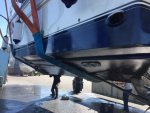
Dazzajohm
N/A
To me that would be a concern, whatever he did last year could very well mask additional osmosis.[/QUO
Was the boat surveyed with all that crap on the bottom ? Surely not.
No of course not it was scrubbed

To me that would be a concern, whatever he did last year could very well mask additional osmosis.[/QUO
Was the boat surveyed with all that crap on the bottom ? Surely not.
No of course not it was scrubbed


To me those hardly look like osmotic blisters. Was acid water pouring out of those blisters or it was just gel coat chipping?

How "deep" are those cavities?I’m still awaiting the full report but the surveyor said that apparently the smell of vinegar was indicative of osmosis blisters and there was the smell of vinegar.


That's not de facto osmosis. Any blister or cavity that has sea water in it for any length of time will smell of vinegar and does not therefore automatically imply osmosis. Judging from the half job it could well have had an epoxy coat dabbed on while on the hard during winter in low temps and the epoxy itself did not cure properly and then created a blister of it's own.
How "deep" are those cavities?
I'm not sure if there's any scientific criteria to draw a line, but I've always heard of "blistering" as referred to something VERY superficial, with bubbles growing between the gelcoat and the first GRP layer, with very little acetic smell and GRP aggression, if any at all.
This is what I assumed in my first reply above, but as far as can be told from your pic, that hole looks very different - as if the chemical degradation would have started from the inner GRP layers.
And if that would be the case, while obviously repairing just a couple of tiny points remains easy peasy, my concern would be that there's no logical reason why the same effect shouldn't be growing subtly also inside many other areas of the hull... :ambivalence:
I hate to come across as scaremongering, but that's the way I see it.
Only based on a not very detailed pic, mind. I might well be totally wrong - and it wouldn't be the first time!
Mmm... Makes me wonder whether it made sense to make humidity measurements at all, with the hull still dripping water.The moisture content of the hull was high but states that some of this would obviously be due to the fact the boat had just been lifted and held in slings for the survey.


To me that would be a concern, whatever he did last year could very well mask additional osmosis.
Mmm... Makes me wonder whether it made sense to make humidity measurements at all, with the hull still dripping water.
That aside, out of idle curiosity, do you possibly have an enlarged photo of the circled spot visible in your post #10?
As far as could be told by that pic, I would have sworn that it's MUCH deeper than 0.5mm, which essentially is still at the level of gelcoat layer.

You do realise this is a 27 year old boat we are talking about. Do you expect brand new condition !
I'm afraid it isn't much better than the previous one, but fwiw (and as far as I can see) that spot doesn't look like the typical gelcoat blistering to me.I've tried to attach an enlarged photo.
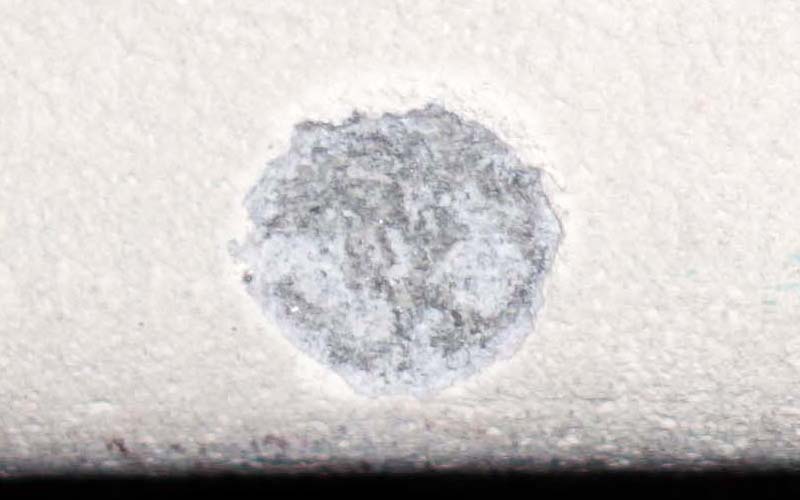
By way of an update, I received the full report which basically says the boat was a fair example for its age. Did have a few recommendations but all relatively simple to fix. In the end, the surveyor found 12 blisters of no more than 10mm in diameter and no more than 0.5mm deep. The moisture content of the hull was high but states that some of this would obviously be due to the fact the boat had just been lifted and held in slings for the survey. So with this in mind I've gone back with a lower offer to take in to account treatment at a later date. See what they come back with.
good call, I still wouldn't be concerned by the potentially high moisture readings or a few possibly osmotic blisters. Moisture content reading is fraught with difficulties (especially in the UK) and ambiguity. If you get a few £ knocked off and buy the boat, just put the boat ashore over the winter for a few winters and let the wind dry it out a bit. What are the engines like?

Did he take oil samples from both engine and gearbox ?According to the surveyor, he was happy with the engines, oil was checked in both engine and gearbox and found to be good as well