Old pictures of square riggers on the Orwell.

Kukri

Well-Known Member
Joined
23 Jul 2008
Messages
15,562
Location
East coast UK. Mostly. Sometimes the Philippines
Visit site
I think most of us know that as recently as the 1930s windjammers from the Gustav Erickson fleet came up the Orwell to Butterman’s Bay and discharged their Australian wheat into Thames barges which brought it into Ipswich docks.

It even gets a mention in Arthur Ransome’s
« We didn’t mean to go to sea »

Now, who has a photo of this?

I hope someone does.

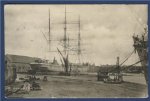
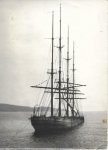
I don’t but I did find these pictureS of the barque Killoran in Ipswich in 1904:
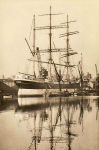
EDB54DA1-799F-4420-A1C6-5F501C7FB671.png6A303C1D-8A37-4371-87DB-E9FC8BE6031E.jpeg

We can roughly date these because the bottom picture is from a postcard with an Edward VII halfpenny stamp cancelled “Nov 28 04”.

(PS for sailing traditionalists: “Do you think she’s got enough baggywrinkle on the mizzen topmast swifters?”)?
 
Last edited:
The Ipswich Maritime Trust May well have photos? The Herzogin Cecile sadly foundered outside Salcombe, allegedly because the Harbourmaster refused to allow her to enter the harbour when she had suffered storm damage as he was afraid her cargo of grain would contaminate the harbour. You can still see the outline of the wreck on the bottom when you walk out along the cliffs.
 
The Ipswich Maritime Trust May well have photos? The Herzogin Cecile sadly foundered outside Salcombe, allegedly because the Harbourmaster refused to allow her to enter the harbour when she had suffered storm damage as he was afraid her cargo of grain would contaminate the harbour. You can still see the outline of the wreck on the bottom when you walk out along the cliffs.
After leaving Falmouth on April 24th, 1936, she ran hard aground in thick fog under full sail.

Eventuallly she was refloated in June and towed to Storehole Bay where she was beached to enable temporary repairs to be carried out.

But in July a heavy gale resulted in the sand being scoured from under her, and she settled on a buried rock formation, leaving bow and stern unsupported so that her back was broken.

She was sold for breaking up where she lay but this work was never carried out and during another gale in January 1939 she capsized and disappeared.

(Described in "Sail Training and Cadet Ships" by Harold A. Underhill, pp 129-123, published by Brown, Son & Ferguson; Glasgow 1956)
 
Thanks for those details, Poignard.
Here's a photo of her taken by my father, I would guess taken in 1937. Down by the head by the look of her.
I'm sure we have another pic somewhere of her in a much worse state later on, taken from the clifftop but I can't find it at the moment.
Herzogin Cecilie 1937 or 38.jpg
 
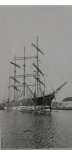
This is the only picture of the Pommern on the Orwell (well, actually, in Ipswich) that I have been able to find. It’s from a postcard:A9BB70E5-08BA-4857-9BC0-C8C9406132B0.jpeg

Where exactly are we? Would she get through the lock, after lightering some of her cargo to Thames barges at Butterman’s Bay?

Talking of which, has anyone got the lock dimensions? The biggest thing that goes through the lock regularly now is the seemingly immortal timber trader Suntis, and she is 86m x 12 metres. Built 1986 and kept “like a yacht” - well, better than some yachts! But the Pommern is a bit bigger. 95 m x 13 metres and a stated draft of 7.5 metres, but I don’t know what sort of draft that was.

She’s a museum ship at Mariehamm now.


Of course the riverside quays were not built then.
 
Last edited:
Interesting, quite different from the story we were told when we holidayed regularly in Salcombe.
As an Antarctic insider, I know that the "official" account of some expeditions and what actually happened vary quite a lot! "Official" accounts tend to downplay failures and emphasize successes. They aren't actually lying, but they are putting the best story forward, and tend to gloss over the iffy bits! Less likely for government organizations in relatively modern times (post 2000), as people have realized that if you don't learn from mistakes, you'll repeat them, but unofficial expeditions tend to be written up in ways that emphasize their successes so as to keep sponsors on-side.

Even "official" accounts can sometimes gloss over bits that would be upsetting for the nearest and dearest of those killed. I won't go into detail as it would identify the incident I'm thinking of, but there are times when you don't want to know the exact circumstances of a fatal accident. My former boss witnessed that incident, and he found it pretty unpleasant; even when telling me about some of the details years later was upsetting for him.

It is entirely possible that the two accounts above are both true - but one was written to make things look good.
 
This is the only picture of the Pommern on the Orwell (well, actually, in Ipswich) that I have been able to find. It’s from a postcard:View attachment 87709

Where exactly are we? Would she get through the lock, after lightering some of her cargo to Thames barges at Butterman’s Bay?

Talking of which, has anyone got the lock dimensions? The biggest thing that goes through the lock regularly now is the seemingly immortal timber trader Suntis, and she is 86m x 12 metres. Built 1986 and kept “like a yacht” - well, better than some yachts! But the Pommern is a bit bigger. 95 m x 13 metres and a stated draft of 7.5 metres, but I don’t know what sort of draft that was.

She’s a museum ship at Mariehamm now.


Of course the riverside quays were not built then.

Nice Pic.

They do look massive when light.

BTW. Am I correct in thinking that "Buttermans Bay" was so named for butter ships
coming from the Channel Islands ? Unloaded in bay and lightered to Ipswich.
 
Nice Pic.

They do look massive when light.

BTW. Am I correct in thinking that "Buttermans Bay" was so named for butter ships
coming from the Channel Islands ? Unloaded in bay and lightered to Ipswich.

Yes, that’s certainly my understanding of the name. Assuming that the “Buttermen” were schooners with a very big rig, they could get to Butterman’s Bay easily enough, but the rest of the river to Ipswich would not have been dredged, this being before the dock was built, and rather than risk a grounding and the loss of a very valuable cargo it would have made sense to anchor in Butterman’s Bay and discharge into small boats.

This BBC article includes chartlets showing the course of the upper Orwell up to Ipswich before it was dredged. It looks like the upper Stour.

BBC - Suffolk - Places - Sold down the river

No wonder the buttermen anchored in Butterman’s Bay!
 
Last edited:
Hi,

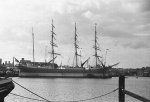
I believe it was in 1939 that the Abraham Rydberg delivered a load of Australian Grain to Ipswich, lightering into sailing barges in Buttermans Bay then continuing on up to Cliff Quay (before the Power Station was built and the transmission lines strung overhead) to discharge the last of her cargo when she didn't need so much water; I believe the upper half, at least; of Cliff Quay pre dates the second war and both the dock end shipyard (Orvis & Fuller) and the Cliff Brewery predate the 20th century, but I never was much of a historian.

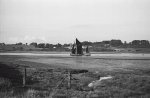
My father was a keen photographer and, although he had left his home town of Ipswich to make his way in the world, he still got home fairly frequently and was lucky enough to see the AR and document her visit. I have clear recollections of photos of her lightering with a couple of barges alongside but don't seem to be able to put my hands on those at present. But I have found a couple of shots of what I believe to be the AR alongside the Quay (such as it was) and one of a barge making her way up from Buttermans Bay to the dock. Sorry, they seem pretty rubbish scans - the negatives and Dad's prints are all with my sister in Hampshire, where there are literally thousands to wade through;

p0300112.jpg

p0300113.jpg


Interesting that, even up off the "quay" they couldn't get alongside to unload, so lay off and lightered into barges which presumably then locked in to discharge direct into the mills on the dockside. I'll post one other photo here which I believe to besomewhere close to where the AR was lying - it's just not clear to me what's going on:

p0300115.jpg

p0100933.jpg

I'm guessing the barge shot is taken from somewhere along the Strand and, although I've always thought it to be on the occasion of the AR's visit to Ipswich, it seems to be some way from the other photos. The scanning was done 20 years ago now by my late brother-in-law - only a selected few photos scanned and the numbers don't seem to relate to Dad's meticulous (but obtuse) cataloguing system.

All photos (c) Jack F Wright, feel free to use them but please credit him if you do.

If any of you knowledgeable historians can throw any further light on any of the photos, I would be most grateful. It's the not unusual story of wishing I had asked him more about the m when he was still around.

Peter.
 
Last edited:
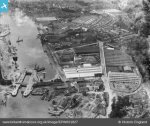
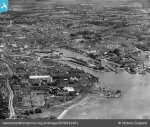
Go to the website Britain from Above, and type Ipswich Docks into the search box..........these from 1920

View attachment 87761View attachment 87762

Great photos and the second one shows the top end of Cliff Quay is there, while the lower end is still a muddy foreshore. I think I can make out the brewery as well.

Thanks.

Peter.
 
The timber ship with a list is a classic of its kind and of course it doesn’t happen nowadays ( ... er... Fred Everard, 1977...).

Timber ships with a deck cargo of timber were and are allowed to load deeper because the deck cargo adds positive buoyancy and of course if the lashings part you are back where you started. This is fine if you have got your sums right, particularly in relation to your arrival GM and the water uptake by soakage of the deck cargo. Which in this case, they evidently had not...
 
Top