
Kukri
Well-Known Member
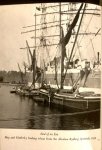
Hervey Benham’s picture. I’ve just noticed that my copy of ‘Down Topsail’ is a signed first edition. I must show it more respect!



there have been some substantial changes along the Wherstead road. It loops much further North now with a roundabout at the Maltings. The new roundabout and Pepsi building being where that huge white building is. They must have demolished a whole couple of terraces for IP Ipswich site!Thanks! Interesting white hulled four master roughly where Sean MacMillan is now.
and I followed your lead and found this four masted barque in 1933:View attachment 87764


Hi,Thanks all, really interesting photo"s and info.
Peter, just asking if the Ipswich maritime trust have seen any of your fathers photos?

View attachment 87785
Hervey Benham’s picture. I’ve just noticed that my copy of ‘Down Topsail’ is a signed first edition. I must show it more respect!

I dived on her in ‘75. The YHA used to do activity holidays so for about £45 for the week you got to stay in Salcombe YH and go out every day to dive. Fantastic fun, a real adventure but I suspect the wreck must have sunk a lot deeper into the sand by now.The Ipswich Maritime Trust May well have photos? The Herzogin Cecile sadly foundered outside Salcombe, allegedly because the Harbourmaster refused to allow her to enter the harbour when she had suffered storm damage as he was afraid her cargo of grain would contaminate the harbour. You can still see the outline of the wreck on the bottom when you walk out along the cliffs.

There was a very good film on you tube of her leaving Bremen & taking 3 weeks to get out of the North Sea, she rounded Cape Hoorn & up to Sanfransisco . Filmed by i think an American who signed on as crew & had to lean all the rigging terms in GermanI dived on her in ‘75. The YHA used to do activity holidays so for about £45 for the week you got to stay in Salcombe YH and go out every day to dive. Fantastic fun, a real adventure but I suspect the wreck must have sunk a lot deeper into the sand by now.

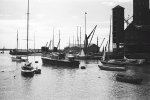
The last picture is I am pretty sure Felixstowe dock. Even more interesting to me is the day racing yacht lying to the buoy just astern of the tender. She is I am 99% certain one of the Royal Harwich One Design class. Designed for the RHYC in 1937 by Robert Clark with Austin Farrar being responsible for the rig and sail plan. I believe they were sometimes moored temporarily in Felixstowe before the war. I owned and raced one of these for about 20 years, great fun.Hi,
I don't believe they have, I should clearly get some copies to them when the travel restrictions ease off. Sadly, he took more photos of power stations and substations than boats, but there are a fair few boaty ones. I seem to recall that a relative of mine, by the name of Bob Pawsey has some connection with the Maritime trust - I must get in touch with him.
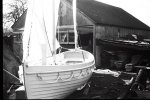
Grandad was Gary Wright of Wright and sons, boatbuilders at Cullingham Road (from when he bought the Palace Boatyard in 1937) and by 1939 he was building whalers and cutters (the RN's standard ships' boats) for the RN in preparation for the inevitable, using the skills he had used to build seaplanes at Felixstowe in the previous war.
View attachment 88155
View attachment 88156
As a naval cadet at Ipswich School in the 1960's, I had a Bosun's ticket which entitled me to take out boats from the pier at HMS Ganges, if any were available. My visits there were in search of a RNSA 14 footer or even a grp Bosun (15'?), but if I was unlucky, and enough bodies were available, I would end up in a 28' whaler or 32' cutter, some of which still carried the Wright and sons builders' plaque. Not really surprising, the yard spent most of the war churning them out. Tacking the beasts properly involved dipping the lug - no easy task.
Father Jack and his brother Eric were the sons of the boatbuilding business which Eric took over when Grandad retired. The Boatbuilding business was wound up around 1967 with much of the machinery, staff and capital transferred into Suffolk Yacht Harbour, of which Eric was the first Chairman alongside his friend, the inspirational Managing Director, Mike Spear.
One more photo here which I think is the Orwell, in fact I believe it's Felixstowe Dock in the days it was a dock rather than a long quayside, but I'm not sure. Perhaps one of you historians can confirm, or otherwise, for me.
View attachment 88157
I believe the smart launch was the tender for the flying boats which lay off the Felixstowe shore in Harwich Harbour.
Peter.

.Hi Kukri,
My copy is a reprint of the second edition, unsigned, but still gets treated with great respect, together with Frank Cooper's Handbook of Sailing Barges and Dennis J Davis' The Thames Sailing Barge - Her Gear and Her Rigging. I bought all 3 together in November 1973 and the latter 2 are invaluable if you want to understand the workings of these wonderful craft. Hervey's book was actually entitled "Down Tops'l" using the pronunciation most bargemen had for the most important sail in the barge, Some of those from Kent corrupted it to "Tawps'l", but "sail" only ever came out in full when used without a prefix (top, main, fore).
Sorry, use of language always fascinates me.
Peter.
A Butt is also a word for a barrel, and a Barrel and a plate of Oysters are depicted on the pub sign, but who knows the original derivation?If you have nothing to do........ IMT Image Archive’s albums | Flickr
Re. Buttermans Bay. I'm thinking of the pub at Pinmill, The Butt and Oyster. A "Butt" is a local name for a dap or flat fish and there are also oysters in the area so would assume this is how Buttermans bay got its name.
For square riggers I would recommend The Last Grain Race by Eric Newby, a brill read
If you have nothing to do........ IMT Image Archive’s albums | Flickr
[...]
That is marvellous! Many thanks.

Alan Villiers' film "By way of Cape Horn"?There was a very good film on you tube of her leaving Bremen & taking 3 weeks to get out of the North Sea, she rounded Cape Hoorn & up to Sanfransisco . Filmed by i think an American who signed on as crew & had to lean all the rigging terms in German

If you have nothing to do........ IMT Image Archive’s albums | Flickr
Re. Buttermans Bay. I'm thinking of the pub at Pinmill, The Butt and Oyster. A "Butt" is a local name for a dap or flat fish and there are also oysters in the area so would assume this is how Buttermans bay got its name.
For square riggers I would recommend The Last Grain Race by Eric Newby, a brill read
Alan Villiers' film "By way of Cape Horn"?

The last picture is I am pretty sure Felixstowe dock. Even more interesting to me is the day racing yacht lying to the buoy just astern of the tender. She is I am 99% certain one of the Royal Harwich One Design class. Designed for the RHYC in 1937 by Robert Clark with Austin Farrar being responsible for the rig and sail plan. I believe they were sometimes moored temporarily in Felixstowe before the war. I owned and raced one of these for about 20 years, great fun.
Looks more like a West Solent, with two sets of full width spreaders: the upper spreaders on ECODs were smaller struts for the diamond stays.Is that an ECOD or perhaps a West Solent Restricted Class behind the RHOD?