
You are using an out of date browser. It may not display this or other websites correctly.
You should upgrade or use an alternative browser.
You should upgrade or use an alternative browser.
Oil Analysis.
- Thread starter oldgit
- Start date

Momac
Well-Known Member
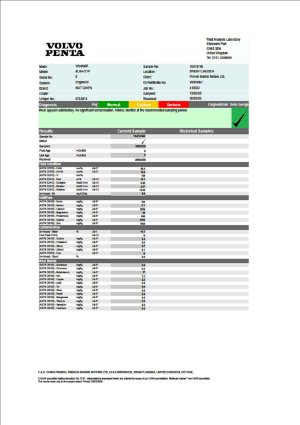
The advice is right there at the top of the report sheet


Parabordi
Well-Known Member
you wanna use a bit of AI mate -
This oil analysis report shows that your engine is in excellent health and the oil is performing exactly as it should. The "Normal" green checkmark indicates that there are no immediate concerns.
Here is a breakdown of what the specific numbers tell you about your Yanmar engine:
What to do now:
This oil analysis report shows that your engine is in excellent health and the oil is performing exactly as it should. The "Normal" green checkmark indicates that there are no immediate concerns.
Here is a breakdown of what the specific numbers tell you about your Yanmar engine:
1. Overall Engine Health (Wear Metals)
The "Wear Metals" section measures microscopic bits of metal shedding from internal parts.[1] Your levels are very low, which is a great sign:- Iron (7.1 ppm): This is the primary indicator of wear on cylinder liners and gears. For a marine diesel engine, anything under 50–100 ppm is typically considered good. Your 7.1 is excellent.
- Copper (2.2 ppm) & Lead (0.9 ppm): These come from your bearings. These extremely low numbers mean your engine's bearings are well-lubricated and not wearing down.
- Aluminum (0.0 ppm): Indicates no wear on the pistons.
2. Oil Condition (Is the oil still good?)
- Viscosity (KV100 = 13.6): This measures the oil's thickness at operating temperature. A value of 13.6 is right in the "sweet spot" for a typical 40-grade marine oil, meaning it hasn't thinned out or thickened excessively.
- BN (Base Number = 8.8): This represents the oil's remaining "acid-fighting" power. Diesel combustion creates acid; the BN is the additive that neutralizes it.[2][3] A BN of 8.8 is quite high, meaning the oil still has plenty of protective life left.
- Oxidation & Nitration: These are low (9.50 and 4.97), indicating the oil hasn't been overheated or overstressed.
3. Contamination (Is anything leaking?)
This is often the most important part of the test for boat owners because it catches "silent" killers:- Fuel (N): The "N" stands for None/Negative. This means your injectors are likely working perfectly and there is no fuel leaking into the crankcase (which would thin the oil).
- Water (< 0.1%): No sign of raw water or coolant getting into the oil.
- Silicon (6.7 ppm): This usually represents "dirt." Your level is low, meaning your air filtration system is doing its job.
- Sodium (2.4 ppm): This is very low. High sodium in a boat often indicates a saltwater leak; you have no such issue here.
Summary & Advice
The diagnostician's note summarizes it perfectly: "Wear appears satisfactory. No significant contamination."What to do now:
- You don't need to take any corrective action.
- Because this is a "Normal" result, you have established a perfect baseline.
- Keep the report. When you test again next season, you can compare the new results to these. If Iron jumps from 7 to 50 next time, you’ll know something has changed, even if it's still technically in the "green" zone.
oldgit
Well-Known Member

Momac
Well-Known Member
Presumably if selling a boat it would be a sound plan to change the engine oil / coolant and all other fluids and filters to enure as far as possible that any analysis on fluids during a survey will give the best possible result.
oldgit
Well-Known Member
Was told that the oil needs to have a few hours on it to give any chance of showing anything really useful.Presumably if selling a boat it would be a sound plan to change the engine oil / coolant and all other fluids and filters to enure as far as possible that any analysis on fluids during a survey will give the best possible result.
Analysis company wanted to know which brand of oil had been used, always used fleet oil and filters from a local motor factor.
Yanmar also stipulate 15/40 mineral only.
potentillaCO32
Well-Known Member
Why are you asking us when it says on the report?
penberth3
Well-Known Member
Why are you asking us when it says on the report?
The name "oldgit" might give you the answer to that question.
Momac
Well-Known Member
This is my point exactly .Was told that the oil needs to have a few hours on it to give any chance of showing anything really useful.
potentillaCO32
Well-Known Member
Thinking about it, and without wishing to detract from the OPs question, a better question might be, " what value is an oil analysis on an older engine and how old should the oil be to tell the correct story?"The name "oldgit" might give you the answer to that question.
penberth3
Well-Known Member
Thinking about it, and without wishing to detract from the OPs question, a better question might be, " what value is an oil analysis on an older engine and how old should the oil be to tell the correct story?"
Or use the Search facility. I think it was 'Chrome Dome' who covered the subject in great detail on the forum not too long ago.

Greg2
Well-Known Member
We have used oil analysis on and off for many years, both when purchasing and routinely on one boat we had owned that didn’t have a complete service history so I wanted to build up an evidence base to reassure prospective purchasers when we went to sell.
As already commented on, the oil needs to have been used a bit to get meaningful results and even then one off sampling might give a misleading picture so a series of samples over time are a far more reliable source of information.
.
As already commented on, the oil needs to have been used a bit to get meaningful results and even then one off sampling might give a misleading picture so a series of samples over time are a far more reliable source of information.
.
Other threads that may be of interest

- Replies
- 5
- Views
- 327


