New mooring / riser on existing grid

mjcp

Well-Known Member
Joined
19 Aug 2009
Messages
1,719
Location
West coast, Scotland
Visit site
I have many questions! It's my 1st time arranging my own mooring (yes, the local association and an experienced diver are involved) so be gentle pls!


I've had the nod to place a new riser and mooring onto an existing grid / trot ground tackle.

Charted depth in the area is 2-5 m (TBC in the actual area when I get out there to measure later this month) and tidal range MHWS c. 5.5m. Its fairly sheltered, I've not seen more than a 1m of fetch, (but its Scotland, so could be bigger on occasions ... eek!)

Boat is ~5000kg, 33 foot with a bow roller for the mooring tackle to go over. (1m above the water line)

So questions:

What size riser chain? Length and weight.

Is the theory for swing mooring tackle based on a catenary similar to anchoring or is there an alternative theory? I assume swing room is a consideration?

Is the riser height tidal range + % or is there a more scientific formula? 7-8m has been suggested (probably assuming ~3m MLWS)


I'd also like to document the max weight on the buoy to dissuade overweight visitors who will almost certainly sneak on while I'm away. What riser chain size etc would safely support say, a max 10T "guest" ?

And then what chain (chain preferred, "just in case") weight for the buoy to boat?


M
 
Check with the local association. They will have actual knowledge, while we can only guesstimate.

"the mooring association and an experienced diver are involved"


Already in touch! Its more trying to understand the theory etc. I understand chain in terms of anchors, but have not located much info for moorings.

M
 
The biggest worry with moorings especially the chain is wear. So you need the biggest chain you can find to last longest. Of course your buoy has to be able to support the weight. This means that actual strength of the chain is way more than needed. Look out for old ship[ anchor chain etc and use biggest shackles you can fit.
The theory of catenary is not really applicable as you will have weight of the base grid and of course no concerns re anchor pull angle. So length should be enough to allow some chain to lie on the bottom giving some cushion effect to the jerk loads. But of course not so long as to give too large swing radius. ol'will
 
"the mooring association and an experienced diver are involved"


Already in touch! Its more trying to understand the theory etc. I understand chain in terms of anchors, but have not located much info for moorings.

M
Slightly different set ups seem to be used in different areas. Whether that’s based on science or experience or just well it worked before I’m not sure. My diver is a specialist mooring contractor so I accept his word as he’s maintained all the other mooring locally and produces a bit of paper alongside his invoice so I can keep the insurer happy!
 
Something to consider: We used twin rope mooring pennants, one in through each bow fairlead on our mooring. Even with a monohull, the boat swung less; with a cat, the improvement is spectacular. I've no proof, but I think rope pennants will outlast chain, and they're certainly easier to DIY when they do need changing.

We use polysteel, a UV resistant polyprop. A hard eye with a Brummel splice in the middle attaches to the riser, and eye splices on each end.

If you do this, my top tip is to have a bit of cord and a snaphook that allows you to attach the eye splices together when you leave the mooring. It makes picking up so much easier.
 
I understand your curiosity. However from an insurance liability POV you, nor us are competent persons to design your mooring*.

When I’ve had a mooring in a harbour that sounds very similar to your set up, they had a framework so all boats / moorings were alike. Either follow that, or instruct the mooring diver / company with broad statement “I want a mooring at x spot capable of holding a my 10m, 5t boat. Please spec Accordingly”

*the reality is a heavy chain just over max HWS plus 10-20% up to a buoy with swivel and strop, it’s really not rocket science but we live in the age when your insurance co will want to sue if the mooring fails and there is no point in losing your home over it!
 
On Menai Strait, which sees considerable wind and tides at times, our riser was 3/4 inch chain with a swivel on the seabed. Length was just as Minerva describes - spring tide height plus a bit. We needed a fairly large buoy to cope with the weight, 8 metres range.
This mooring was according to our contractor's specification, originally for a light 27 foot boat but was unchanged for our GK29 and Sadler 34.
 
Around here there are a lot of moorings and operators who all use a similar method. its around 1.6 x depth for length of riser. The heavy ground chain for shallower moorings can be up to half the overall length and around 40mm. It makes a great snubber in rough weather and less prone to be worn away dragging on the seabed.
The riser is 1" or ⅞" (22mm) . The ⅞ fits through a hippo type buoy whereas the 1" does not. Advantage of a hippo type is that the swivel and shackle sits on top rather than underwater. Polyform buoys eventually get their eye ripped out or it splits leading to the mooring sinking if there is no boat on it.
You need the same overall chain length as your neighbours so everyone swings in harmony.
1" can be good for up to 5 years before needing lifting and inspecting.
I could suggest a light boat in strong winds snakes around a lot causing higher wear on the links whereas a heavy boat is more stable, less movement and less wear.
Eye marine have a chart giving chain weight per metre so you can work out what buoyancy your mooring buoy needs to have.
12-13% can be taken off the chain weight due to immersion in sea water and an allowance for the excess chain sat on the sea bed.
Use a smaller riser chain and you will be changing it sooner.
 
I understand your curiosity. However from an insurance liability POV you, nor us are competent persons to design your mooring*.
Understood! But as with many things in life: "What am I buying?", "Do I need it?", "Am I getting it?", "Can I get it for better value?" etc etc. If they say "Here's 22mm chain...", because that's what's on the shelf, but actually 14mm is fine and would be signed off by said diver / company, I may save £xxx and still be compliant.

M
 
Eye marine have a chart giving chain weight per metre so you can work out what buoyancy your mooring buoy needs to have.
12-13% can be taken off the chain weight due to immersion in sea water and an allowance for the excess chain sat on the sea bed.
Use a smaller riser chain and you will be changing it sooner.

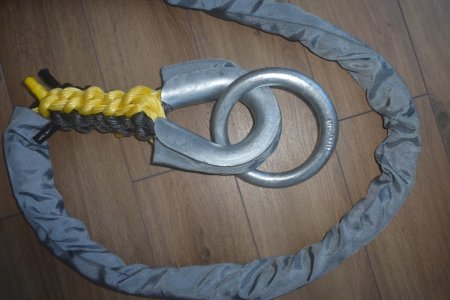
EYE will also make up risers. Photo shows one they made up for me, the buoy and pennants ( 2 x 24mm polysteel) attach to the large ring.

As the OP has the benefit of an association and local diver for advice, I would follow their recommended specification to avoid any dispute if it fails.
 

Attachments

  • P1010274a.jpg
    P1010274a.jpg
    261.4 KB · Views: 11
Check with the local association. They will have actual knowledge, while we can only guesstimate.

In UK .... most Harbour Masters have mooring setup guides for the areas they cover. Clubs are expected to comply.

If you are mooring to a grid / trot system .. are you swinging or two end trot (ie moored to the trot by bow and stern) ?

Often its a decent weight riser chain to near surface level and then mooring rope strop to boat. The strop having a buoy to carry it so you can hook it on board.
Some "two end trots" have a floating line between the two strops so you pick that up and it gives you both fore and aft strops.
 
Ensure that the swivel is on the top of the buoy.
3 years replacement for the chain is normal at Portland and diver inspection more ofyten.
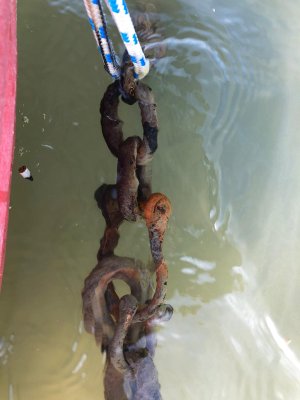
Why you need to inspect the chain

iu


And I've seen worse :eek:
 
Go with the opinion of the local professionals who have experience of the area. If the cost is not excessive a larger riser will last longer and might save in the long run. When I laid my own mooring for a 2.6T boat I used a 3/4" ground chain and 10mm riser through the middle of a spar buoy with a swivel on top. This eliminates several underwater joins and is easy to inspect. Underwater swivels become seized and do not work for long. You will find that corrosion is faster at the top of the riser where there is more oxygen and much less at the bottom if buried in mud. I did experiment with chain anodes which I think helped a little to reduce corrosion.
My current Dart Harbour mooring uses a buoy with a steel rod through the centre and a swivel ring on top which has been fine for the 30 years I have been there (annual inspection).

Your only task will be to sort the pick up arrangement. I use a chain with a backup rope. If the rope to the pick up buoy is just shorter than the chain it will always be under slight tension and remain close to the main buoy but not tangle around the riser. Polysteel seems popular now but it will possibly float when left and could wrap around the main buoy when the tide turns.
I could never decide on the best length for the mooring rope/chain. If they are short the main buoy will remain under the bow and you might need a bow fender. If they are longer there should be less jerking but with wind over tide the main buoy may migrate down the side of the boat and damage the topsides. It is very much trial and error to find what works best for you.
 
I'm not sure why you are trying to second guess whoever certifies your mooring during its annual check which you will need to comply with insurance. I have a mooring on the Clyde which gets a tag number when checked along with a report. I leave it to the professionals.
 
A few years ago, I'd been nagging the guy who does my mooring to give it a once-over for months. He eventually did it, and I asked him how it was. He pulled a face and said, "Well, let's just say you've had your money's worth."

A couple of weeks later we had 60 knot gusts, with a few boats breaking their moorings.
 
I might disagree with ansarkit in that wear of the chain and shackles is really a function of movement.Perhaps there is more oxygen at top but primarily there is more movement. ie the chain lying on the ground will not move as much as that up near the buoy. It is the friction that wears away the protective galvanising /rust that permits new rust so rapid wear. I have all stainless steel which after 15 years is looking good. no wear. (yes professionally inspected every 2 years) ol'will
 
Surely the difference in O2 levels between the surface and the bottom in anything but completely stagnant water will be minimal for any depths a mooring would be set in, so I reckon wear is the main culprit.

I couldn't find the photo, but I've seen mooring chain where the sides were practically normal thickness, and where the links touched they were practically non-existent. The mooring pennant is the worst offender, because it gets pulled around a lot, and is much thinner, so less metal to begin with, and it wears mostly in the bit you can't see, at the bottom. That's one reason why I favour rope pennants.
 
Top