
New mooring / riser on existing grid

I might disagree with ansarkit in that wear of the chain and shackles is really a function of movement.Perhaps there is more oxygen at top but primarily there is more movement. ie the chain lying on the ground will not move as much as that up near the buoy. It is the friction that wears away the protective galvanising /rust that permits new rust so rapid wear. I have all stainless steel which after 15 years is looking good. no wear. (yes professionally inspected every 2 years) ol'will
It is called corrosive wear. The contact points wear against each other, creating bright metal, known as nascent. These corrode rapidly. The corrosion product, rust in the case of steel, is easily worn away. The process recommences. Contact points in the suspended section of the chain wear rapidly by this mechanism.

Chain lying on the bottom may wear partly by this mechanism due to tidal rise and fall but also by abrasion against the seabed.
 
I might disagree with ansarkit in that wear of the chain and shackles is really a function of movement.Perhaps there is more oxygen at top but primarily there is more movement. ie the chain lying on the ground will not move as much as that up near the buoy. It is the friction that wears away the protective galvanising /rust that permits new rust so rapid wear. I have all stainless steel which after 15 years is looking good. no wear. (yes professionally inspected every 2 years) ol'will
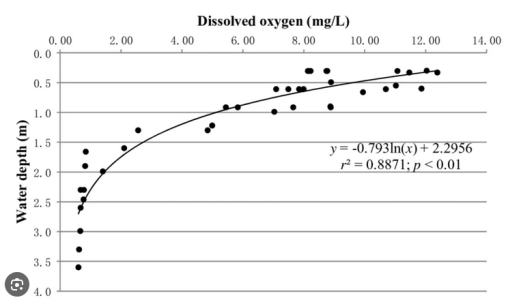
You are probably right and I am not a chemist but I assumed that wave action would affect oxygen levels near the surface. This graph of readings taken in a lake would seem to provide some evidence for that conclusion but in a tidal location it might be completely different.
1775299550959.png

It was very noticeable that the riser top couple of feet had much more corrosion than further down. That was when I started to put the swivel and shackles on the top of the buoy where they were easily inspected. My ground chain of 3/4" stud link chain was still good after 10 years in the mud of the seabed.
 
In my experience of moorings, the riser chain suffers most from corrosion up near the surface, where there's more air and light. It suffers the most wear over the length which is in intermittent contact with the seabed, ie a little more than the tidal range. That's why it is good and accepted practice to "winterise" your mooring, by dropping the riser to the seabed, with a messenger line and buoy.
 
Top