Moving from 1,2,Both switch to VSR

I have asked the Beneteau Owners why the negative switch. Let’s see what they say.
Please report back on this, I would be curious to know the reasoning.
FWIW, this is what the ISO 10133 (which deals with DC systems in small crafts) has to say on the subject:
'A battery disconnect switch shall be installed in the positive conductor of a system with earthed negative or the positive and negative conductor (simultaneously switched) of a fully insulated two-wire DC system.' (6.1, 2012 edition).
Fully insulated means that the DC negative is not connected to the ground (the water surrounding the boat).
I am curious as I have such a DC setup, but have not bothered with a main switch in the negative. As usual, the ISO regulation gives no rationale.
 
Please report back on this, I would be curious to know the reasoning.
FWIW, this is what the ISO 10133 (which deals with DC systems in small crafts) has to say on the subject:
'A battery disconnect switch shall be installed in the positive conductor of a system with earthed negative or the positive and negative conductor (simultaneously switched) of a fully insulated two-wire DC system.' (6.1, 2012 edition).
Fully insulated means that the DC negative is not connected to the ground (the water surrounding the boat).
I am curious as I have such a DC setup, but have not bothered with a main switch in the negative. As usual, the ISO regulation gives no rationale.

I thought that the Recreational Craft Directive required earth bonding...
 
I thought that the Recreational Craft Directive required earth bonding...
I seem to remember that the RCD mostly just points at the relevant ISO regulations, for DC ISO 10133 and for AC ISO 13297.
I think you are correct that the ISO 13297 requires that the protective earth of the AC system should be bonded to earth aboard the craft, either through the DC negative or, for a fully insulated DC system, through a dedicated ground plate (or the hull, if metal).
As both the ISO's mention the option of a fully insulated DC system, I don't see that there can be a requirement to connect the DC negative to earth...
 
I seem to remember that the RCD mostly just points at the relevant ISO regulations, for DC ISO 10133 and for AC ISO 13297.
I think you are correct that the ISO 13297 requires that the protective earth of the AC system should be bonded to earth aboard the craft, either through the DC negative or, for a fully insulated DC system, through a dedicated ground plate (or the hull, if metal).
As both the ISO's mention the option of a fully insulated DC system, I don't see that there can be a requirement to connect the DC negative to earth...

The ISO is a set of standards, not regulations.
 
I seem to remember that the RCD mostly just points at the relevant ISO regulations, for DC ISO 10133 and for AC ISO 13297.
I think you are correct that the ISO 13297 requires that the protective earth of the AC system should be bonded to earth aboard the craft, either through the DC negative or, for a fully insulated DC system, through a dedicated ground plate (or the hull, if metal).
As both the ISO's mention the option of a fully insulated DC system, I don't see that there can be a requirement to connect the DC negative to earth...

You're right and there isn't such a requirement now. The 2000 version of the AC ISO said:

"The protective conductor shall be connected to the craft's d.c. negative ground (earth) as close as practicable to the battery (d.c.) negative terminal."

This is, of course, nonsense. Because, if the installation is fully isolated the DC negative will not be connected to ground, which totally defeats the point of the rule.

Subsequent editions of the ISO use different wording, but are still not well worded.
 
Well I did some reading. If you are in the camp that is satisfied when told the reason for a common negative battery switch is that it’s because Beneteau/Jeanneau/et al have fitted them for years, then read no further.

I am not a qualified marine electrician, I am in my 60’s and owned and worked on boats all my adult life, so I am not giving advice you can rely on here!

In fact I spoke to Ancasta support in Hamble, they couldn’t tell me why it was there only that the builder always fits them. Right - where have I heard that before?

I posted on the Beneteau Owners UK forum 2 days ago. No answer so far.

Just to be clear the Beneteau 381 has three battery switches - two red and one black - as per attached diagram. In summary this allows all loads to be powered by the engine battery, or the domestic, or both. But not powered separately. In each option the common negative should be closed also (switched on). If you are confused by this so was I when I first stepped onboard.
8F412430-4BFA-4A65-8AAE-971E26E9A50C.jpeg
ISO 13297 2020-12 Small craft — Electrical systems — Alternating and direct current installations (replaces 10133 2012) has this to say about battery-disconnect switch, DC systems
“9.1 A battery-disconnect switch shall be installed in the positive conductor of a system with grounded/ earthed negative or the positive and negative conductor (simultaneously switched) of a fully insulated two-wire DC system. The disconnect switch shall be installed in a readily accessible location, and as close as practical to the battery or group of batteries. The following constitute exceptions:
a) outboard-powered craft with engine starting and navigation lighting circuits only; b) electronic devices with protected memory and protective devices such as bilge pumps and alarms if individually protected by a circuit breaker or fuse as close as practical to the battery terminal;
c) engine/fuel tank compartment ventilation exhaust blower if separately protected by a fuse or circuit breaker as close as practical to the battery terminal;
d) charging devices which are intended to be used when the craft is unattended (e.g. solar panels, wind generators) if individually protected by a fuse or circuit breaker as close as practical to the battery terminal.
9.2 Battery switch ratings - The 30-second rating of a battery switch shall not be less than the maximum cranking current of the largest engine cranking motor that it serves. The minimum continuous rating of a battery switch shall be the total of the ampacities of the main overcurrent protection devices connected to the battery switch, or the ampacity of the feeder cable to the switch, whichever is less.”

My interpretation is that a separate non-simulateously switched negative switch is not compliant with ISO 13279. Also other negative post battery connections that bypass a simultaneously switched common negative battery switch are permitted as outlined in the exceptions.

I found another answer to my question on another forumhttps://forums.sailboatowners.com/threads/battery-switches.132698/
reasons given include
- to reduce battery discharge during long term storage (if this is true seems to suggest a short somewhere)
- as an emergency shut down in the event of fire (but would not shut down any permanatly wired circuits like bilge pump, wind generator, etc)
- to isolate the batteries when working on them.

There are pros and cons, and clearly some are fans of this system, but since the setup is unique compared to other boats, and is prone to human error and suboptimal battery charging, I am not a fan.

In conclusion because I want to charge and draw on the engine and domestic battery banks separately and at the same time, I am going to alter the wiring so that one red switch powers the engine from the engine battery and one red switch the domestic circuits. (The engine switch will probably be a “1,2,both,off” job). I will also remove the common negative switch (a) to eliminate confusion, (b) ground negative bus to boat’s grounded bus (c) comply with ISO 13297.
 
Well I did some reading. If you are in the camp that is satisfied when told the reason for a common negative battery switch is that it’s because Beneteau/Jeanneau/et al have fitted them for years, then read no further.

I am not a qualified marine electrician, I am in my 60’s and owned and worked on boats all my adult life, so I am not giving advice you can rely on here!

In fact I spoke to Ancasta support in Hamble, they couldn’t tell me why it was there only that the builder always fits them. Right - where have I heard that before?

OK, so why is it there then ?

Just to be clear the Beneteau 381 has three battery switches - two red and one black - as per attached diagram. In summary this allows all loads to be powered by the engine battery, or the domestic, or both. But not powered separately. In each option the common negative should be closed also (switched on). If you are confused by this so was I when I first stepped onboard.

That doesn't make any sense at all, if the schematic is correct it's a stupid way of wiring the boat. I've worked on several Beneteaus and Jeanneaus with the same three switches and with all the ones i have worked on the engine switch is for the engine, the domestic switch is for everything else. Amongst those is a Beneteau 375 from 2006, which works as i described. Have you checked the switches actually work in accordance with the schematic ? ie, only switch the domestic switch on, can you start the engine ? With only the engine switch on, do the domestic circuits all work ?

ISO 13297 2020-12 Small craft <snip>

My interpretation is that a separate non-simulateously switched negative switch is not compliant with ISO 13279. Also other negative post battery connections that bypass a simultaneously switched common negative battery switch are permitted as outlined in the exceptions.

It won't be. The boat wasbuilt in 2008 and the ISO you quote is 2020. Prior to 2012 there was no mention of double pole isolators, your boat could have been built without the negative switch altogether.

I found another answer to my question on another forumhttps://forums.sailboatowners.com/threads/battery-switches.132698/
reasons given include
- to reduce battery discharge during long term storage (if this is true seems to suggest a short somewhere)
- as an emergency shut down in the event of fire (but would not shut down any permanatly wired circuits like bilge pump, wind generator, etc)
- to isolate the batteries when working on them.

Ignore all of those, they are internet nonsense. The positive isolators achieve all of those functions.

There are pros and cons, and clearly some are fans of this system, but since the setup is unique compared to other boats, and is prone to human error and suboptimal battery charging, I am not a fan.

I can see no pros. It can be subject to human error, i once had a customer call me up to say all of his systems were dead, engine and domestics, he'd not turned the negative isolator on. Its presence does not mean suboptimal battery charging, your battery charger is connected directly to the batteries bypassing the switch.

In conclusion because I want to charge and draw on the engine and domestic battery banks separately and at the same time, I am going to alter the wiring so that one red switch powers the engine from the engine battery and one red switch the domestic circuits. (The engine switch will probably be a “1,2,both,off” job). I will also remove the common negative switch (a) to eliminate confusion, (b) ground negative bus to boat’s grounded bus (c) comply with ISO 13297.

After double checking that the switching does operate in accordance with the schematic, i'd also make some changes. I would separate the engine and domestic circuits, as you say, but i would not add a 1-1-B switch. The two existing red switches work fine. I would not remove the negative switch, i would re-purpose that as an emergency parallel switch. Either paint it yellow and label it accordingly, or remove the knob. I have wired countless systems with three separate switches, one for engine, one for domestics and an emergency parallel switch, i've never had anyone comment that they accidentally switched all three on.

All you need to do with the negative switch is to join all of the cables together, a terminal post, busbar or just a nut and bolt can be used, whichever works best for you.

I'm not sure what you mean by "ground negative bus to boat’s grounded bus (c) comply with ISO 13297."
 
  • Like
Reactions: pvb
My boat has got a extra isolator in the negative hidden in the bottom of a locker.
Never understood why it’s there but am reluctant to remove it. I was thinking if someone broke into my boat they can turn as many switches as they like but nothing will work unless you know of the ‘secret switch’.
Now I’ve said that out loud it sounds daft
 
That is also how my Bene 36cc is wired. Never saw the need for the -ve switch, but is there and I have to use it...

When running the engine, the domestic bank won't charge unless both +ve switches are on. Not a real problem since the domestic bank is always on and the engine battery always get switched off at the end of (and often during) the day to protect it. Windlass hangs off the domestic switch so I suppose the only advantage of this setup is that the alternator directly feeds that load (in parallel with both the batteries) when lifting the anchor.

I'm also going to separate it out to two separate circuits and fit one of these Victron units to cross-connect between them as the alternator is connected to the engine battery switch (via the starter cable).

Victron Energy Cyrix-ct 12/24V 230A Intelligent Battery Combiner - CYR010230010R – Battery Megastore

I'm also going to re-purpose the -ve switch as an alternative, manual cross-connect.

I also want to add an inverter so will take the opportunity to upgrade all the battery cabling to 50mm2 (from 35mm2) and add some 'cube' fuses onto the battery terminals.

So, what started out as a battery charger upgrade is turning into new batteries, fuses, wiring, busbars and a charger/inverter....

Well I did some reading. If you are in the camp that is satisfied when told the reason for a common negative battery switch is that it’s because Beneteau/Jeanneau/et al have fitted them for years, then read no further.

I am not a qualified marine electrician, I am in my 60’s and owned and worked on boats all my adult life, so I am not giving advice you can rely on here!

In fact I spoke to Ancasta support in Hamble, they couldn’t tell me why it was there only that the builder always fits them. Right - where have I heard that before?

I posted on the Beneteau Owners UK forum 2 days ago. No answer so far.

Just to be clear the Beneteau 381 has three battery switches - two red and one black - as per attached diagram. In summary this allows all loads to be powered by the engine battery, or the domestic, or both. But not powered separately. In each option the common negative should be closed also (switched on). If you are confused by this so was I when I first stepped onboard.
View attachment 107401
ISO 13297 2020-12 Small craft — Electrical systems — Alternating and direct current installations (replaces 10133 2012) has this to say about battery-disconnect switch, DC systems
“9.1 A battery-disconnect switch shall be installed in the positive conductor of a system with grounded/ earthed negative or the positive and negative conductor (simultaneously switched) of a fully insulated two-wire DC system. The disconnect switch shall be installed in a readily accessible location, and as close as practical to the battery or group of batteries. The following constitute exceptions:
a) outboard-powered craft with engine starting and navigation lighting circuits only; b) electronic devices with protected memory and protective devices such as bilge pumps and alarms if individually protected by a circuit breaker or fuse as close as practical to the battery terminal;
c) engine/fuel tank compartment ventilation exhaust blower if separately protected by a fuse or circuit breaker as close as practical to the battery terminal;
d) charging devices which are intended to be used when the craft is unattended (e.g. solar panels, wind generators) if individually protected by a fuse or circuit breaker as close as practical to the battery terminal.
9.2 Battery switch ratings - The 30-second rating of a battery switch shall not be less than the maximum cranking current of the largest engine cranking motor that it serves. The minimum continuous rating of a battery switch shall be the total of the ampacities of the main overcurrent protection devices connected to the battery switch, or the ampacity of the feeder cable to the switch, whichever is less.”

My interpretation is that a separate non-simulateously switched negative switch is not compliant with ISO 13279. Also other negative post battery connections that bypass a simultaneously switched common negative battery switch are permitted as outlined in the exceptions.

I found another answer to my question on another forumhttps://forums.sailboatowners.com/threads/battery-switches.132698/
reasons given include
- to reduce battery discharge during long term storage (if this is true seems to suggest a short somewhere)
- as an emergency shut down in the event of fire (but would not shut down any permanatly wired circuits like bilge pump, wind generator, etc)
- to isolate the batteries when working on them.

There are pros and cons, and clearly some are fans of this system, but since the setup is unique compared to other boats, and is prone to human error and suboptimal battery charging, I am not a fan.

In conclusion because I want to charge and draw on the engine and domestic battery banks separately and at the same time, I am going to alter the wiring so that one red switch powers the engine from the engine battery and one red switch the domestic circuits. (The engine switch will probably be a “1,2,both,off” job). I will also remove the common negative switch (a) to eliminate confusion, (b) ground negative bus to boat’s grounded bus (c) comply with ISO 13297.
 
That is also how my Bene 36cc is wired. Never saw the need for the -ve switch, but is there and I have to use it...

When running the engine, the domestic bank won't charge unless both +ve switches are on. Not a real problem since the domestic bank is always on and the engine battery always get switched off at the end of (and often during) the day to protect it. Windlass hangs off the domestic switch so I suppose the only advantage of this setup is that the alternator directly feeds that load (in parallel with both the batteries) when lifting the anchor.

I'm also going to separate it out to two separate circuits and fit one of these Victron units to cross-connect between them as the alternator is connected to the engine battery switch (via the starter cable).

Victron Energy Cyrix-ct 12/24V 230A Intelligent Battery Combiner - CYR010230010R – Battery Megastore

I'm also going to re-purpose the -ve switch as an alternative, manual cross-connect.

I also want to add an inverter so will take the opportunity to upgrade all the battery cabling to 50mm2 (from 35mm2) and add some 'cube' fuses onto the battery terminals.

So, what started out as a battery charger upgrade is turning into new batteries, fuses, wiring, busbars and a charger/inverter....

Interesting to hear of another Bene wired this way, it's totally bonkers ! Perhaps some of the ones i have worked on started this way and have been altered, although a lot of my customers boats are also newer, so it seems Beneteau/Jenneau have wired the later ones differently (properly).

Good call on the Victron Cyrix, if Corbert-Beacons Bene doesn't have split charging (sounds like that'll be the case) i'd recommend the Cyrix to him too.

I would just question that particular Cyrix, as it's rated at 230a, unless your charging systems are that high, i'd go for the 120a version, it's almost 1/3rd of the price: Victron Energy Cyrix-ct 12/24V 120A Intelligent Battery Combiner - CYR010120011 – Battery Megastore

Which inverter are you planning to fit ?
 
Last edited:
Interesting to hear of another Bene wired this way, it's totally bonkers ! Perhaps some of the ones i have worked on started this way and have been altered, although a lot of my customers boats are also newer, so it seems Beneteau/Jenneau have wired the later ones differently (properly).

Good call on the Victron Cyrix, if Corbert-Beacons Bene doesn't have split charging (sounds like that'll be the case) i'd recommend the Cyrix to him too.

I would just question that particular Cyrix, as it's rated at 230a, unless your charging systems are that high, i'd go for the 120a version, it's almost 1/3rd of the price: Victron Energy Cyrix-ct 12/24V 120A Intelligent Battery Combiner - CYR010120011 – Battery Megastore

Which inverter are you planning to fit ?
I reckoned the higher current Victron unit was a slightly better spec'd for the cranking current of my MD2040 (measured it at just over 200A), Lower current model has 180A cranking current rating. So, if I use the manual inbuilt override function it would be borderline. That said, I've never in the 10 years I've had the boat ended up with a flat start battery.... so it'll probably never be used (i hope). It also has a status LED indicator which seemed vaguely useful and a cable for the manual switch. So, not much between the 2 units, I guess. And I'll still have the old -ve switch for paralleling as well, which I might as well keep since it is already there.

Am looking at the Sterling 1600VA or, maybe the 2500W. The latter is a bit of an overkill and I'd need to uprate the wiring around the main distribution to an even higher cable size. Also wanted the Victron 1600VA, but the controls are on the base of the unit (which on my boat will unfortunately be in the engine bay) so not practical, really. The Sterling has slightly higher power rating at 40oC and a remote control panel which I quite like.

This whole wee project started with spending 4 nights at anchor recently; heating on constantly and combined with fridge took my 330AH domestics to 40-50% SOC.
- So, 500AH AGMs going in..
- They need a bigger charger than my 30A...
- Not many chargers rated at around 60A, but want some mains backup for my ancient Fischer Panda genset, which am sure will die soon
- Realised charger/inverters give good charging capacity and some mains backup, so a good fit
- Wirings needs upgraded to run the inverter and has too many wires hanging of the battery terminals
- So that needs tidying up with a decent set of busbars and fusing
- Then want to separate the domestic and starter circuits, hence the need for a VSR and why I found this an interesting wee thread.
- Oh, and I need to re-route some of the 240V mains wiring to separate out the incoming 240V to feed the charger and then let the inverter drive all the boat sockets as well
- And on it goes... if only I could actually get to the boat to start it all...

Hope to keep the boat for a while longer and it is reaching the age where it needs some future-proofing WRT mains power afloat (don't NEED it, but want it for convenience!).

Apologies - thread highjack :)
 
I reckoned the higher current Victron unit was a slightly better spec'd for the cranking current of my MD2040 (measured it at just over 200A), Lower current model has 180A cranking current rating. So, if I use the manual inbuilt override function it would be borderline. That said, I've never in the 10 years I've had the boat ended up with a flat start battery.... so it'll probably never be used (i hope). It also has a status LED indicator which seemed vaguely useful and a cable for the manual switch. So, not much between the 2 units, I guess. And I'll still have the old -ve switch for paralleling as well, which I might as well keep since it is already there.

I like the Cyrix and have fitted lots of them, but never wire the "start assist". To my thinking it solves a problem that shouldn't exist. The emergency parallel switch will "jump start" a flat engine battery, without the current and time constraints of the "start assist". It will also allow to to isolate either battery/bank and run everything from the other battery/bank, provided you wire it to the load side of the engine and domestic banks. So, if you have the emergency switch, the 120a Cyrix is fine, if your charging doesn't exceed 120a. But, if you want the LED there's no down side to fitting the 230a version, other than the cost.

Am looking at the Sterling 1600VA or, maybe the 2500W. The latter is a bit of an overkill and I'd need to uprate the wiring around the main distribution to an even higher cable size. Also wanted the Victron 1600VA, but the controls are on the base of the unit (which on my boat will unfortunately be in the engine bay) so not practical, really. The Sterling has slightly higher power rating at 40oC and a remote control panel which I quite like.

Sorry so say, the Sterling inverters are truly rubbish. A 1200w Victron will perform better than the 1600w Sterling, possibly even the 2500w one. The smaller Victron Multiplus does have the controles on the bottom, but this model has them on the front: MultiPlus - Victron Energy

I have no affiliation with Victron, but i do fit their kit by default because it always does exactly what it says on the tin, if not more.

This whole wee project started with spending 4 nights at anchor recently; heating on constantly and combined with fridge took my 330AH domestics to 40-50% SOC.
- So, 500AH AGMs going in..
- They need a bigger charger than my 30A...
- Not many chargers rated at around 60A, but want some mains backup for my ancient Fischer Panda genset, which am sure will die soon
- Realised charger/inverters give good charging capacity and some mains backup, so a good fit
- Wirings needs upgraded to run the inverter and has too many wires hanging of the battery terminals
- So that needs tidying up with a decent set of busbars and fusing
- Then want to separate the domestic and starter circuits, hence the need for a VSR and why I found this an interesting wee thread.
- Oh, and I need to re-route some of the 240V mains wiring to separate out the incoming 240V to feed the charger and then let the inverter drive all the boat sockets as well
- And on it goes... if only I could actually get to the boat to start it all...

Hope to keep the boat for a while longer and it is reaching the age where it needs some future-proofing WRT mains power afloat (don't NEED it, but want it for convenience!).

Apologies - thread highjack :)

All sounds about right and typical of how some boat projects spiral. You can get 60a chargers, but as i suspect you've noticed, they cost nearly as much as a charger/inverter.

A cautionary note on cable sizes for the inverter. A 2500w inverter will draw a constant 250a (your batteries will love that :() depending on what you use it for, startup loads could briefly be higher. So unless your inverter is right next to the batteries, 50mm cable is pushing it. You might be better to stick with the 35mm cable that you have, but connect the inverter straight to the batteries with thicker than 50mm cable, obviously including and isolator switch and a fuse or thermal breaker. You could fit a resettable breaker that serves as a switch and circuit protection.
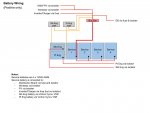
 
Just to be clear the Beneteau 381 has three battery switches - two red and one black - as per attached diagram. In summary this allows all loads to be powered by the engine battery, or the domestic, or both. But not powered separately. In each option the common negative should be closed also (switched on). If you are confused by this so was I when I first stepped onboard.

Indeed a very odd switching arrangement.
What ever the thinking behind it is, I would be surprised if the existence of the negative main switch in this context has anything to do with the requirements of the ISO 13297.
Also, since you quote from a 2020 version of the (now merged?) ISO's, did you find an online source for it?
 
I like the Cyrix and have fitted lots of them, but never wire the "start assist". To my thinking it solves a problem that shouldn't exist. The emergency parallel switch will "jump start" a flat engine battery, without the current and time constraints of the "start assist". It will also allow to to isolate either battery/bank and run everything from the other battery/bank, provided you wire it to the load side of the engine and domestic banks. So, if you have the emergency switch, the 120a Cyrix is fine, if your charging doesn't exceed 120a. But, if you want the LED there's no down side to fitting the 230a version, other than the cost.

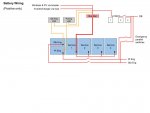
I'd welcome advice on sensible modifications needed to the charging/battery setup on my Broadblue catamaran. We aim to use only solar to charge, along with engines when they are in use. The setup is shown in the attached schematic and features:
  • 2 x engines with 20A alternators
  • Each alternator connected to it's own start battery (standard flooded), and each battery connected to Service Bank via Victron Cyrix VSR
  • Service bank of 480Ah AGM batteries
  • 540W solar panels connected so Service Bank
Rather than getting into the VSR versus 1-2-B debate, let me just state my preference for VSRs, as I like the automatic way they operate. The questions I would appreciate your views on are:
  1. What modifications do I need (if any) to ensure I do not inadvertently drain my Start batteries in the event of a failure of part of the system
  2. In the event of a Start battery failing, how do I bring an other battery into use, either the other Start or Service? I know the Cyrix has the ability to be switched, but as its rated at 120A this doesn't seem suitable to pass a cranking current through
  3. As the solar keeps the Service battery full most of the time, the VSRs will be engaged for much of the time. Is this a problem as the Service batteries are AGM where as the Start batteries are flooded? Or am I worrying about nothing here
  4. Inverter/charger is connected directly to the Service Bank via a fuse but no isolator. Is this OK?
To help frame people's responses let me say that I am an informed amateur engineer and I'm very happy to be schooled by more experienced and knowledgeable engineers!
 

Attachments

  • Battery Wiring.jpg
    Battery Wiring.jpg
    54.7 KB · Views: 16

Firstly, welcome to the forum.

I'd welcome advice on sensible modifications needed to the charging/battery setup on my Broadblue catamaran. We aim to use only solar to charge, along with engines when they are in use. The setup is shown in the attached schematic and features:
  • 2 x engines with 20A alternators
  • Each alternator connected to it's own start battery (standard flooded), and each battery connected to Service Bank via Victron Cyrix VSR
  • Service bank of 480Ah AGM batteries
  • 540W solar panels connected so Service Bank
Rather than getting into the VSR versus 1-2-B debate, let me just state my preference for VSRs, as I like the automatic way they operate. The questions I would appreciate your views on are:

My thoughts on 1-2-N switches are well known on here, i'm with you on the separate switches and split charging, in whatever form that takes.
  1. What modifications do I need (if any) to ensure I do not inadvertently drain my Start batteries in the event of a failure of part of the system
  2. In the event of a Start battery failing, how do I bring an other battery into use, either the other Start or Service? I know the Cyrix has the ability to be switched, but as its rated at 120A this doesn't seem suitable to pass a cranking current through
  3. As the solar keeps the Service battery full most of the time, the VSRs will be engaged for much of the time. Is this a problem as the Service batteries are AGM where as the Start batteries are flooded? Or am I worrying about nothing here
  4. Inverter/charger is connected directly to the Service Bank via a fuse but no isolator. Is this OK?

1. Having separate systems and VSR make this almost impossible.

2. I never connect the Cyrix "start assist". Fit a on/off battery isolator between the port engine isolator (on the engine side, not the battery side) and the load side of the domestic isolator (no domestic isolator shown in your schematic). If the engine needs a "jump start", close the switch, start the engine, open the switch. If the battery totally fails open the engine switch and close the emergency switch, the engine then runs from the domestic bank until you can fix the problem. The VSR will stay closed and some charging will go to the failed battery, if this is an issue disconnect the negative from the VSR (you could fit a switch here, but that might be a bit overkill). Repeat for the starboard engine.

3. Providing the flooded charging voltages are suitable for the AGM batteries, there isn't likely to be an issue. But, keep a close on them.

4. Yes, that's OK.

An alternative system that might suit you: replace both VSRs with a 3 output Victron Argofet. Each engine connects to its owb Argofet and the 3 outlets allow that engine to charge all batteries. The solar panels just connect to the domestic bank, so the engine batteries never get any charge from the panels. This can be beneficial with some large solar arrays or installations where the domestic bank is deep cycle (for instance) with higher than normal charging voltages.
 
2. I never connect the Cyrix "start assist". Fit a on/off battery isolator between the port engine isolator (on the engine side, not the battery side) and the load side of the domestic isolator (no domestic isolator shown in your schematic). If the engine needs a "jump start", close the switch, start the engine, open the switch. If the battery totally fails open the engine switch and close the emergency switch, the engine then runs from the domestic bank until you can fix the problem. The VSR will stay closed and some charging will go to the failed battery, if this is an issue disconnect the negative from the VSR (you could fit a switch here, but that might be a bit overkill). Repeat for the starboard engine.
Thanks for prompt reply - very helpful. One clarification: the connection to the main DB goes via a 300A fuse and then an isolator. If I connect the emergecy parallel wires to this, should I connect before the fuse; after the fuse; or after both the fuse and the isolator? ie positions 1, 2, or 3 in the updated scehmatic Battery Wiring 2.jpg. Thanks
 
If you assume the starter motor is going to draw more than 300 amps when in parallel or jump mode powered from service battries then yes take off to the parallel switches needs to be from before (battery) side of 300 amp fuse. Likewise the isolator switch. ol'will
 
Thanks for prompt reply - very helpful. One clarification: the connection to the main DB goes via a 300A fuse and then an isolator. If I connect the emergecy parallel wires to this, should I connect before the fuse; after the fuse; or after both the fuse and the isolator? ie positions 1, 2, or 3 in the updated scehmatic View attachment 130087. Thanks

With twin engines you have more choices than a single engine. You could fit a single emergency switch after the two engine isolators, that parallels the two engine batteries. For a simple jump start, start the "good" engine, close the switch, start the other engine, open the switch. For a failed battery, open the switch to the failed battery, close the emergency switch, start the engines and leave the switch closed until you get the battery replaced (open all engine battery switches when the engines are not running).

You can fit two switches, as in your schematic above. If an engine needs a "jump start", close the switch, start the engine, open the switch. If a battery totally fails open the engine switch and close the emergency switch, the engine then runs from the domestic bank until you can replace the battery. Another benefit of this setup is that if your domestic bank has an issue you can open the domestic switch, close one of the emergency switches and run the domestics from the engine/engine battery. You'd obviously only do that with the engine running and only for basic systems to get you home or get the problem fixed. For this to work, the emergency switches need to be connected to the load side of the domestic isolator (position 3). The 300a fuse should be more than adequate for your small engines.
 
Top