
Moving from 1,2,Both switch to VSR

fredrussell

Well-Known Member
Joined
24 Mar 2015
Messages
4,388
Visit site
My new to me boat came with two batteries and a 1,2,Both switch. I would like to change to two house batteries and a small starter battery. I have installed the two 110AH batteries into the current setup, and mounted the smaller starter battery (but not connected it at all, and I would like to use a VSR to take care of switching charging between house and starter batteries.

Ideally I would like to retain the ability to switch between the two banks, and I've installed VSRs before on camper vans so know how to install those. Does anyone know of a good website that details the basic principles of a 1,2,Both switch as these are new to me. Or if someone could explain how they operate that would be appreciated. Are they all wired in the same regardless of boat? I have a Durite 40 amp VSR, Alternator is 30A.
 
A 1, 2, both switch switch is the simplest method of switching between two batteries or battery banks .
You can select one battery or the other to be in use and be on charge , or you can have both in service and on charge , or both off

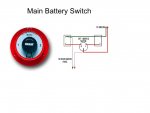
See diagram attached for the way it would be wired

You could add a 2 way VSR then both batteries would always be charged regardless of which is selected to be the " inservice " battery.
I'm not sure if your Durite VSR is 2way. I dont think it is . You will have to check it out. Actually I cannot see a 12V 40A one mentioned on the Durite website

Id suggest the following procedure to use such a switch
  • Select the engine start battery
  • Start the engine
  • Allow the battery to recharge if you don't have the VSR
  • Switch via the both position to the services battery
  • Keep the services battery in use until you next need to start the engine or you switch everything off.
DO NOT switch to off while the engine is running or you will blow the alternator diodes. Only the skipper should be allowed to operate the switch for this reason


I am going to bed
Others can produce diagrams of better ways of battery switching, using separate isolating switches and an emergency cross over switch,
 

Attachments

  • 1 2 both switch.jpg
    1 2 both switch.jpg
    59.5 KB · Views: 177
Last edited:
Vic's operating procedure for 1,2,both switch is correct. However the problem is the temptation to simply start and operate on both. This means that you don't have to do anything else and both batteries get charged. The down side is that if you then have a period of discharge you can end up discharging both batteries. You lose the value of quarantining one battery for later engine start. The other down side is that at some stage one or both batteries will die as in unable to start the engine. This failure can be masked by having the other or 2 batteries in parallel. So you don't know you have a failure until yo have dual failures and so no engine start. The answer is diligence in operating the system as described. ie only discharge one battery not both and regularly start on each battery individually.
The VSR set up uses one battery exclusively for engine start. A cheaper smaller battery optimised for high Cold Cranking Amps (CCA) For OP it will mean both deep cycle batteries can be used for domestic loads so more capacity. For emergency starting provision is made to connect all batteries in parallel either by a high current jumper lead or dedicated switch. It is generally assumed that the 2 big batteries can be used in parallel with the start battery if and when it gets old. This approach is mostly OK though not always. Normally no action is required to operate the system which is essentially 2 entirely separate systems connected together by a common negative heavy wire and a VSR.
So if OP has a 1,2,both switch system it is OK but he has the stuff and the will to fit VSR system and this will be better. As long as he has provision to parallel the batteries and understands the likely failure modes of the batteries used he will do well. ol'will
 
1,2, both switches are notorious for corroding internally, causing high resistance, and for allowing people to ruin &/or flatten batteries, especially if you have leisure (deep cycling) batteries as the house bank and a normal automotive battery for the engine.

I would gang the house batteries together then use a VSR of some description* to charge both banks. I wouldn't necessarily fit a switch to the engine battery (how many cars have one?) but would fit a simple isolator switch to the house bank and a second to permit coupling them to the engine for emergency engine starting, the key for which needs to be kept on a bungee or suchlike so that it is annoying and obvious when the batteries are coupled.

* I have recently bought a Sterling A-B Charger which does a far better job than a simple VSR, but at greater expense. They also offer alternator controllers and give very good advice, e.g. here.
 
My mistake Vic, it’s the 140A one. Cheers for link to diagram too, just the job.
Cheers for all replies - very helpful. I shall proceed.
I think that is unidirectional ... but I am not sure

Wire it as indicated om its casing but keep the engine battery selected while the engine is running. The VSR will charge the services battery once the engine battery is recharged,
Switch to the services battery when you stop the engine.
 
Last edited:
1,2, both switches are notorious for corroding internally, causing high resistance, and for allowing people to ruin &/or flatten batteries, especially if you have leisure (deep cycling) batteries as the house bank and a normal automotive battery for the engine.

I would gang the house batteries together then use a VSR of some description* to charge both banks. I wouldn't necessarily fit a switch to the engine battery (how many cars have one?) but would fit a simple isolator switch to the house bank and a second to permit coupling them to the engine for emergency engine starting, the key for which needs to be kept on a bungee or suchlike so that it is annoying and obvious when the batteries are coupled.

* I have recently bought a Sterling A-B Charger which does a far better job than a simple VSR, but at greater expense. They also offer alternator controllers and give very good advice, e.g. here.

For this reason a good quality switch suitable for the marine environment should be fitted

I doubt if many forumites will agree with the suggestion not to fit an isolating switch to the engine start battery

Advanced alternator controllers and A-B chargers take the discussion to the next level
 
When I first got my boat coded the surveyor said he would be happier if I went from the current VSR charging system to the 1-2- both off system. When I asked him to prove that that was a better system he couldn't. So it stays the same. No problem in 6 years.
 
When I first got my boat coded the surveyor said he would be happier if I went from the current VSR charging system to the 1-2- both off system. When I asked him to prove that that was a better system he couldn't. So it stays the same. No problem in 6 years.
I don't think anyone, apart from your surveyor, would suggest changing from a system with separate isolators and some sort of split charge system to a 1,2 both switch and no split charging and certainly not when things get more complex with the addition of auxiliary charging systems etc
 
My new to me boat came with two batteries and a 1,2,Both switch. I would like to change to two house batteries and a small starter battery. I have installed the two 110AH batteries into the current setup, and mounted the smaller starter battery (but not connected it at all, and I would like to use a VSR to take care of switching charging between house and starter batteries.

Ideally I would like to retain the ability to switch between the two banks, and I've installed VSRs before on camper vans so know how to install those. Does anyone know of a good website that details the basic principles of a 1,2,Both switch as these are new to me. Or if someone could explain how they operate that would be appreciated. Are they all wired in the same regardless of boat? I have a Durite 40 amp VSR, Alternator is 30A.

I fail to see how you're going to use a 1-2-Both switch as well as a VSR. The 1-2-Both switch concept is way outdated, and there are much better solutions today. A VSR to link the batteries when charging, plus two simple on/off switches, will control your batteries easily without any of the risks associated with 1-2-Both switches (primarily flattening the starter battery!).
 
I ditched my 1-2-b-off switch with a diode splitter in favour of two key switches whidh worked well for several years and was still ok when i sold Anemone. However if i were doing it now id consider this blue sea switch.
Blue Sea Mini Dual Circuit Plus Battery Switch Red 300 Amps 32 Volts 6011 MD 632085060114 | eBay
It has the advantage of always keeping battery banks seperate but can be paralleled if needed. Very simple operating procedure: on on arrival, off when leaving.
 
I ditched my 1-2-b-off switch with a diode splitter in favour of two key switches whidh worked well for several years and was still ok when i sold Anemone. However if i were doing it now id consider this blue sea switch.
Blue Sea Mini Dual Circuit Plus Battery Switch Red 300 Amps 32 Volts 6011 MD 632085060114 | eBay
It has the advantage of always keeping battery banks separate but can be paralleled if needed. Very simple operating procedure: on on arrival, off when leaving.
The trouble with the dual circuit plus switch is that although you can use it to parallel the batteries you cannot use it to run on one battery leaving a dead battery isolated .......... unless you physically disconnect the dead battery or have some other form of local isolation
 
When I first got my boat coded the surveyor said he would be happier if I went from the current VSR charging system to the 1-2- both off system. When I asked him to prove that that was a better system he couldn't. So it stays the same. No problem in 6 years.

No problem in 27 years with 1,2,both switches on 4 boats so I'll stay the same:)
 
As long as the engine battery is totally isolated from the house batteries you will have no problems, as if you flatten both house batteries you can start the engine and recharge them.

The reason we fitted two isolator switches with the VSR was safety, allowed you to isolate the engine or electric power in an emergency. It also removed a fire hazard when the boat was unattended and possible battery drain.

Brian
 
As long as the engine battery is totally isolated from the house batteries you will have no problems, as if you flatten both house batteries you can start the engine and recharge them.
Maybe but if the but if the engine start battery fails a"dual circuit" or "dual circuit plus" switch does not enable you to leave it isolated and start the engine from the services battery
 
You should also have a jump start solenoid that allows the engine to start from the domestics without the danger of running the engine battery down by inadvertently using the 1,2 both switch.

No need for a solenoid - a simple on/off switch does the job.
 
This topic seems to be endlessly discussed with no clear conclusion.

Sea Start tell me that they like the simple 1-2-1+2-OFF switch - a more complex solution makes faults harder to trace.

Incidentally,, I once had a wiring fault which took to output from the alternator - 30 A alternator on Yanmar 1GM10 - intermittent open circuit - the alternator still works, although you might not be so lucky.
 
Sea Start tell me that they like the simple 1-2-1+2-OFF switch - a more complex solution makes faults harder to trace.

They're in the business of fixing boats, not enjoying the use of boats. The biggest drawback of the 1-2-Both switch (apart from frying the alternator if you turn the switch off accidentally) is having to keep changing the switch setting, with the associated risk of leaving it on the wrong setting and flattening the start battery - which I suppose is where Sea Start get involved. Just having two simple on/off switches and a VSR (or low-loss splitter) makes for the easiest possible operation. Arrive at the boat, turn both switches on, use the boat, then turn both switches off when you leave the boat. No risk of a flat starting battery. No risk of a well-meaning crew member messing up the 1-2-Both switch setting.
 
Top