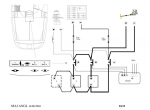
Moving from 1,2,Both switch to VSR

I already said the small solar panel would close the VSR during the day. That's why i suggested, in your case, a low loss splitter.


Not sure why you've slipped back to dual sensing VSRs, even without the small solar panel, i didn't suggest that you fit one. Way back in post #42 i said "Of course, if you have a large deep cycle bank that you charge at high voltages or regularly de-sulphate, it might be a different story. " I've never said a VSR suits all installations and i've certainly never suggested a dual sensing VSR for yours.

The OP specifically asked how to connect his VSR to his boat, fitted with a 1-2-B switch. That was answered way back.
I am simply pointing out the drawback of fitting a VSR so that those on this forum understand the consequences before they install one. It may or may not be an issue to everybody who is considering it but since you don't point this issue out somebody needs to
 
  • Like
Reactions: GHA
Both my Benes had/have 2 positive switches, one for each bank, and a common negative. There is a link on the switched sides of the positives. Both banks will start the engine separately. Engine bank off conserves it. The mains charging system charges both banks whether switched on or off. Whichever bank is switched on gets the alternator charge. The solar goes only to the house bank. In practice I switch both on at all tines, Ive never had a flat starter bank.

At the risk perhaps of stating the obvious, the Beneteau two positive switches function exactly as a 1-2-both switch due to the combining link. I replaced my link with a VSR.
 
You don't seem to grasp, the internal voltage of the faulty battery will be just over 10v, the reading at the battery terminals will be that of the charging source, the two will differ greatly.

<snip>


As i have said, all along, if you are happy to take that risk, to save a few £££s that is your choice.

My choice will be to point out the risk to others, any time i see you advocate what you have.

I have no problems understanding the above.
What I don't grasp is your claim that the healthy battery will be dragged down, despite there being a charging voltage (from the alternator)at its terminals. As already said: Electrons don't flow uphill.

Since this belief seems to be the foundation of your criticism of the split charging system that myself and others are running, it would be nice if you could expand on what you think is happening when this perceived risk plays out. I am open to a good argument.

A VSR is not more £££ than the heavy duty relay I am using, so that remark is way off.
 
I am simply pointing out the drawback of fitting a VSR so that those on this forum understand the consequences before they install one. It may or may not be an issue to everybody who is considering it but since you don't point this issue out somebody needs to

That's untrue, you came into the thread, after the OP was answered and started ranting about VSRs and people insisting you should bin your switch and/or fit a VSR.

My original post gave a schematic for two different systems, related to the OPs installation. I don't need to post a schematic or gice an explanation for every possible system in existence. However, i explained way back in post #42 that there were many options and not all would suit a particular installation, in particular, i mentioned "a large deep cycle bank that you charge at high voltages or regularly de-sulphate "

You have steadfastly ignored everything i have said and continue to post rants about your right to choose. No one has said you cannot choose. Even when i suggested a low loss splitter would work for you, you continued to rant about dual sensing VSRs.

Time to stop digging.
 
I have no problems understanding the above.
What I don't grasp is your claim that the healthy battery will be dragged down, despite there being a charging voltage (from the alternator)at its terminals. As already said: Electrons don't flow uphill.

Since this belief seems to be the foundation of your criticism of the split charging system that myself and others are running, it would be nice if you could expand on what you think is happening when this perceived risk plays out. I am open to a good argument.

A VSR is not more £££ than the heavy duty relay I am using, so that remark is way off.

No major manufacturer builds boats with 1-2-B switches anymore, or fixed relays like yours. Various companies have developed better switching arrangements and a host of split charge systems to suit every possible installation. Commercial vessels, however small, are not fitted with such primitive systems, nor would they be likely to pass coding (my work on commercial vessels has to pass coding and always has passed without issue).

Despite that, you still think your relay is the best option.

"There are none so blind as those that will not see"

No point my flogging this dead horse any longer, the OP has an answer he's happy with, the rest of the World can read the thread and make their own minds up.
 
At the risk perhaps of stating the obvious, the Beneteau two positive switches function exactly as a 1-2-both switch due to the combining link. I replaced my link with a VSR.
Is that true?
Or do the two switches on a Beneteau enable the engine battery to be connected to the starter motor, while the house battery is connected to the domestic loads, but the two systems are not linked. That is fundamentally not what a 1 B 2 switch does, in the typical 80s boat installation.
 
No major manufacturer builds boats with 1-2-B switches anymore, or fixed relays like yours. Various companies have developed better switching arrangements and a host of split charge systems to suit every possible installation. Commercial vessels, however small, are not fitted with such primitive systems, nor would they be likely to pass coding (my work on commercial vessels has to pass coding and always has passed without issue).

Despite that, you still think your relay is the best option.

"There are none so blind as those that will not see"

No point my flogging this dead horse any longer, the OP has an answer he's happy with, the rest of the World can read the thread and make their own minds up.

Seems like arguments begin to ebb away and along comes a dead horse...

No, I don't think my relay is 'the best option', I think it may suit some and therefore might be worth considering.

I will agree with your last statement.
 
One thing a 1-2 Both switch can do in Both mode is to provide power to all boat systems when the 1 or 2 battery is disconnected for recharging ashore, replacement or whatever.

My eber and vhf are both wired directly to a battery. I'd lose power to them in such a situation if not for the Both switch.
 
One thing a 1-2 Both switch can do in Both mode is to provide power to all boat systems when the 1 or 2 battery is disconnected for recharging ashore, replacement or whatever.

My eber and vhf are both wired directly to a battery. I'd lose power to them in such a situation if not for the Both switch.

With separate switches you can still do this James. If you look at the second schematic that i posted #27, turning the emergency combine switch on will allow everything to run from one battery. Ordinarily, in the case of a failed battery etc, you would turn that battery isolator off, but in the case you describe, you'd have to leave it on, but ensure the positive cable from the removed battery was safely insulated.
 
Both my Benes had/have 2 positive switches, one for each bank, and a common negative. There is a link on the switched sides of the positives. Both banks will start the engine separately. Engine bank off conserves it. The mains charging system charges both banks whether switched on or off. Whichever bank is switched on gets the alternator charge. The solar goes only to the house bank. In practice I switch both on at all tines, Ive never had a flat starter bank.

This is rather odd and if you have it right, i don't think it's how Bene turned the boat out. Standard fit for the 381 was a single engine battery, with its own switch and a single domestic battery, also with its own switch. There was a negative switch too, as you say. The mains charger charged both batteries, even if the switches were all off. The alternator only charged the engine battery. So, the batteries each performed separate functions, one for engine circuits, the other for domestics. It should not be possible to start the engine from the domestic bank, without turning the link switch on.

A second domestic battery was option, as was split charging, which was usually a diode pack. There may have been the option for the link switch you describe., but i'd have expected that to be there for emergency starting, rather than to charge the domestics. It's perfectly OK to turn both isolators on, but the link switch should be off.

It is, of course, possible that a previous owner has made changes to the above.
 
At the risk perhaps of stating the obvious, the Beneteau two positive switches function exactly as a 1-2-both switch due to the combining link. I replaced my link with a VSR.

I don't thinks so. Now you have removed the link switch, can you start the engine from the domestic battery ? What boat/age ?
 
I am simply pointing out the drawback of fitting a VSR so that those on this forum understand the consequences before they install one. It may or may not be an issue to everybody who is considering it but since you don't point this issue out somebody needs to
As expected you have had the same patronising treatment, your thick, you dont understand, you even refuse to understand, only 'sir' knows best, great here isnt it.
 
One last try.....

Does require you to consider what i have said, might you do that for a brief moment ? The text in bold are genuine questions.

Firstly, whilst i consider there to be much better systems than those involving 1-2-B switches, i have at no time during this thread told anyone to remove their switch, or said no-one can use them. On the contrary, as i have said several times, i answered the OPs question by typing him up a schematic and posting it here. The OP has chosen to keep the switch, fine by me. The choice to use a VSR was his, see post#1. My schematic reflects the facts that he has a 1-2-B switch and a VSR.

Why do you insist on saying that you are being told that you should not use a 1-2-B switch and you must use a VSR ? Please provide a link to where i have said this ?

As to your use of the switch, you are (again, i've said it before) you are free to use it how ever you want, it's your boat. Consider this though, why do you have separate batteries ?

I'll guess here, it's so you have a backup battery and don't get left with no means of starting the engine. If that's the case, then all of the time you have the switch set to both, you negate that safety feature. Something, however remote, could go wrong and leave you with no power. It's very easy to retain the 1-2-B switch, yet still be able to charge all batteries, risk free, fit a split charge system. Doesn't have to be a VSR, there are several options, the VSR was included in my schematic because that's what the OP has, a low loss splitter is equally appropriate.

I have no axe to grind, i don't sell switches, VSRs or other charging equipment. I design and install systems for all manner of boats, from very simple arrangements to very complex systems with multiple battery banks and multiple charging sources, using whatever equipment is appropriate. I post on here freely and try to give the best and most up to date advice, that may change as time goes by (a few years ago the advice might have been to fit a diode, not any more). You are free to take the advice, or not.

I would appreciate you keeping your word.. 'One last try' that is....

What you have done, is to name call those who use a different none VSR control system, we are' ranters' rather than fellow members expressing a different and legitimate point of view, who, you clearly consider thick, who do not understand, or are purposely frustrating you by insisting that what they have used with great success, over many years and reject your more modern VSR for those very reasons, quite why anyone would waste time doing that I cannot say.
You support your contentions, quite properly, that boat manufacturers do not install 1, 2, BOTH systems, yet in chandlers and the internet there is no shortage of that lovely well made switch for obviously the many adherents of its employment.

Your posts clearly and falsely are based on our supposed preference for the BOTH position being on all the time, it is most certainly NOT, I speak only for myself, but I cannot find anywhere where those using 1, 2, BOTH do that. Hence your question 'why do you have separate batteries'
That question assumes we do not know the answer, it is why we like the certainty of manual selection as and when WE feel it needed and not rely upon a remote, hopefully faultless never let me down, relay.
Your guess re back up batteries is another nonsense again on the assumption the engine battery is not protected by the switch being in position 1 which it is for the vast majority of the time. Using BOTH when the engine running ensures all are charged, but for a limited time to recharge following any starting procedure in 2, then back to 1.

You also quite falsely assume others are less knowledgeable on this rather simple matter, we may well be, but never assume.. ASS-U-ME... doing so makes an ASS out of U and ME.

For the record: The Voltage Sensitive Relay (VSR) allows two batteries to be charged at the same time. When the engine is started and the start battery reaches 13.7 volts, the VSR engages, allowing two battery banks (start and house) to be charged simultaneously. When the voltage drops below 12.8 volts for example.

My preference, and I say again ad-nauseum, I prefer, and apparently so do others, the manual certainty of a disciplined regime of manually controlling what goes on in my two banks of batteries.
Like any other system it does have challenges, the main and only one is it requires a discipline, often considered none PC, it doesn't need a long military career to establish such disciple in order to be habitual when using a manual system, though it does help, just a recognition that you need to be in control, that applies to so much we do as sailors in order to survive, this is just such an area. Making things 'soldier proof' if anyone can break something give it to a soldier, gives me the certainty all is well. I have been accused, not by you I may add, of having a closed mind, a mind is like a parachute, it only works when open... mine didn't fail on some 148 occasions. Change is the only constant to be considered, weighed and acted upon if required, for me a VSR is not.
You may well consider this contribution another rant, I really couldn't give a rip what your next label will be, I stand 100% by everything I have posted.
 
Last edited:
This is rather odd and if you have it right, i don't think it's how Bene turned the boat out. Standard fit for the 381 was a single engine battery, with its own switch and a single domestic battery, also with its own switch. There was a negative switch too, as you say. The mains charger charged both batteries, even if the switches were all off. The alternator only charged the engine battery. So, the batteries each performed separate functions, one for engine circuits, the other for domestics. It should not be possible to start the engine from the domestic bank, without turning the link switch on.

A second domestic battery was option, as was split charging, which was usually a diode pack. There may have been the option for the link switch you describe., but i'd have expected that to be there for emergency starting, rather than to charge the domestics. It's perfectly OK to turn both isolators on, but the link switch should be off.

It is, of course, possible that a previous owner has made changes to the above.

I do not think Beneteau381 mentioned a link-switch, just a link, as per my 331 (see below).

I don't thinks so. Now you have removed the link switch, can you start the engine from the domestic battery ? What boat/age ?

I would now have to use the Cyrix start assist function (or a jump lead) to start from the domestic.
Although I did not purchase my 2004 Beneteau 331 new, the link looks original and is shown in the owners manual. The original fit mains charger has dual outputs wired to each battery. :

1581533508739.png

The Oceanis 381 manual shows a similar link. I expect later Beneteaus might be wired differently. My friends similarly aged Jeanneau does not appear to have a link.


Anyway, this is all incidental and not helping the OP.
 
Brian (aka Halcyon) absolutely depends on electronics - he makes his living from it!

I don't, semi retired now and spend to much time on here, by the way my boatI have a dynastart charging my engine battery, plus an alternator to charge the service battery.

Back in the 70's played with battery charging, saw an article on how to make a bar graph voltmeter for your car. Hit me the bar graph could also drive a relay to connect split charge relay when I wanted it to, also disconnect loads at low voltage to protect the battery. Added multistage mains charger option and supplied them built into switch panels to production boat builders.

But I always tell you what the problems where and why we do what we did, in the end it's always your choice as to what suits you. I have made or modified VSR's to fit to 1, 2, both switches for customers who wanted auto operation, even had one that switched the neg and monitored the pos.

Brian
 
I do not think Beneteau381 mentioned a link-switch, just a link, as per my 331 (see below).

You're right, i misread "link" for "link switch".


I would now have to use the Cyrix start assist function (or a jump lead) to start from the domestic.
Although I did not purchase my 2004 Beneteau 331 new, the link looks original and is shown in the owners manual. The original fit mains charger has dual outputs wired to each battery. :

View attachment 84909

The Oceanis 381 manual shows a similar link. I expect later Beneteaus might be wired differently. My friends similarly aged Jeanneau does not appear to have a link.

Interesting, thanks for taking the time to post it. Bit of an unusual combination, but it would, as you say, work like a 1-2-B switch. My last boat was a Jeanneau and also didn't have the link, the original owner had opted for the second battery and split charging options. I linked the negative cables and used the black switch as an emergency switch.


Anyway, this is all incidental and not helping the OP.

Indeed, at least it's a civil discussion ;)
 
Last edited:
Top