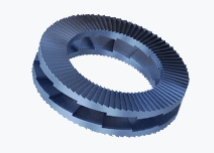
Most effective locking washer?

I actually thought half inch bolts had been consigned to oblivion decades ago, except in, decimalised, Australia where we can buy spanking new (why spanking) imperial bolts over the counter without question and with ease.

But to avoid accusations of thread drift, or nit picking, what is the recommendation - where the bolts are too short for an extra half nut. I'm now wondering about 6 brackets with 2 bolts each and all 12 bolts (not now) secured with spring washers. I had already wondered about security and thought I'd change to Nyloc nuts. :(

Jonathan
 
I actually thought half inch bolts had been consigned to oblivion decades ago, except in, decimalised, Australia where we can buy spanking new (why spanking) imperial bolts over the counter without question and with ease.

But to avoid accusations of thread drift, or nit picking, what is the recommendation - where the bolts are too short for an extra half nut.

Jonathan

We may be EU land here and metric even during Soviet time ... but local nut and bolt shop do UNF / BSW and Metric as example .... in Galv, black iron and ST Steel.
 
I actually thought half inch bolts had been consigned to oblivion decades ago, except in, decimalised, Australia where we can buy spanking new (why spanking) imperial bolts over the counter without question and with ease.

But to avoid accusations of thread drift, or nit picking, what is the recommendation - where the bolts are too short for an extra half nut. I'm now wondering about 6 brackets with 2 bolts each and all 12 bolts (not now) secured with spring washers. I had already wondered about security and thought I'd change to Nyloc nuts. :(

Jonathan
Why will these nuts come undone?
I used to have a 1960 Triumph motorbike.
Vibration, thermal cycling, poor design.
Only a few fasteners on that were prone to loosening.

Perhaps one of the key things is that fine threads were used for a lot of it?
Imperial (american!) nuts and bolts are widely available in UNF as well as UNC.

For some purposes, serrated flange nuts are very good.
Sometimes tapping the hole in the fixed part and avoiding the nut question entirely works.
Loctite usually works.
If the engine designer has specified something like a Schorr washer, they've probably done that for good reason.

Doing it up properly with a torque wrench may also help?

I put my prop nut on with a spring washer, loctite and a locking grub screw bearing on the flat of the nut.
I was still relieved when it didn't fall off.
 
There's only one thing which will never, ever come undone, that's a corroded bolt on a French car.
And a Volvo engine bolt that's sat in a damp, salty engine compartment for 15 years. Exception made for mounting adjustments that will sit for years, then "adjust" themselves for no apparent reason when you aren't looking.
 
I normally refer people to this document: https://ntrs.nasa.gov/api/citations/19900009424/downloads/19900009424.pdf
It's the NASA fastener design manual, which covers various techniques for locking fasteners and why they do or do not work.

The typical helical spring washer is made of slightly trapezoidal wire formed into a helix of one coil so that the free height is approximately twice the thickness of the washer cross section. They are usually made of hardened carbon steel, but they are also available in aluminum, silicon, bronze, phosphor-bronze, stainless steel, and K-Monel. The lock washer serves as a spring while the bolt is being tightened. However, the washer is normally flat by the time the bolt is fully torqued. At this time it is equivalent to a solid flat washer, and its locking ability is non existent. In summary, a Iock washer of this type is useless for locking.
 
Spring washers actually work by keeping some tension on the bolt if movement occurs.
That tension creates friction in the threads and hence the nut has some resistance to turning.
So they are appropriate for a situation where movement might occur due to say thermal change, and a bolt/flat washer/nut combo would go slack, meaning there is little friction to stop vibration undoing the nut.
Millions of nuts and spring washers are out there working.

In other assemblies, the bolt is long enough to be under spring tension, so the nut isn't loose even if things shrink a little.
If the bolt is not under tension, then metal/metal friction between nut and bolt won't resist much vibration, so find another solution.
I don't think there is one solution for every situation.
If you've worked on cars or motorbikes or bicycles even, you get an idea of what works where, which may guide your choice.

Bolting a shelf in my garage is a different problem to bolting a mudguard onto a trailer, where there will be vibration. I'd probably use spring washers and nylocs for the latter. I'd use a second locknut for something where I didn't want the joint too tight, like the pivot of a pair of shears.
When in doubt, I use loctite. As well as resisting un-doing, it resists corrosion.

Sometimes a pop rivet is a better answer. Or glue.....
 
This thread reminds me, a bit, of some advice from an old boatbuilder trying to run a busines for profit:

"Nail where you can, screw where you must!"

;)
 
Most effective lock washer is a proper tab washer being a positive lock with a internal tab inside the washer the fit in a slot in the bolt

and not just a friction lock like spring /star washere or even nylock nuts.

There used to be an arotite lock nut for aircraft due to the possibility of nylock nuts melting in a fire

The most positive lock is a castle or slotted nut with a split pin through the bolt the will not undo even if the bolt od loose

Spring washers do lock and help loosening by the sharp corner on the top / bottom split digging into the nut and base material This still does not lock the nut to the bolt
 
Another, botcher's, way of locking a nut is to saw half-way through the bolt or stud, flush with the top of the nut, then knock it over to close the saw cut.
 
the simple answer is if you can do it then safety wire is used in aviation where something cannot come loose for likely catastrophic reasons. i like serrated washers as they can be renewed but if my life depended on it then safety wire is the way to go.
 
Top