Modern gadgets

I had to consult my wife, she pre-dates me with wizardry and had an abacus. My slide rule is quite new compared to her device.

We still have both.

Josephine and Jonathan. :)
I was wondering whether to mention my slide rule given me by my father, but you have trumped me. Mind you I have never used the slide rule to calculate my course.
 
But you could use the slide rule - if your mental arithmetic is poor (becoming more common) it allows you to divide length of passage by speed to give hours - but that's all I can think of.

I vaguely recall devices similar to a slide rule were used for air navigation - but I might be making that up.

Jonathan
 
A friend bought a second-hand non-portable satellite navigator of some sort (mid/late 1980s?) off a chum of his who'd bought it for a transatlantic and then wrecked his boat.

I recall us crossing the Thames Estuary with it, anxiously repeatedly re-checking it while it spent about 25 minutes trying to calculate where we had been at the beginning of that time. For at least 90% of its attempts, at the end of the 25 minutes it would declare there weren't enough satellites to calculate a position.

I think the first time we got a position was when we were tied up in Brighton Marina, and had stopped checking it. When we did eventually notice it had a position, we were able to marvel at its accuracy! ?

At least it kept us fit, though, running up and down the companionway steps to see how it was getting on.
 
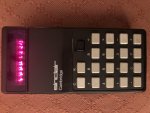
Grief, the Sinclair calculator. Tiny in a little while box. Was a serious amount of money, at the time.
Now you could run a lunar module on £10 calculator from Tesco.

But how much was the first mobile phone you purchased.? 1983 was more than a grand and Securicor delivered the SIM.
 
But you could use the slide rule - if your mental arithmetic is poor (becoming more common) it allows you to divide length of passage by speed to give hours - but that's all I can think of.

I vaguely recall devices similar to a slide rule were used for air navigation - but I might be making that up.

Jonathan
Many cunning devices were used by air navigators in WW2 - some of them got them to targets, a few even got them home.

I am good at mental arithmetic and use simple mathematics in the day job. I however remember when my mate and my dear navigator both did their day skipper theory and then carefully calculated a course to allow for tidal offset and informed me of the course as we crossed the bar they both got their tickets). To their advice I replied that I was already doing within one degree of that course and further explained that I just aim between the two islands as I had done for 25 years, get swept up to starboard off the outer one, and theres Cardiff.

Of course my come uppance was being unable to see the mass of lights with red above as a dredger, not an obscure over illuminated fishing vessel until it was 3 cables away and thus needing to make hasty course correction when I realised it would not pass to port because it was effectively immobile.
 
My father was an observer in the Fleet Air Arm. He had a "course calculator" which I played with as a child. From memory it was purely mechanical with a rotating dial to set wind speed and a larger one to set course to the target with sliders to set air speed and wind speed. It then pointed to the course to steer. He did spend much of the war in Swordfish which, even by the standards of the day, were slow. I think stall speed was about 45 knots.
 
But you could use the slide rule - if your mental arithmetic is poor (becoming more common) it allows you to divide length of passage by speed to give hours - but that's all I can think of.

I vaguely recall devices similar to a slide rule were used for air navigation - but I might be making that up.

Jonathan
I have one of them, somewhere
 
And instead of mobile phones we used Telex (with the message as perforated paper tape) and cables. If you wanted to speak to someone at the other end of the world in some places you had to book the telephone call.

Jonathan
 
When I bought my current boat she came with an inboard engine. Never having dealt with such new fangled nonsense I discussed removing it and making do with the quant. Everyone I spoke with told me I was daft.
I must have been daft..... :)
 
I bought a 6" ex RAF grid compass from a WD surplus store in 196? - Then the Seafarer Mk1 - a 2nd hand (?) A Walker log I still have - A Nova Tech RDF which I had for 10 years which was superseded by the first cheapie Decca Navigator in the 1980se out - I also bought the first Autohelm and was a true supporter of all NASA kit

.resource.jpeglog.jpgnovatech-.jpg
 
Grief, the Sinclair calculator. Tiny in a little while box. Was a serious amount of money, at the time.
Now you could run a lunar module on £10 calculator from Tesco.

But how much was the first mobile phone you purchased.? 1983 was more than a grand and Securicor delivered the SIM.
Here’s mine. Still works. Bought in 1972 I think so 49 years old.
index.php
 

Attachments

  • 76E67E98-B31C-401A-A73B-F6992DB832A9.jpeg
    76E67E98-B31C-401A-A73B-F6992DB832A9.jpeg
    364.6 KB · Views: 98
Overlooked my slide rule. One of the few things that my father bought me. He died when I was in my 20's and our relationship was not the easiest.

The slide rule got used through uni and my first job as a chemist in a paint works.
There are the odd tools that are sentimentally connected to him in the tool box.
 
A friend bought a second-hand non-portable satellite navigator of some sort (mid/late 1980s?) off a chum of his who'd bought it for a transatlantic and then wrecked his boat.

I recall us crossing the Thames Estuary with it, anxiously repeatedly re-checking it while it spent about 25 minutes trying to calculate where we had been at the beginning of that time. For at least 90% of its attempts, at the end of the 25 minutes it would declare there weren't enough satellites to calculate a position.

I think the first time we got a position was when we were tied up in Brighton Marina, and had stopped checking it. When we did eventually notice it had a position, we were able to marvel at its accuracy! ?

At least it kept us fit, though, running up and down the companionway steps to see how it was getting on.
I think, from memory, that there was a sytem around at that time called 'Satnav', a term that has been re-used to describe GPS, which is entirely different, and actually works. So far as I remember, it was an expensive gadget, and not something that ordinary cruisling yachtsmen aspired to. Decca was then the thing for coastal and local offshore sailing. That too took about twenty minutes to find itself. My Navstart set had a very good aphanumeric key system and would even calculate tidal offsets for you but its accuracy varied from excellent to useless, as at Beach Head.

A favoured gadget was the Ventimeter, which would tell you if your hat was likely to blow off.
 
I bought a Navstar 2000 satnav for my parents at the Southampton Boat Show in 1988 - it cost GBP 500 then which everybody thought was very reasonable, compared to what else was on the market.
And it was accurate! To a mile or two at the best.
And it would get fixes often - like every 20 minutes or half hour if it was in a good mood.
We were bowled over by it - thought it was amazing.
Navstar also produced a 2000 Decca as well, and I remember using one of these on a boat racing in Cowes Week, and marvelling at how I could just punch in the waypoint for the next mark, and the Decca would give me a course to steer for it.

Re the satnav, my folks were visiting England then, and they were able to claim the VAT back when they flew back home from Gatwick - which made it seem even more of a good bargain at the time.

Now of course you can buy very accurate GPS units for a fraction of what that Navstar cost (in today's money the satnav would probably be about GBP 1,500?)

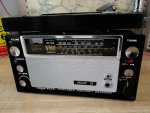
Prior to acquiring this impressive navigation instrument, we used to navigate around the Eastern Caribbean with nothing more than a compass with outrageous deviations, and a transistor radio for direction finding (even a simple tranny would develop a good 'null' signal, and was pretty accurate).
Oh, and when sailing back to Barbados from the Grenadines, against the wind, 100 miles beating to windward, the best way of navigating was to keep an eye out for the LIAT aeroplanes - if they were still heading east we knew that Barbados still lay ahead somewhere.
Hence why the Navstar satnav became such an amazing and treasured part of our navigation equipment.
 
I don't think this counts but we have the jackstaff off a decommissioned Oz destroyer (and, unexpectedly, still use it - but as a flagpole - its very Australian to fly a flag on various occasions - we invested in a very big flag). The flagpole also acts as a lightening conductor as part of the original build (before our time).

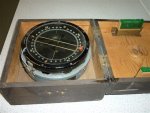
In keeping with recycling 'mechanical' devices - also from a destroyer, UK, we have the oil damped bridge compass - unsurprisingly - it still works as intended though being under a glass coffee table does not move very far (and the gimbals are not used). I had intended installing it into our saloon table on our cat - but never had the heart (and maybe lacked the confidence) to cut the hole in the table.

Jonathan
 
Prior to acquiring this impressive navigation instrument, we used to navigate around the Eastern Caribbean with nothing more than a compass with outrageous deviations, and a transistor radio for direction finding (even a simple tranny would develop a good 'null' signal, and was pretty accurate).
Oh, and when sailing back to Barbados from the Grenadines, against the wind, 100 miles beating to windward, the best way of navigating was to keep an eye out for the LIAT aeroplanes - if they were still heading east we knew that Barbados still lay ahead somewhere.
Hence why the Navstar satnav became such an amazing and treasured part of our navigation equipment.

We were travelling in China in the early 80's. At the time the Chinese airforce had established some form of 'commercial' airline. We were flying from Beijing to Suzhou, but actually landed in Wuxi. I asked the 'hostess' (who served the tea from a gas fired boiler at the back of the plane) why we seemed to be wandering all over the sky. Treating me like a complete idiot she told me that the pilot was following the river.

How things have changed.

Jonathan
 
Top