

You are using an out of date browser. It may not display this or other websites correctly.
You should upgrade or use an alternative browser.
You should upgrade or use an alternative browser.
Mineral Engine Oil -again - sorry
- Thread starter Ian_Edwards
- Start date

vyv_cox
Well-Known Member
I used to buy from Morris Oils. As you say based in Shrewsbury but depots in many places. A 5 gallon drum, two fills for my BMC 2.5 litre engine, was free delivery and very reasonably priced.Morris oils in Shrewsbury near me produce mineral oils of various viscosity suitable for simple marine diesel engines. Available at chandler's around here.

AntarcticPilot
Well-Known Member
Can I reiterate that Tesco's cheapest in-store engine oil is both mineral and to a specification suitable for most older diesels? I forget exactly what it's rating is, but I think it's one level up from the (no longer available) oil rating recommended for Volvo 200x engines.

Skylark
Well-Known Member
I have a Yanmar 3JHE and the recommended oil is 15W40 to API CI-4.
I also reckon that Yanmar knows a thing or two about their engines so I’m happy to follow their recommendation.
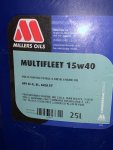
25 litres of Millers represents reasonable value for money.
I also reckon that Yanmar knows a thing or two about their engines so I’m happy to follow their recommendation.
25 litres of Millers represents reasonable value for money.

Spirit (of Glenans)
Well-Known Member
Synthetics are meant for modern high performance diesel engines powering road vehicles. Most boat engines are based on simple industrial engines not of recent vintage.Why not synthetics or semi-synthetics? There is nothing in the Yanmar spec that suggests that. Any good oil will exceed CF, which is somewhat obsolete.
An obvious old school choice would be Rottela T4.
Google API and SAE classifications. For even more confusion (bluring the synthetic-conventional line), read up on base oil groups. Nearly all conventional engine oils are a mix of group II and group III oils, and both of these blur the line between conventional and synthetic in terms of chemistry and performance. https://www.machinerylubrication.com/Read/29113/base-oil-groups
ENGINE OIL
Engine Oil Specifications
Using engine oil that does not meet or
exceed the following guidelines or
specifications may cause seizure of parts,
abnormal wear and shorten engine life.
Service Categories
Use an engine oil that meets or exceeds
the following guidelines and classifications:
• API Service Categories CD, CF, CF-4,
CI and CI-4.
• SAE Viscosity: 10W-30, 15W-40. Engine
oil 10W-30 and 15W-40 can be used
throughout the year.
NOTICE
• Be sure the engine oil, engine oil storage
containers and engine oil filling
equipment are free of sediment or water.
• Change the engine oil after the first 50
hours of operation and then at every 250
hours thereafter.
• Select the oil viscosity based on the
ambient temperature where the engine
is being operated. See the SAE Service
Grade Viscosity Chart (Figure 5).
• Yanmar does not recommend the use of oil additives.
Spirit (of Glenans)
Well-Known Member
The place to buy oil is not at a garage or a supermarket, but at a motor factors, or preferably at a specialist oil vendor.I'm finding it increasingly difficult to find mineral oil for my Yanmar 4JH4E.
My local garage only stocks synthetic oils or semi synthetic, as does my local super market.
Yanmar say 15W40 API CI-4 CF-4
Yanmar branded oil is now £50+ for 5L
I need 6L for and oil change.
I've found a supply of Comma 15W40 , says "API SL CF CG-4" on the label, is that suitable for my Yanmar?
I've tried googling API SL CF CG-4, but can't find anything that makes sense to me.
jwfrary
Well-Known Member
Like you went through this back in February for my Yanmar 4JH2-E.
Have a look at Shell Rimula R4 X 15W-40.
I ordered a 20Lt drum from www.opieoils.co.uk back in February which came with free delivery. Cost then was £80.95 with a 10% discount. There are quite a few recommendations for Opie Oils from other "oil" threads on this forum.
This drum should last me 3-4 years and works out somewhat cheaper than the 5 Lt can.
Theres a wide range of shell products, specifically for heavy duty and marine. There's also a pretty extensive network of agents for it.
This stuffs favored by fishing fleets and I have been using it exclusively for a decade.

Refueler
Well-Known Member
Oh Dear ...
FOLLOWING IS MY OPINION ......
Being in the 'biz' - Comma oil and similar cheap is often a mix of recycled and virgin + additives to get visco etc. to required levels.
Its fine to use - but I would not exceed oil change routines with it ...
Do I use such ? No.
OK - Mineral vs Semi vs Synthetic .....
For general use - Semi is fine ... no need to spend fortune in the car travelling to find Mineral ...
I'm in the 'biz' - but when I buy Lub oil for my Volvo XC70 ... my Renault Master Van ... my Generators ... Lawn Tractors .... boat engines ............. I choose based on 10-40W ... or whatever W rating needed ... and even in my old Perkins 4-107 ... its generally 10-40W Semi Synthetic ... and its been fine for nigh on 20 yrs with me ...
I will not buy high priced branded oils ................ yes they do have additions to make more long term stable etc. - but for most boaters ?? Middle priced is good enough ... cheap oil as a top up !!
FOLLOWING IS MY OPINION ......
Being in the 'biz' - Comma oil and similar cheap is often a mix of recycled and virgin + additives to get visco etc. to required levels.
Its fine to use - but I would not exceed oil change routines with it ...
Do I use such ? No.
OK - Mineral vs Semi vs Synthetic .....
For general use - Semi is fine ... no need to spend fortune in the car travelling to find Mineral ...
I'm in the 'biz' - but when I buy Lub oil for my Volvo XC70 ... my Renault Master Van ... my Generators ... Lawn Tractors .... boat engines ............. I choose based on 10-40W ... or whatever W rating needed ... and even in my old Perkins 4-107 ... its generally 10-40W Semi Synthetic ... and its been fine for nigh on 20 yrs with me ...
I will not buy high priced branded oils ................ yes they do have additions to make more long term stable etc. - but for most boaters ?? Middle priced is good enough ... cheap oil as a top up !!
dankilb
Well-Known Member
Yeah I’m definitely not in the ‘bargain bin’ oil for the boat camp. I wonder if this stems from advice to use lower-spec mineral oil to avoid glazing - which is valid - but doesn’t necessarily imply ‘any’ and/or ‘the cheapest’ is best either.
I’m conscious of the value of our low hour Beta and wanting to give it the most love I can! That’s why I prefer the idea of Millers (or Rotella or any other similar fleet/commercial grade mineral oil) lubricating the valve assembly and other components.
These oils are designed with the aim to prolong the life of engines and reduce maintenance. The cheapest supermarket oil is only designed with the aim of being the cheapest.
I’m conscious of the value of our low hour Beta and wanting to give it the most love I can! That’s why I prefer the idea of Millers (or Rotella or any other similar fleet/commercial grade mineral oil) lubricating the valve assembly and other components.
These oils are designed with the aim to prolong the life of engines and reduce maintenance. The cheapest supermarket oil is only designed with the aim of being the cheapest.

Poignard
Well-Known Member
I have a BUKH DV10ME engine which is now 40 years old. It starts easily and doesn't burn oil.
A few years ago I emailed the technical department at Duckhams to ask which of their oils they would recommend for this engine. The reply was:
"Reading the viscosity / temperature specification and having consulted our Technical Lead, we are confident that our recently introduced Duckhams Classic Q10W-40 would be an excellent choice for your engine."
I also sent the same enquiry to Castrol and they replied:
"I would suggest ideally a fairly basic 15W-30 would be ideal – Castrol Agri MP 15W-30, or you could use a straight SAE 30 - Classic XL30 ( Castrol Classic Oils – 01954 231668 should be able to supply )"
A few years ago I emailed the technical department at Duckhams to ask which of their oils they would recommend for this engine. The reply was:
"Reading the viscosity / temperature specification and having consulted our Technical Lead, we are confident that our recently introduced Duckhams Classic Q10W-40 would be an excellent choice for your engine."
I also sent the same enquiry to Castrol and they replied:
"I would suggest ideally a fairly basic 15W-30 would be ideal – Castrol Agri MP 15W-30, or you could use a straight SAE 30 - Classic XL30 ( Castrol Classic Oils – 01954 231668 should be able to supply )"
gordmac
Well-Known Member
When I bought my previous boat, two na Ford d6 engines, I used oil I got from a local supplier, a known brand. The port engine in particular leaked a bit and used a bit. I changed to the recommended Millers oil (I used them in vehicles), the leaks and usage went to near enough zero. Not all oils are the same even if they meet the same specs.
PetiteFleur
Well-Known Member
I've used COMMA mineral oil in my Beta 25 for years now - bought from my local car factor.
Refueler
Well-Known Member
I've used COMMA mineral oil in my Beta 25 for years now - bought from my local car factor.
Do you change at recc'd hours or more frequently ?
Of course it meets spec designed for - but its when you want to over-run the hours or usage that its 'quality' then shows its limitations.

thinwater
Well-Known Member
Synthetics are meant for modern high performance diesel engines powering road vehicles. Most boat engines are based on simple industrial engines not of recent vintage.
It does not say that in the manual. It said "meets or exceeds." Does Yanmar say that somewhere?
Is the concern leaks (synthetics can remove old sludge) or something else?
If you get down to it, you won't find a multi-vis without group II base stock as a blending agent, and that actually makes it a semi-synthetic in all practical ways. Just sayin'.

emmalina
Well-Known Member
Changing oil types in older engines sometimes upsets them ..
Last edited:
dankilb
Well-Known Member
Synthetic can itself form nasty ‘varnish’ and sludge if run at low revs or short runs over the life of an engine. I know this is a high performance petrol - but check out this clip (a minute or so from 6:03 in):It does not say that in the manual. It said "meets or exceeds." Does Yanmar say that somewhere?
Is the concern leaks (synthetics can remove old sludge) or something else?
If you get down to it, you won't find a multi-vis without group II base stock as a blending agent, and that actually makes it a semi-synthetic in all practical ways. Just sayin'.
Tranona
Well-Known Member
Not sure why people with small yacht engines get obsessed with oil when the demands on it are so modest. The typical yacht engine does 100-150 hours a yea and spends most of the year idle for long periods. My car averages 26 miles an hour, so 150 hours is equivalent to 3900 road miles. My car has a 3 cylinder 1l engine boosted to 128hp, rather more demanding than my 1.2l 3 cylinder Beta which produces a maximum of 29hp, but normally only runs at half that. So the "change every year" which is common is very conservative - and yacht engines, even if neglected rarely wear out.Do you change at recc'd hours or more frequently ?
Of course it meets spec designed for - but its when you want to over-run the hours or usage that its 'quality' then shows its limitations.
Different if you are operating commercially. When I had my boat on charter it averaged 450-500 hours a year and the oil and filter were typically changed 3 times a year. When I sold it at 3500 hours it was running as well as it did new.
Much more important to look after the cooling system and run the engine hard from time to time than fret about the spec of the oil.
dankilb
Well-Known Member
Absolutely agree. But, I still wouldn’t use either supermarket/‘bargain’ mineral nor synthetic. The former for the sake of a few quid. The latter because it’s the wrong thing, for ours, according to Beta…Not sure why people with small yacht engines get obsessed with oil when the demands on it are so modest. The typical yacht engine does 100-150 hours a yea and spends most of the year idle for long periods. My car averages 26 miles an hour, so 150 hours is equivalent to 3900 road miles. My car has a 3 cylinder 1l engine boosted to 128hp, rather more demanding than my 1.2l 3 cylinder Beta which produces a maximum of 29hp, but normally only runs at half that. So the "change every year" which is common is very conservative - and yacht engines, even if neglected rarely wear out.
Different if you are operating commercially. When I had my boat on charter it averaged 450-500 hours a year and the oil and filter were typically changed 3 times a year. When I sold it at 3500 hours it was running as well as it did new.
Much more important to look after the cooling system and run the engine hard from time to time than fret about the spec of the oil.

Porthandbuoy
Well-Known Member
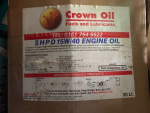
I'm using Crown Oil 15/40 in my Yanmar 4JH3E. It's API CI-4, so superior and backwards compatible with the CD recommended when my engine was first produced.
penberth3
Well-Known Member
I'm in the 'biz' - but when I buy Lub oil for my Volvo XC70 ... my Renault Master Van ... my Generators ... Lawn Tractors .... boat engines ............. I choose based on 10-40W ... or whatever W rating needed ... and even in my old Perkins 4-107 ... its generally 10-40W Semi Synthetic ... and its been fine for nigh on 20 yrs with me ...
You're in the Biz, but you've got your "W's" in the wrong place!