
Mast Truss

MagicalArmchair

Well-Known Member
Joined
11 Jan 2013
Messages
1,540
Location
Kings Hill, Chatham Marina
Visit site
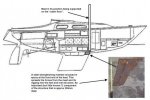
The mast truss on my 1971 Albin Ballad, Triola is made from mild steel encapsulated in resin in a well at the front of the keel.
Untitled.jpg

There have been cases in other Ballads where water has penetrated to the steel, the steel has started to rust, rust expands and slowly splits the front edge of the keel letting more water seep in, allowing more rust to form, and pretty soon you are knee deep in water. I hasten to add, my mast step shows no sign of rust or splitting or any of that jazz, however, I would feel more comfortable replacing it. Mild steel in a salt water environment was never a clever idea, but that said, it has gone for forty plus years and still shows no sign of weakness or failure.

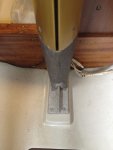
My mast step now:
2ZiFQ1pl.jpg

So, a solution for a replacement. Cut out the saloon sole and remove the offending steel, then, to replace it:

Either, a stainless steel augmented version based around Bobs design below:

14935285518_cf984b8794_o.jpg


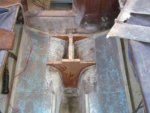
Or a composite step made of hardwood and glass fibre
Untitled2.jpg

One final note, my late father was an awesome shipwright. I can hear his voice in my head telling me to not worry about it and just go flipping sailing - there are no signs of stress or failure, so why look for trouble where there is none? Happy for your thoughts around that final point too - do I leave it alone??

Check out Bobs (a fellow Ballad enthusiast) post here for his experience so far: http://balladklubben.se/balladexchange/viewtopic.php?f=8&t=3495
 
A tough question Mark, and that voice in your head is probably right to advise you get out and sail the thing.

However, looking at picture 3 it seems you have the area exposed and more space and access than you ever have again.
Yes it has been there for 40 years and looks fine. But with access it's very tempting and who in their right would put cast iron in a confined space knowing it will expand and cause major damage?

The deciding question for me would be am I going to keep her long term or do I plan to put her on the market?

I suspect if was planning to keep her I'd fix it before it became a major problem. However I would not even consider timber no mater what sort, fact is if it gets wet it will still fail. I would go a solid lump of stainless steel.

Good luck and fair winds. :)
 
However, looking at picture 3 it seems you have the area exposed and more space and access than you ever have again.

I don't think that's his boat. I think it's one of the possible repair options, photographed on someone else's.

I think in the OP's position I would do nothing for now except monitor very carefully. Unless there is some reason why it will be easier to fix now than later (already undergoing a major refit, have decent facilities now but will be going away, planning to coppercoat the bottom and don't want to rip it apart again, etc). If it's no harder to fix when the problem becomes apparent, why not wait until it does, if it does?

Pete
 
I don't think that's his boat. I think it's one of the possible repair options, photographed on someone else's.

I think in the OP's position I would do nothing for now except monitor very carefully. Unless there is some reason why it will be easier to fix now than later (already undergoing a major refit, have decent facilities now but will be going away, planning to coppercoat the bottom and don't want to rip it apart again, etc). If it's no harder to fix when the problem becomes apparent, why not wait until it does, if it does?

Pete

Hi Pete,
Thanks for clarifying that and given the circumstances I go along with your suggestion.

Good luck and fair winds. :)
 
That's right, they are photos from others experiences of digging out their mast foots (feet??).

Thanks all, I will quit worrying and frowning at my mast foot and get on with enjoying my amazing boat and just keep a weather eye on it in the same way I do the rest of my kit.
 
So as she is out of the water, so I thought I'd try and find a way to inspect the mast foot - I managed to get an endoscope (and actually my iPhone) over the top of the bulkhead just aft of the truss - to find the following:

tNdAunul.jpg


Rather rudimentary probing with a screwdriver below recorded with the endoscope:


This lump of mild steel rust is all that's keeping the mast up - I have sprayed a whole load of epoxy rust treatment in there and will give it a proper scrape out (well, best I can through the tiny access hole) and then take another look - my feeling is it needs to come out :(.
 
Interesting problem you have there MagicalA. All I have at the mast foot is a lump of wood, I guess one day it will collapse.

It does look like you need to act. It might be possible to do a bit of keyhole surgery and only remove the GRP upstand on the floor - a shame to destroy the look of that floor - and dig out the remains of the steel in the resin. You could then build it up with hardwood and resin, making sure there was a conduit for water.

I personally would not put any metal back in there.
 
Unfortunately I need to get all that mild steel out otherwise it stands a chance of rusting, expanding, and splitting the front edge of the keel - hence surgery on the cabin sole will be required. I was thinking about going for some 'teak' solution, like Tek Deck, to hide the sole repair after the truss replacement.
 
That has gotta get fixed before you go sailing again, that is my opinion. You are going to fix it anyway, I hope.

The risk of having a mayor failure at sea and all the additional costs involved make it a no brainer as a decision.

As to the repair method, well the original lasted how long? It would be a simple job to fabricate in mild steel. Cost a bit more in stainless I suppose
 
Unfortunately ... I was thinking about going for some 'teak' solution, like Tek Deck, to hide the sole repair after the truss replacement.


Yes, with this sort of stuff if you can't preserve the original it is often better to engineer a contrast.

Are you going to sail this season, are you in the water? A matter of nice judgement.
 
I do hope to sail this season once my many jobs are complete! She is out of the water at the moment and the fine folk at Chatham marina can drop the rig at a good price. The truss has broken Ballads before, and I owe it to the boat to prevent that happening (and more importantly for the safety of my family who come sailing with me).

TQA, the original truss lasted 40 years give or take, so it did do a good job (even if putting mild steel in the bilges was a questionable call by Albin Marin)! I think my problem started just before I bought her - she had standing rain water in her bilges for some years when she was not used (judging by the water damage to the woodwork I repaired when I got the boat) and that likely got at the truss.

I am getting a stainless replacement priced up. I wouldn't mind looking at engineering plastics, Acetal has similar characteristics to stainless steel and wouldn't suffer any of the potential corrosion metal would. I am not keen to put any form of wood down there, encapsulated in fibreglass and epoxy or not, I would always be worried that water would get to it (even if that was in another 40 years!).
 
I've had a stainless truss priced up, however, after a bit of thinking and research, a stainless truss beneath an aluminium mast and mast foot seems like an exceedingly bad idea as the stainless stands a good chance of 'eating' the mast foot.

So, make the truss in aluminium? However that has its own challenges, as the truss lives in the bilges, you stand the chance of crevice corrosion when it gets wet. So sheath the aluminium in epoxy resin? It can no longer produce its oxidised protective layer, however, it will be protected by the epoxy instead... apart from where the bolts pass through the aluminium thread, and there I will seal up with lots of Sikaflex.

So, in summary,

  • Stainless = Bad as dissimilar metals.
  • Wood & Epoxy composite = Bad as if water penetrates to the wood, it will fail rapidly.
  • Aluminium & epoxy = Best approach?

43CeslVm.jpg


6Kdo3jgm.jpg


See another ballad owners mdf mock up of the new truss design below - they have already removed their truss, I am awaiting my rig to be dropped.

1J7SweKm.jpg


Am I missing any options or are any of my assumptions flawed?
 
I've had a stainless truss priced up, however, after a bit of thinking and research, a stainless truss beneath an aluminium mast and mast foot seems like an exceedingly bad idea as the stainless stands a good chance of 'eating' the mast foot.

See another ballad owners mdf mock up of the new truss design below - they have already removed their truss, I am awaiting my rig to be dropped.


1J7SweKm.jpg


Am I missing any options or are any of my assumptions flawed?

You can isolate the dissimilar metals, using plastic plate / bushings / washers or duralac.

Will you normally have water standing in this area?
 
My bilges stay pretty dry, however my problem happened before my ownership when the boat was left to stand for a number of years with rainwater in her coming up over the saloon sole. Now, in my ownership where Triola is generally loved, mollycoddled and otherwise well looked after, she will never or rarely have any water in there, however, I'd like to put something in that will last at least another forty years so any future owner doesn't have to tussle with their truss as I am having to.

The mast truss DOES have a GRP cap on it that looks like the below:

2ZiFQ1pm.jpg


So perhaps stainless steel is an option - the original was mild steel after all and that didn't eat the bottom of the mast. My worry is the bolts holding the foot in place - presumably these would be SS, so SS bolts through aluminium - I suppose that's where Duralac would come in? So perhaps SS sheathed in epoxy?
 
I've had a stainless truss priced up, however, after a bit of thinking and research, a stainless truss beneath an aluminium mast and mast foot seems like an exceedingly bad idea as the stainless stands a good chance of 'eating' the mast foot.

So, make the truss in aluminium? However that has its own challenges, as the truss lives in the bilges, you stand the chance of crevice corrosion when it gets wet. So sheath the aluminium in epoxy resin? It can no longer produce its oxidised protective layer, however, it will be protected by the epoxy instead... apart from where the bolts pass through the aluminium thread, and there I will seal up with lots of Sikaflex.

So, in summary,

  • Stainless = Bad as dissimilar metals.
  • Wood & Epoxy composite = Bad as if water penetrates to the wood, it will fail rapidly.
  • Aluminium & epoxy = Best approach?

43CeslVm.jpg


6Kdo3jgm.jpg


See another ballad owners mdf mock up of the new truss design below - they have already removed their truss, I am awaiting my rig to be dropped.

1J7SweKm.jpg


Am I missing any options or are any of my assumptions flawed?
Is there any need to for the mast step to be removable?
Like a keelbolt underneath? If not then just laminate a hardwood floor accross the bilge with a thick layup and it'll do the job perfectly and cheaply.That location is just begging for it.
 
Is there any need to for the mast step to be removable?
Like a keelbolt underneath? If not then just laminate a hardwood floor accross the bilge with a thick layup and it'll do the job perfectly and cheaply.That location is just begging for it.

Nope, there is no requirement to get underneath there at all. I did seriously consider it, however I dislike the idea of wood as the truss - if water found its way in, it'd be curtains for the mast... Although if I layed up the fibreglass thick with Epoxy and used something like oak or even better, teak...

I still don't like the idea that a small amount of water penetrating into the truss could ultimately cause complete rig failure through failure of the truss and then the foot. Saying that, another Ballad owner did do something similar as below:

lf4iXZJl.png


Do we think wood is going to be the best solution? I'm still leaning towards SS...
 
Nope, there is no requirement to get underneath there at all. I did seriously consider it, however I dislike the idea of wood as the truss - if water found its way in, it'd be curtains for the mast... Although if I layed up the fibreglass thick with Epoxy and used something like oak or even better, teak...

I still don't like the idea that a small amount of water penetrating into the truss could ultimately cause complete rig failure through failure of the truss and then the foot. Saying that, another Ballad owner did do something similar as below:

lf4iXZJl.png


Do we think wood is going to be the best solution? I'm still leaning towards SS...
I think your fears are unfounded.Most boats have wooden floors laminated in with polyester and water doesn't penetrate the structure.If you thorougly prepare the surface and use epoxy the chances of water ever getting past are nill.
 
however I dislike the idea of wood as the truss .

How about using engineering plastics in place of the wood covered in fibre glass and resin.

Plastic cutting boards have been used in the past for backing of skin fittings replacing the wood to eliminate water absorption problems of wood,
 
How about using engineering plastics in place of the wood covered in fibre glass and resin.

Plastic cutting boards have been used in the past for backing of skin fittings replacing the wood to eliminate water absorption problems of wood,
It won't be easy.The resin doesn't adhere to the plastic and it has to be well rounded off so the rovings can follow the contours ( with wood as well).The laminate alone will take all the loads or most anyway because the plastic will be loose underneath.With wood there will be a composite structure of which ,I might add,whole boats are constructed without water ever getting in!
Not offense intended but it appears the OP has little knowledge of the properties of wood epoxy structures.
 
How about using engineering plastics in place of the wood covered in fibre glass and resin.

I thought engineering plastics would be a good fit too, so I approached a couple of companies who work with Acetel (which is often used as a plastic SS substitute). When I suggested the compressive loads could be north of three tonnes (a rough rule of thumb being the weight of the boat is equal to the loads at the mast foot) they ran a mile and refused to quote, so no cigar there.

It won't be easy.The resin doesn't adhere to the plastic and it has to be well rounded off so the rovings can follow the contours ( with wood as well).The laminate alone will take all the loads or most anyway because the plastic will be loose underneath.With wood there will be a composite structure of which ,I might add,whole boats are constructed without water ever getting in!
Not offense intended but it appears the OP has little knowledge of the properties of wood epoxy structures.

No offence taken, on the contrary, thanks for the input. I initially started from the position of a composite step, wood and epoxy, however I have been warned off it from multiple sources. I'm quite used to relying on wood (my father sailed a 1930s Harley Mead Gaff Cutter, so my youth was spent on that). How would you suggest to fill that void then? End grain facing upwards, and multiple oak 'bulkedheads' epoxied in one at a time before fibreglassing the whole solid 'truss' in. Having no voids that can fill with water seems like a good way to go - with the added bonus of no metal to rust, no crevice corrosion. Finally, to fix on the mast step to the new composite truss, self tappers bonded with epoxy (http://www.westsystem.com/ss/bonding-hardware/)?
 
Top