Mangusta 70 - 80ft (1996 - 2004) Advice

Hey Port, any knowledge on the Kiatos 76?
Kaitos 76 seams like a solid go fast boat. A little spars inside but smart layout. Thanks
It is a very solid and fast boat ( the twin MTU 2000 Hp version ) in your link . It will have high maintenance costs if there’s anything needed on those engines ….and fuel bills to run it as intended .
Cantieri di Pisa is ( or is it “was “ ?) a top Italian pretty exclusive yard . Nothing wrong with them up there with the best imho .

As i said earlier you really need to step aboard to feel the ambience , touch n feel etc , and take a test drive in the sea states you will be using it .
Some candidates will be eliminated, hope one will be stand out for you .
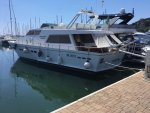
 
1C96D696-277B-499E-8A13-C3E94D1C24EE.jpeg
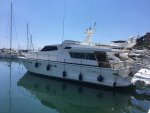
Would something like this interest you for a live aboard? This is one of there smallest .They do bigger .
Thinking lower buy in , ( more headroom budget to ship and fix it up as you desire ) lower berth fees , lower engine maintenance, lower fuel bill etc .

56F9A92A-01F0-4C06-BC53-C21B38832A15.jpeg
 
Hey Port, any knowledge on the Kiatos 76?
Kaitos 76 seams like a solid go fast boat. A little spars inside but smart layout. Thanks

The Kaitos line from Cantieri di Pisa was a very expensive operation which ultimately at the time made them go in crisis, to be bought and saved by Camuzzi Group in 2004 which also owned Mondomarine at the time.
I have a magazine article somewhere (I think it was 2002), and nothing was left to chance, to make them one of the best high performance sporty yachts of the time with exterior designed by Lazzarini and Pickering who also did most of the lastest Magnum. (exterior design not hull).
Hulls tank tested, with the least modifications made for a perfect ride. At the time a client of mine upgraded from a Pershing 73 to a new Kaitos 76 I think it was 04 and 05.
With the Kaitos, Pisa did not want to compete with Mangusta but more with Magnum, they wanted an exclusive product. I think they build a total of five two 64s and three 76s.
As is Cantieri di Pisa everything had to be made for high end clients who knew what they wanted.
 
What would you suggest as a suitable and enjoyable live aboard cruiser similar to man gusts 80 styling.

Boats styled like the Mangusta are not really intended for use as live aboard cruisers. Internal accommodation on the main deck is compromised to provide more outdoor entertaining space, and the outdoor space you gain is intended for sun-bathing and partying, not relaxed living. Sleeping accommodation and galley, etc. are the same as you will find on any boat this size. Mechanically, they're designed for fast cruising over short distances and not long-distances at displacement speed, and as a result they come with big, thirsty engines and limited range.

If you have your heart set on a sports cruiser style boat, you could take a look at shaft-drive boats from builders such as Sunseeker, Princess, Riva, Azimut, etc. ... Over the years all have produced succesful sports cruisers or sports fly boats in the size you're looking at which offer a slightly more rounded, less extreme package than a Mangusta. or its equivalents. Something like a Princess V72 with Caterpillar or MAN engines would be more expensive to buy, but would come with lower running costs, better use of available space and should be easier to sell in future.
 
Really appreaciate your input. Why did you buy the P57

Lots of reasons ... and as always with boats, lots of compromises ... but I'll try to explain the logic.

Size .... The P57 is just under 60 feet/19 metres and this is the largest size I feel I can comfortably operate, maintain and manage on my own without any help. Above this size, you need someone to assist with the lines and if you go much bigger you start to need crew to help with cleaning, maintenance, etc. While my partner likes boating and is happy to be onboard as much as possible, she has no interest in acting as crew :) I have a Yacht Controller system fitted, which means that with some advance planning and preparation I can usually do pretty much everything myself. 19-20m is also a convenient size for marina berths in the South of France ... you can almost always find somewhere at short notice ... but is big enough to be comfortable at anchor. You're also not subject to the anchoring restrictions which now apply to boats of more than 20/24m in many areas.

Sports cruiser v flybridge ... We tend to use the boat in one of two ways: either day trips for larger groups (6-12 people), or 1-2 week cruises for 2 or maximum 4 people. We don't eat onboard very much, prefer to stay in marinas where possible and don't use the boat as a floating apartment or have lots of guests staying onboard overnight. Because of this we don't need the extra accommodation and living space that you get with a flybridge and prefer the feeling of "one-level" living close to the water that you get with a sports cruiser. The P57 has a sliding door between the saloon and cockpit, so you can create a large entertaining space with two seating areas that can easily hold 10-12 people. It has a galley-down layout which we prefer because it keeps food preparation, etc. away from guests.. We increased the size of the galley by removing the downstairs seating area and adding extra refrigeration/freezer capacity, laundry equipment, etc. There is a full width master and large VIP, each with their own ensuite (so perfect for two couples), together with a third cabin for occasional use and a small crew cabin which is used mostly for storage. Other than the flybridge itself, we are not missing anything you would find on a 60 foot flybridge.,

Why Sunseeker? ... I've owned several Sunseekers and have always been impressed by the overall build quality and reliability, and by the sea-keeping and performance. In the past they were behind Princess and others in utilisation of available internal space, but in recent years they have caught up. The exterior styling has always been an acquired taste, but recent generations of boats have been styled more conservatively and look good IMHO. Most importantly, I think the after sales service and support is better than most other manufacturers ... the boats and their systems are not without problems, but if its something that will actually stop you going boating, there is usually a Sunseeker engineer there to fix it within 24-48 hours whether the boat is in warranty or not.
 
Spray rails taken fully aft and widened out , carefully located do create meaningful lift at the stern .At certain speeds .
As I said mine are extra wide and do indeed run all the way back ( except the lower pair which stop where the shaft s pop out )
So they morph into lifting strips .Sure start as spray rails forwards in the bow area in-front of the disruption layer .

Maybe this is where we are locking horns .You are only in front of the disruption layer and I am thinking in both areas the rear as well ?

A lot of boats you see them disappear around 70 % of the way back from the bow .Not every designer utilises them , the potential lift function or needs to .There’s huge variability, you see it in the yards ( it’s better than trains spotting guys ) :)

Depending on the shape and profile and indeed width there position and how far back they are taken …..what starts off as a bow spray deflector can end up as it s taken to the stern doing less spray deflection and more lift ing .
They don’t always have to be run all the way to the transom or change width .They have pluses and minuses .

SCIENCE

Go to the literature review .

For those reading unfamiliar with papers and how SCIENCE works in the wider world ( apologies for those au fair granny suck eggs etc ) - , authors often write a “ literature review “with references to set out the current knowledge/ position .They add references see below .

Ignore the subject matter , it’s the REVIEW , the interesting bit the reason why I link it .You might find it interesting thought but that’s not why I am using it .Iam high jacking the REVIEW.

Using this guys LR it’s got a good para on spray rails the current understanding.For ease I have copied the relevant pages and highlighted in blue + red by own emphasis.

https://www.diva-portal.org/smash/get/diva2:1440146/FULLTEXT01.pdf

Look up papers [55 ] [ 56 ] [ [57 ] in particular ,

Further more these papers are pier reviewed by others before the author publishers and a second verification is done by editorial boards before publication.So it’s not some one’s opinion .It’s real SCIENCE.

For example if JMF was right the author would be asked to remove , re write the part I underlined in red / blue prior to publication .


View attachment 149224
View attachment 149225
Foe those without a scientific background another well known boaty guy, if Dag Pike isn’t familiar.
Ray hunt design .
Its so universally accepted , this lift thing that it’s just mentioned in passing here .
The Hunt Deep-V | Ray Hunt Design | Naval Architecture

No one’s written in , arguing with them ( Ray hunt design ) hinting his web page is full of crap or has a tiny miss truth in it .
Other naval architects , there friends and colleagues arn’t begging them to re write any of this page .

View attachment 149229
Porto, sorry slow reply - been away.

This is getting tedious for probably everyone so I'll try to keep this short. In summary, I disagree with everything you say. In as few words as I can:

1. your approach to any debate appears to be to google hard for anything that might support you. If there isn't anything, then make do with something that might at first sight appear to support you, and turn a blind or lazy eye to the fact that if you read it / critique it properly it doesn't support you. In all cases, cherry-pick and ignore the stuff that doesn't support you. It's all an extreme example of confirmation bias. Also, apply no thought of your own. Focus only on what others have written online. You're free to do all this Porto, but it's tedious for those around you and ultimately if you want to believe something then of course you can.

2. Turning to your citations. I'm very aware of the peer review process (I went to uni, and these days I'm a director of the controlling shareholder of one of the world's biggest academic publishers - not Elsevier, one of the other biggies). I know how peer review works. Your cited research paper by Castoldi was a sub PhD thesis written not in native language and the section you cite is merely the author's "literature review" ie his mere catalogue of other people's work. The part you underline is a straight copy/paste by Castoldi of the synopsis within the research paper referenced as number 57 - another team's (Seo et al) work. In peer review, that copy/paste would have got the attention it deserves, so what you cite frankly lacks weight. If you actually read the rest of Castoldi's paper including his test tank work, as opposed to his copy/paste literature review, you'll see that he says nothing at all in support of your argument.

3. More importantly, let's look at that other team's (Seo et al) work (did you?) - item 57 in the Castoldi document you cited. It dealt solely with a wave piercing round bilge hull and the science of reducing the athwartships component of the water flow at the round bilges, as happens in all round bilge hulls as speed increases. The researchers added spray rails at the round bilges (so convderting a round bilge hull to a somewhat hard chine hull) and got more lift, just as happens with a normal hard chine classic planing hull. That's not a surprising conclusion and entirely consistent with what I have written above. It doesn't support your arguments one iota.

4. So in overall terms you're offering no argument of your own and relying only on what others say. Yet there is no scientific support for your general proposition that normal spray rails (as opposed to chine extenders/creators in "item 57" above) do not add lift. They reduce pumping losses by deflecting spray, and that in meaningfully increases hull speed, which in turn means lift is increased, obviously (and that's what Ray Hunt must have had in mind in his passing reference), but that's never been our bone of contention and is not even up for debate. It remains the case, with no scientific evidence or opinion to the contrary, that spray rails underwater (and therefore not deflecting spray) do not increase lift as compared with removing the spray rail and leaving the plain flat V hull section.

5. By the way, if spray rails make lift why doesn't every boat builder just take all the spray rails to the stern to get some nice stern lift? Why not even have more spray rails at stern than at bow, instead of fewer? In the tiny photo in your Ray Hunt article above, there are only two spray rails. That fine for deflecting spray and reducing pumping losses, and is consistent with most other hulls that also have around 2-3 rails. But if they're so good at creating lift, way not have loads more of them? They're cheap as chips to make. Answer = they don't create lift. Your Itama 46 picture above with that wide rail going back to the transom - that rail is self evidently there for a different purpose (that's kinda obvious) and does not not itself create more lift than if the hull had just kept its deadrise angle at that point.

6. Under the hull of your Itama, in the planing surface part that is wet at 30 knots, you currently have maybe 3 spray rails each side, taken somewhat to the transom or all the way. As a rough guess these rails are something like 5cm wide, approx. So, if we look at a cross section of your hull a couple of metres in front of the transom, and guessing approx 4m of beam, your planing surface has say 30cm of surface that is flat/horizontal (parallel to the horizon) and 3.7m that has a deadrise angle. Imagine if this part of the hull were covered in spray rails that were say 10mm wide, so the cross section looked a bit like the teeth of a saw blade. As a result the entire 4m beam would resent a flat/horizontal surface to the water. If you did this, your lift would be no higher than it is today .

This is really boring and we should end it for everyone's sake. I'm only replying because you took the trouble to write a long post.
 
Last edited:
Porto, sorry slow reply - been away.

This is getting tedious for probably everyone so I'll try to keep this short. In summary, I disagree with everything you say. In as few words as I can:

1. your approach to any debate appears to be to google hard for anything that might support you. If there isn't anything, then make do with something that might at first sight appear to support you, and turn a blind or lazy eye to the fact that if you read it / critique it properly it doesn't support you. In all cases, cherry-pick and ignore the stuff that doesn't support you. It's all an extreme example of confirmation bias. Also, apply no thought of your own. Focus only on what others have written online. You're free to do all this Porto, but it's tedious for those around you and ultimately if you want to believe something then of course you can.

2. Turning to your citations. I'm very aware of the peer review process (I went to uni, and these days I'm a director of the controlling shareholder of one of the world's biggest academic publishers - not Elsevier, one of the other biggies). I know how peer review works. Your cited research paper by Castoldi was a sub PhD thesis written not in native language and the section you cite is merely the author's "literature review" ie his mere catalogue of other people's work. The part you underline is a straight copy/paste by Castoldi of the synopsis within the research paper referenced as number 57 - another team's (Seo et al) work. In peer review, that copy/paste would have got the attention it deserves, so what you cite frankly lacks weight. If you actually read the rest of Castoldi's paper including his test tank work, as opposed to his copy/paste literature review, you'll see that he says nothing at all in support of your argument.

3. More importantly, let's look at that other team's (Seo et al) work (did you?) - item 57 in the Castoldi document you cited. It dealt solely with a wave piercing round bilge hull and the science of reducing the athwartships component of the water flow at the round bilges, as happens in all round bilge hulls as speed increases. The researchers added spray rails at the round bilges (so convderting a round bilge hull to a somewhat hard chine hull) and got more lift, just as happens with a normal hard chine classic planing hull. That's not a surprising conclusion and entirely consistent with what I have written above. It doesn't support your arguments one iota.

4. So in overall terms you're offering no argument of your own and relying only on what others say. Yet there is no scientific support for your general proposition that normal spray rails (as opposed to chine extenders/creators in "item 57" above) do not add lift. They reduce pumping losses by deflecting spray, and that in meaningfully increases hull speed, which in turn means lift is increased, obviously (and that's what Ray Hunt must have had in mind in his passing reference), but that's never been our bone of contention and is not even up for debate. It remains the case, with no scientific evidence or opinion to the contrary, that spray rails underwater (and therefore not deflecting spray) do not increase lift as compared with removing the spray rail and leaving the plain flat V hull section.

5. By the way, if spray rails make lift why doesn't every boat builder just take all the spray rails to the stern to get some nice stern lift? Why not even have more spray rails at stern than at bow, instead of fewer? In the tiny photo in your Ray Hunt article above, there are only two spray rails. That fine for deflecting spray and reducing pumping losses, and is consistent with most other hulls that also have around 2-3 rails. But if they're so good at creating lift, way not have loads more of them? They're cheap as chips to make. Answer = they don't create lift. Your Itama 46 picture above with that wide rail going back to the transom - that rail is self evidently there for a different purpose (that's kinda obvious) and does not not itself create more lift than if the hull had just kept its deadrise angle at that point.

6. Under the hull of your Itama, in the planing surface part that is wet at 30 knots, you currently have maybe 3 spray rails each side, taken somewhat to the transom or all the way. As a rough guess these rails are something like 5cm wide, approx. So, if we look at a cross section of your hull a couple of metres in front of the transom, and guessing approx 4m of beam, your planing surface has say 30cm of surface that is flat/horizontal (parallel to the horizon) and 3.7m that has a deadrise angle. Imagine if this part of the hull were covered in spray rails that were say 10mm wide, so the cross section looked a bit like the teeth of a saw blade. As a result the entire 4m beam would resent a flat/horizontal surface to the water. If you did this, your lift would be no higher than it is today .

This is really boring and we should end it for everyone's sake. I'm only replying because you took the trouble to write a long post.
If that's trying to keep it short..
Need to try harder ???
 
Under the hull of your Itama, in the planing surface part that is wet at 30 knots, you currently have maybe 3 spray rails each side, taken somewhat to the transom or all the way.
Actually, they are NOT taken all the way up to the transom also in Itamas.
Ok, I can't speak for PF boat particularly, but I'm pretty sure to have seen at least a couple of other Itamas with two spray rails on each side of the bottom (plus the chines - not sure if you included that in your assumption of 3 rails/side).
And the inner one stops well before the shafts exit, while the outer one is a bit longer but still "vanishes" well before the transom.
Which I think makes good sense - and btw is very similar to what I've got in my boat.
 
PS: out of idle curiosity, I checked if by chance I took any pics of those Itamas which I've seen on the hard, but I didn't.
OTOH, a quick web search pointed me to this thing, which matches what I had in mind just perfectly...
PHMtnJCS_o.jpg
 
If that's trying to keep it short..
Need to try harder ???
@ JFM Thanks for the reply .Much appreciated,
The peer review stuff was as said aimed at the none scientists on here .Not personally @ you .I don’t do personal stuff in debates not interested on how / what / why or where info comes from .
I have a some more evidence.
See lifting strikes below .
TBDP - Lift Strakes and Spray Rails Analysis

Then this below .
Spray Rails and Lift Strakes (PBR Feb 2015)

5- ….keeping it brief there are pluses and minuses , like I said .Minuses , disadvantages to going mad adding too many , your saw tooth analogy is well documented you increase stiffness so turning becomes an issue , harshness so obviating a deep V if ride quality was high up in the first place .
As far as ‘ why don’t all boats run them to the transom and create mega lift …….simple a combo of a lower deadrise flat hull to begin with so not necessary and move able drives eg legs and Arnesons etc which can be trimmed to create lift .

Its up to readers on here to make there own minds up on “ lifting strips “ et al other under water architectural add ons .

If you don’t think lifting strips exist ? - clearly then present evidence they don’t work with references .Internet is acceptable btw .Doesn’t matter which search engine if Google isn’t your thing and I use it .That s a cul d sac I am happy where ever you can find info to say or contradict the thrust of my links supporting my position ,

Or if you like we just drop it .You might find it boring but others may not .Adding zillions of “ saw tooth’s “ defeats the soft ride a deeper V infers .That’s why they are used carefully .

There seems a gen consensus 3 stakes are optimal and 2 1/2 inch width on most boats posterior to the disruption line .
I was looking at some evidence the other day suggesting actually confirming over 2/12 inches wide the lift contribution rises and it isn’t linear .All depending on the edge profile of said lifting strips .That’s as important as the relative widths .

6 Seeing as if you mention my boat and quite understandably have gotten a few details in the description incorrect or fuzzy permit me to clarify .13.1 WL L , 4,2 M beam .23 degree dead rise . Straight shafts .
Three spray rails fwd of the disruption line .
Remember the lower spray rail phases out before the shafts . .
The higher morphs into the hard chine with runs pretty conventionally to near where the under water exhaust ( UWE ) is .
Posterior to the UW E is that chine widens and in the last M or so inverts by a 2 degrees ( est)

Its the middle spray rail that runs to the transom and widens out .I haven’t actually placed a ruler on at the transom but it’s distinctly wide ,


They ( Amarti ) added lift back in that’s was lost going down the deep dead rise route.
Previous to this on the 46 which has a 22 * dead rise and 4.4 M beam those strips are not as wide .The 42 same hull as the 48 is about the same L but narrower 4,2 M .Some 46 s were fitted with Arnesons as well .All 46s and 54 s had that lifting or dipping rudder bar to reduce drag ,The 46 ended circa 1998 and the 42/48 hull entered about 2001 ish ( PYB might tidy up theses dates )

The boats were built to customer specs , very customisable in every aspect and the prices reflected .
So listening to customer feed back the 42/48 hull was really the evolution of the 46 in the modal line up before he sold up and retired passing control on to Bulgari .

Any how a few pics to lighten things . :)
1BA0920A-BA67-4F27-93CB-B6E0F7CBF532.jpeg
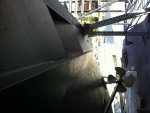
Fwds of the disruption line ,

F6A47968-4DA5-43DC-9C82-420CADFFA3D9.jpeg
D9BBA033-0997-4091-BC9A-9E484A692969.jpeg
8FE6043B-1C66-4B41-B449-6984E595AE01.jpeg

53FA2140-2CD3-47FF-9D57-4147D8CFBED3.jpeg

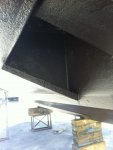
Middle one @ transom, it’s over2/12 inches ( American naval architecture info ) wide .^^^

5201BC99-C9EA-4EE1-850E-E74D45D57383.jpeg
Its edge view ( middle one ) Shows the depth too .^
Also note the UWE …….and for those unaware Amarti ( the designer ) was the worlds first , ie he invented UWE in leisure boats .

440DD82E-BA34-4209-9746-DACA1D616132.jpeg
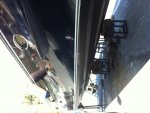
Chine and extra wide flat middle spray rail ( what we are arguing about it functions) extended to the transom.^

AC20E69A-022B-4A9E-8D1B-F9D6AE8C0F07.jpeg

That middle strip adds lift , it’s shape position and subtle size on a 23 dead rise hull .You can just see a slight turn on the chine flat negative at the very stern end kinds twists from the UWU area .

Does any one else think lifting strips don’t add lift ?
Bearing in mind Dag Pike , RayHunt et all ….countless others I have linked in fact the whole naval architecture community.

Apart from JFM any others out there ?
If so why ?
 
Last edited:
PS: out of idle curiosity, I checked if by chance I took any pics of those Itamas which I've seen on the hard, but I didn't.
OTOH, a quick web search pointed me to this thing, which matches what I had in mind just perfectly...
PHMtnJCS_o.jpg
See my post ^ lower deadrise .

Any how it not where they are it’s why they are there .
 
This is the main reason why you have be careful on the dims and placement read L see MapishMs pic .

The bit I have highlighted in red .


F1A0CB25-9765-4935-8478-CB2EFB166D4B.jpeg
Turning at speeds over 26 knots is hopeless i have said this before the turning circle is huge .At 30 knots + rudders just slow it even on full lock and maybe it deviates by 5 degrees as little as that .

To turn shaper col avoidance etc I have to pull the sticks back drop it down to under 25 knots .As say 23/24 it turns like any other boat safely.

Thats the downer .The up side is stability and arrow like running , wake has zero effect to the bearing it on .
Very min steering input needed and when it turns it hardly heals compared to other boats .And it runs very flat zero tabs = the lift .But that lift and extra stability comes as a pay off for turning radius , it won’t turn speed gets too set .
Thats why you have to careful running them those strips back fully and increasing the dims , depth as well as width .

Look how deep the “ Trip edge “ is in front the UWE pic . 2nd from the bottom ^^ .
 
Does any one else think lifting strips don’t add lift ?
Bearing in mind Dag Pike , RayHunt et all ….countless others I have linked in fact the whole naval architecture community.

Apart from JFM any others out there ?
If so why ?
Just to be clear, the two peer-reviewed research papers discussed above support my side of this debate not yours. Your "whole naval architecture community" claim is preposterous.

The two new links in your post above are from the same guy, and he just says something without any rationale, and he is simply not correct. The internet is full of incorrect statements on engineering and physics.

You are just googling to cherry pick stuff here and there that seems to you to support your position, without even understanding whether it actually does that, and copy/pasting it on here. Fine, but I don't wish to spend any more time reading that stuff. You are not advancing any argument that you yourself understand and your question today "What happens to the headroom when I plug my 32 amp boat into a 64 amp shorepower socket?" speaks volumes. I think everyone is bored to death so I hope you don't mind that I'm retiring from this.
 
Lots of reasons ... and as always with boats, lots of compromises ... but I'll try to explain the logic.

Size .... The P57 is just under 60 feet/19 metres and this is the largest size I feel I can comfortably operate, maintain and manage on my own without any help. Above this size, you need someone to assist with the lines and if you go much bigger you start to need crew to help with cleaning, maintenance, etc. While my partner likes boating and is happy to be onboard as much as possible, she has no interest in acting as crew :) I have a Yacht Controller system fitted, which means that with some advance planning and preparation I can usually do pretty much everything myself. 19-20m is also a convenient size for marina berths in the South of France ... you can almost always find somewhere at short notice ... but is big enough to be comfortable at anchor. You're also not subject to the anchoring restrictions which now apply to boats of more than 20/24m in many areas.

Sports cruiser v flybridge ... We tend to use the boat in one of two ways: either day trips for larger groups (6-12 people), or 1-2 week cruises for 2 or maximum 4 people. We don't eat onboard very much, prefer to stay in marinas where possible and don't use the boat as a floating apartment or have lots of guests staying onboard overnight. Because of this we don't need the extra accommodation and living space that you get with a flybridge and prefer the feeling of "one-level" living close to the water that you get with a sports cruiser. The P57 has a sliding door between the saloon and cockpit, so you can create a large entertaining space with two seating areas that can easily hold 10-12 people. It has a galley-down layout which we prefer because it keeps food preparation, etc. away from guests.. We increased the size of the galley by removing the downstairs seating area and adding extra refrigeration/freezer capacity, laundry equipment, etc. There is a full width master and large VIP, each with their own ensuite (so perfect for two couples), together with a third cabin for occasional use and a small crew cabin which is used mostly for storage. Other than the flybridge itself, we are not missing anything you would find on a 60 foot flybridge.,

Why Sunseeker? ... I've owned several Sunseekers and have always been impressed by the overall build quality and reliability, and by the sea-keeping and performance. In the past they were behind Princess and others in utilisation of available internal space, but in recent years they have caught up. The exterior styling has always been an acquired taste, but recent generations of boats have been styled more conservatively and look good IMHO. Most importantly, I think the after sales service and support is better than most other manufacturers ... the boats and their systems are not without problems, but if its something that will actually stop you going boating, there is usually a Sunseeker engineer there to fix it within 24-48 hours whether the boat is in warranty or not.
Appreciate your insight ?
 
The Kaitos line from Cantieri di Pisa was a very expensive operation which ultimately at the time made them go in crisis, to be bought and saved by Camuzzi Group in 2004 which also owned Mondomarine at the time.
I have a magazine article somewhere (I think it was 2002), and nothing was left to chance, to make them one of the best high performance sporty yachts of the time with exterior designed by Lazzarini and Pickering who also did most of the lastest Magnum. (exterior design not hull).
Hulls tank tested, with the least modifications made for a perfect ride. At the time a client of mine upgraded from a Pershing 73 to a new Kaitos 76 I think it was 04 and 05.
With the Kaitos, Pisa did not want to compete with Mangusta but more with Magnum, they wanted an exclusive product. I think they build a total of five two 64s and three 76s.
As is Cantieri di Pisa everything had to be made for high end clients who knew what they wanted.
Thanks for the insight. It seams the 76 is very reasonable on second hand market under $500k may need some work on closer I selection.
 
Because owners know better than anyone else that selling those boats for as little as buyers are willing to pay is preferable to keep feeding a bottomless pit! :D
Ok, you can say that of all pleasure boats, arguably. But for the ones you seem attracted from, more than for many others...!
 
Top