MAIB harness report.

I think your point about probabilities is well made.
How often do most of us fall on our tethers?
....
They are meant to be a last line of defence.
....
If you want to make tethers and jacklines the primary thing between you and the ocean, a complete re-think is required, not fiddling with details.

I think this is the important point. For most of us the tether is one element in a chain of risk mitigation that starts with not going out in bad weather, via reefing early and holding on, and ends with a PLB etc. I have never personally been in a situation where I could expect to get washed overboard if I didn't have a tether, and I don't know many sailors who have.

In contrast for the serious offshore sailors there is perhaps an expectation that the tether/jack-line system will be called upon reasonably regularly, and therefore more care should be taken in designing that system (and I believe more care is taken).

For the normal sailor, while a better set-up is obviously better, the reality is that an merely adequate system is perfectly reasonable. If there is no penalty for having a better system then of course this should be the goal, but if a compromise is required then this is reasonable. For example you would not remove a centre cleat that you use every time you moor the boat because it is a snag risk for the jack-line.
 
Several have stated that the edge of a yacht conditions where MOB recovery is problematic should be treated like a 500-foot cliff. Once a sailor flips over the rail on a tether there are always bruises or worse. These posters are right, and this bears repeating over and over. It is too easy to be complacent and get in a hurry. I hope no one disagrees that this is so. Staying on board is vital. Even so, accidents happen and the gear should work.

Were the main hazards known? Perhaps not to the general sailing public, but yes they were. I should add that I have been climbing ice and rock for 40 years and working at-height in refineries as a trained engineer for 35 years. I've have designed many fall protection systems, including high-line and tether systems that served for decades without incident. I also enjoy the feel of risk... but I need to know my equipment is right and that I understand how it works in concert with a dynamic situation. You need to try and understand the whole system.

I think if you showed the problem to a fall protection engineer, without prejudicing him with tradition, he would point a few things out:

* Side loading--equipment ratings. These standards (have been around for decades (UIAA 121, ANSI Z359, others). Any DIY could have glanced that the Gibb hooks and guessed that he could clamp it in a vise and bend them. I, for one, was not surprised by the failure. I have never used stamped metal or non-locking hooks. Moreover, carabiners that have been certified for side loading have been around a long time. I use Kong Tangos, as well as other Petzl and Black Diamond products. The Wichard ProClip is also rated for side loading above the forces involved in this accident (I repeated the test myself on a test stand with calibrated load cell). So anyone could have foreseen this.
* Side loading--avoiding the hazard. This has been a standard part of industrial and climbing safety forever. Yes, you look for such things. I relocated my jacklines during the trial period in part because of a spot they could side load. Also to eliminate a tripping hazard. I do not use the cleats because they are not in the right place. In fact, wouldn't it be thr greatest of coincidences if mooring cleats and jackline anchors just happened to be in the same place? I think it is only tradition and because it is easy.
* Jacklines should not go right to the edge or far ends. If they do, there should be another set farther in. You can work at the end, but the anchor point should be at least 3-4 feet back. This is obvious.
* Work station tethers. One of the sailors was clipped short and was easily recovered. Short positioning tethers must be used. Think about that 500-foot cliff thing when you say it's awkward. In fact, there have been very few falls when sailors are moving along the lines, using both hands and paying attention. It is when they stop to work that they are at greatest risk.
* Sailors need training in the systems and how to use the equipment. That these issues were surprises to manufactures and rule-making groups is obvious proof.
* Stretch must be considered in each system. There is no such thing as a one-size-fits-all design unless boats are the same size and shape This is obvious. Even lifeline diameter varies with LOA, but not jacklines specs. The materials and strength required will vary with length and deflection limits. I've seen steel cable up to 1/2" specified for strength and stretch reasons on long high line systems. For example, the proper material for the Clipper line was probably at least ~ 15,000-pound Dyneema webbing or something similar. This means stronger anchors too. Obviously.
* Energy absorption by the tether must be considered; this is in every industrial spec and recreational climbing standard, but not in the sailing standards. That is just as much a problem as the clip. Would you anchor without either a nylon rode or lots of cataenary? No you would not. The final impact on Speirs was provably about 1000 pounds--he was injured in the water, I would bet on it. (Normally the jackline would provide impact absorption, but remember that the clip was jammed.)
* Harness design needs serious research. If not a body harness (I wouldn't like that either), something that actual subjects take short falls in multiple dirrections, not dummies. I bet no one has ever taken even a 6" fall, intentionally, with a sailing harness and tether. I would ask/require the standard writers to do this, and then look at their faces. This isn't theory. An improved chest harness with leg loops could probably do it, but I don't know. This requires study. We can't just wave off the problem because we don't know the answer.

These are the basics. Then there is the detail.

this is all excellent stuff.....as a climber, i am completely amazed at the apparent primitive nature of jackline and tether arrangements on boats, particularly when so much work has been done in climbing, arborist, and industrial fall arrest technology.....we need to learn from others
 
I've often wondered why new yachts may have attachments which could be used by jack stays but don't (correct me if I'm wrong ) actually have them fitted as an option. It's up to the owner to decide.

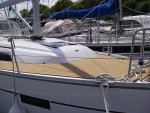
When I ordered my Bavaria in 2014, a factory option I specified was to have stainless jackstays along the side of the coachroof. They're neat, unobtrusive, well inboard and seem to work well.

IMGP1030.jpg
 
I think this is the important point. For most of us the tether is one element in a chain of risk mitigation that starts with not going out in bad weather, via reefing early and holding on, and ends with a PLB etc. I have never personally been in a situation where I could expect to get washed overboard if I didn't have a tether, and I don't know many sailors who have.

In contrast for the serious offshore sailors there is perhaps an expectation that the tether/jack-line system will be called upon reasonably regularly, and therefore more care should be taken in designing that system (and I believe more care is taken).

For the normal sailor, while a better set-up is obviously better, the reality is that an merely adequate system is perfectly reasonable. If there is no penalty for having a better system then of course this should be the goal, but if a compromise is required then this is reasonable. For example you would not remove a centre cleat that you use every time you moor the boat because it is a snag risk for the jack-line.

This is a real difference in veiwpoint between climbers/industry and sailors:

"I think this is the important point. For most of us the tether is one element in a chain of risk mitigation that starts with not going out in bad weather, via reefing early and holding on, and ends with a PLB etc. I have never personally been in a situation where I could expect to get washed overboard if I didn't have a tether, and I don't know many sailors who have."

The climbers know that if they make serious rigging error they will die every time, not just a once in a lifetime possibility. So the training is generally much better, the standards are realistic, and the gear is better suited to the task. I once had a young climber land 20 feet to my right after a 250-foot fall.

"In contrast for the serious offshore sailors there is perhaps an expectation that the tether/jack-line system will be called upon reasonably regularly, and therefore more care should be taken in designing that system (and I believe more care is taken)."

The system design is one-size-fits-all. Obviously, the gear was not improved nor was greater attention taken.

"For the normal sailor, while a better set-up is obviously better, the reality is that an merely adequate system is perfectly reasonable."

For it to be merely adequate, it must survive a fall over the wire. That means a running start and a 3-4-foot drop. There was nothing exceptional about the Clipper accident. The weather was typical and the fall was a common one. Is there a different way to define adequate? From a climbing perspective, the gear and quaility to climb El Capitan or Mount Everest are the same; it either works or it does not. The difference is training.

To go farther for offshore work on a fast boat could mean additional jacklines, dedicated hard points and work station tethers and better training. That is what you see on some race boats. Also many cruising boats. But these may not be needed for the inland/coast sailor.
 
Last edited:
I should have added that there is absolutely no market for climbing gear that does not meet UIAA standards. And yet even major chandleries carry harnesses and tethers that fail to meet even the intent of ISO 12401 standards. Shame on them for knowingly selling unsafe equipment. Off the topic, but sad. The saving grace is that the people who buy the rubbish probably don't go out much.
 
When I ordered my Bavaria in 2014, a factory option I specified was to have stainless jackstays along the side of the coachroof. They're neat, unobtrusive, well inboard and seem to work well.

View attachment 68490

Yes, hand rails would be nice. I always wear gloves in rough conditions so that I can safely use things like that jackstay as handholds. But rails are also foot holds when heeling.

How does that work, with the jackstay ending so far from the bow? I'm surprised they did not go to the forward corner of the cabin. Can your reach the forestay from there? If you can, then short clipping to the pulpit could be very good.

Clipping to the pulpit requires thought:
* The pulpit needs to be strong enough. If the lifelines are too code, it must be (they have to anchor 5000 pounds without tearing off the boat... though most can't).
* You may be able to clip to the welded loop the lifeline attaches too, if there is enough room. You are, of course, side loading the weld in a bad way.
* You can clip to the rail IF the clip opens 26mm. The Wichard ProClip does and The Kong Kango does. The old-school clips do not.
* You can clip the tether back on itself... but that is terrible practice with most clips. Don't.
* You can clip the tether back to the harness if it is long enough.
* You could hang a clipping loop from the pulpit or add a hard point at deck level.

Just something to think about. No one answer, since it depends on what you are doing up there.
 
* Jacklines should not go right to the edge or far ends. If they do, there should be another set farther in. You can work at the end, but the anchor point should be at least 3-4 feet back. This is obvious.
An improved chest harness with leg loops could probably do it, but I don't know. This requires study. We can't just wave off the problem because we don't know the answer.
.

Please explain why it is " Jacklines should not go right to----or far ends"
I can understand not needed to go right to the bow but not detrimental. But thinking it through, I think that if I went over on a yacht doing 3+ kts I could not get back over the side very easily ( I do have lines at the stern but not relevant for this point) so if on a crewed yacht I think that until they stopped the boat I would rather be just behind the hull, being dragged along, than alongside it,being bashed against it. So I would let the line run well aft if I could. The number of boats that have inboard lines is very limited simply due to practical reasons. The danger introduced by having to keep swapping them when moving forward cannot be ignored. Nobody has mentioned that lots of yachts now have control lines running to cabin mounted winches & it would be easy to accidentally hook to a control line instead of a jackline running down the cabin roof

My Spinnlock deck vest does have leg loops & Spinnlock do make a much lighter harness for deck work only (not mast work) pattern & I believe this has leg loops. I did consider buying one but as I sail single handed I have decided that if I cannot get back on board in a couple of minutes I never will & if I am not far offshore I will cut myself loose & rely on my PLB & miniflares attached to the deckvest. Hopefully the boat will also run into something & raise the alarm as well.
 
Last edited:
Please explain why it is " Jacklines should not go right to----or far ends"...
I can understand not needed to go right to the bow but not detrimental. But thinking it through, I think that if I went over on a yacht doing 3+ kts I could not get back over the side very easily ( I do have lines at the stern but not relevant for this point) so if on a crewed yacht I think that until they stopped the boat I would rather be just behind the hull, being dragged along, than alongside it,being bashed against it. So I would let the line run well aft if I could. The number of boats that have inboard lines is very limited simply due to practical reasons. The danger introduced by having to keep swapping them when moving forward cannot be ignored. Nobody has mentioned that lots of yachts now have control lines running to cabin mounted winches & it would be easy to accidentally hook to a control line instead of a jackline running down the cabin roof

My Spinnlock deck vest does have leg loops & Spinnlock do make a much lighter harness for deck work only (not mast work) pattern & I believe this has leg loops. I did consider buying one but as I sail single handed I have decided that if I cannot get back on board in a couple of minutes I never will & if I am not far offshore I will cut myself loose & rely on my PLB & miniflares attached to the deckvest. Hopefully the boat will also run into something & raise the alarm as well.

Jacklines to extreme ends. BTW, if you think your tether will allow you to slide back to the transom, it will not. It will catch on the first stanchion.

1. There is no need. If you are using a 6' tether it will reach the end, perfectly well and standing tall, clipped 4.5 feet back. Your chest tie is ~ 4' off the ground and the rest is simple trig. A shorter tether leg can be clipped to something else fixed (which is better) when you get there. If there is any advantage, please explain it. Mathimatically and practically, it will only be slack line. Mine have ended 4' back for a decade and they have never felt short.
2. Boats can slow rapidly when they stuff a wave. A tether from behind you prevents getting thrown forward.
3. A long tether will do nothing to keep you on the deck near the bow. It's too skinny.
4. If you have an outboard, the reason for not being tethered just off the back should be obvious. Otherwise, it is not so bad, but reason (1) still applies; there is no need whatsoever. Lines going to the transom only insure that it is possible to go over. They must stop at least 4' back to restrain you.
5. The only reason we run jacklines near the weather rails is heel; to keep us up hill. That does not apply at the bow at all. Otherwise, there is never a good reason to place restaint anchors near the edge. You wouldn't do this on a building roof.
6. The only advantage to using the bow cleats is that it is easier. Not a great reason for a safety compromise, and embarrassing to use as an excuse after an accident, don't you think?
7. I like keep the deck cleats clear for their intended function at all times. Granted, webbing does not interfere much.

I do not argue the practicality of multiple jacklines. There are good arguments both ways and I believe it depends on the boat. Of course, assuming you have two tether legs (required to be available by the OSR) there is negligable risk in clipping through. In fact, cases of people falling off while moving, vs. working are very, very rare. People fall when they are using their hands for work and are distracted. In fact, I think the point is largely moot.

Cut-away. This is not universally agreed and the OSR does not require it. That said it is a good option to have. Just remember, that if you are solo and sailing outside the harbor, cutting away will not be very helpful, particularly if the water is cold. If your crew is not experienced and it is very rough or dark it is not very helpful. While it might be the only choice, other than fair weather in the harbor or on a crewed race boat, remember it is not a reliable plan. You'll die anyway.

Control lines. We all have these someplace. This is one of the reasons people like cable or webbing and you hear very little discussion of rope; with these is it easy to tell the difference.

----

Perhaps you will consider this coincidental, but the accident that started this thread would not have happened if the jackline had ended back 3-4' at a dedicated anchor point. The clip would not have been up by the cleats.
 
Last edited:
But the accident might have had less risk of happening if he had had a hook that would withstand side loads and he was using a 'more' elastic tether.

In the same way anchor snubbers (this thread has some of the destructive characteristics of an anchor thread :( ) should be elastic, so should tethers - the elasticity will absorb some of the energy (in this case of a falling body) which will reduce the snatch load on the hook (and jackstay).

None of this is rocket science.

2 very simply fixes, different hooks, elastic tethers.

There are hooks available there are tested for side loads, they are used in marine applications they are available 'over the counter', or by mail order (wherever you live) if you want to buy from West Marine. By all accounts, tests for example by Thinwater, these alternative hooks (for example Kong Tango) will withstand side loads factorially greater than the side loads that may have damaged the hook used. These same hooks are tested for side loads as part of industry standards - other than marine/sailing standards.

Using climbing rope as a tether is hardly 'original'.

As an aside - It would be very difficult to slide down the sidedeck past, roughly, the aft edge of the coachroof. Between the aft edge of the coachroof and transom most side decks I can think of have winches, some forms of jammers and then cleats, runners and blocks - which in themselves are each likely to do you harm (but will certainly markedly slow progress).

Jonathan
 
Top