I have one of these immediately downstream of the gas regulator.
8mm Alde Marine/Boat Gas Leak Detector (Bubble Tester)
The system is tested every time I switch on.
I install and maintain Gas Detection instrumentation for a living and I haven't found a Flammable Gas Detector that I'd be happy to install on my boat yet!
The issue is power consumption on any of the Flammable heads I have found. Most draw 30 to 50mA . Which is too much to leave on while the boat is unattended. I see no point in having Flammable Gas detection if its not on continuously. Powering up the Electrical system when you arrive back to the boat is the most dangerous situation, if you have gas in the bilges.
If you have enough Solar/ Wind , If you are a live aboard and generate plenty of power then its a great idea.
I have worked on Neureus and Trident marine systems , both designed and manufactured in the Uk and seems like good kit.
I do use a domestic Carbonmonoxide Detector . There has been lots of discussion the site as to whether they are Certified for marine use or not.
They are inexpensive and a good back up, And they do the job fine. Honeywell or EI are excellent makes with amazing technology built in for the price. I'm sure there will be a few who will tell me that diesels shouldn't produce CO . They say the same about Gas boilers and I have seen Gas Boilers with air control issues producing dangerous levels of CO. I think the CO detectectors are a good insurance policy on pleasure boats especially if you have diesel or solid fuel heating..
Kinsale 373
I have a FireAngel CO-9D detector on board. It isn't certified for marine use, but it's dry in the cabin and I'm sure it'll work fine.
Fitting an LPG detector has never crossed my mind. If the gas bottle is turned off when it's not in use, what's the danger? People seem obsessed by the supposed danger of LPG on boats, when in reality it's very safe if you're vaguely sensible.
I'm not sure why anyone would leave their boat without turning off the gas at the bottle.
I have one of those bubble detector as well as a LPG alarm but I find the best is the Mk 1 nose can detect the added smell at much lower concentrations than my detector.
If you have any gas appliances on when sleeping on board a CO detector is advisable.
A smoke detector in the engine compartment would help if a fire breaks out in the engine together with a remote operated fire extinguisher.
Powering up the Electrical system when you arrive back to the boat is the most dangerous situation, if you have gas in the bilges.
Kinsale 373
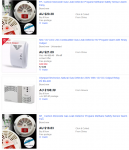
We've got the second one from the top. Works as far as I can tell (tested with lighter). It has a relay that can operate a remote shut-off valve if you have one. The green LED is rather bright and lights up the galley floor in the dark - handy!
Nothing in them that warrants a price over €25. All of them require a warm-up time for the sensor (they all use the same type of sensor, a standard component).