
LPG Gas Leak Detectors

coopec

N/A
Joined
23 Nov 2013
Messages
5,211
Visit site
I'm planning to install a LPG leak gas detector but just got a shock when I priced them at over AUD500. (261.45 GBP)

Does anyone have a recommendation?

Are cheaper ones a risk?
Screenshot_2020-07-09 lpg gas leak detector 12V dc eBay.png
 
I have one of those bubble detector as well as a LPG alarm but I find the best is the Mk 1 nose can detect the added smell at much lower concentrations than my detector.

If you have any gas appliances on when sleeping on board a CO detector is advisable.

A smoke detector in the engine compartment would help if a fire breaks out in the engine together with a remote operated fire extinguisher.
 
I install and maintain Gas Detection instrumentation for a living and I haven't found a Flammable Gas Detector that I'd be happy to install on my boat yet!
The issue is power consumption on any of the Flammable heads I have found. Most draw 30 to 50mA . Which is too much to leave on while the boat is unattended. I see no point in having Flammable Gas detection if its not on continuously. Powering up the Electrical system when you arrive back to the boat is the most dangerous situation, if you have gas in the bilges.
If you have enough Solar/ Wind , If you are a live aboard and generate plenty of power then its a great idea.

I have worked on Neureus and Trident marine systems , both designed and manufactured in the Uk and seems like good kit.

I do use a domestic Carbonmonoxide Detector . There has been lots of discussion the site as to whether they are Certified for marine use or not.
They are inexpensive and a good back up, And they do the job fine. Honeywell or EI are excellent makes with amazing technology built in for the price. I'm sure there will be a few who will tell me that diesels shouldn't produce CO . They say the same about Gas boilers and I have seen Gas Boilers with air control issues producing dangerous levels of CO. I think the CO detectectors are a good insurance policy on pleasure boats especially if you have diesel or solid fuel heating..
Kinsale 373
 
I install and maintain Gas Detection instrumentation for a living and I haven't found a Flammable Gas Detector that I'd be happy to install on my boat yet!
The issue is power consumption on any of the Flammable heads I have found. Most draw 30 to 50mA . Which is too much to leave on while the boat is unattended. I see no point in having Flammable Gas detection if its not on continuously. Powering up the Electrical system when you arrive back to the boat is the most dangerous situation, if you have gas in the bilges.
If you have enough Solar/ Wind , If you are a live aboard and generate plenty of power then its a great idea.

I have worked on Neureus and Trident marine systems , both designed and manufactured in the Uk and seems like good kit.

I do use a domestic Carbonmonoxide Detector . There has been lots of discussion the site as to whether they are Certified for marine use or not.
They are inexpensive and a good back up, And they do the job fine. Honeywell or EI are excellent makes with amazing technology built in for the price. I'm sure there will be a few who will tell me that diesels shouldn't produce CO . They say the same about Gas boilers and I have seen Gas Boilers with air control issues producing dangerous levels of CO. I think the CO detectectors are a good insurance policy on pleasure boats especially if you have diesel or solid fuel heating..
Kinsale 373

I have a FireAngel CO-9D detector on board. It isn't certified for marine use, but it's dry in the cabin and I'm sure it'll work fine.

Fitting an LPG detector has never crossed my mind. If the gas bottle is turned off when it's not in use, what's the danger? People seem obsessed by the supposed danger of LPG on boats, when in reality it's very safe if you're vaguely sensible.
 
I have a FireAngel CO-9D detector on board. It isn't certified for marine use, but it's dry in the cabin and I'm sure it'll work fine.

Fitting an LPG detector has never crossed my mind. If the gas bottle is turned off when it's not in use, what's the danger? People seem obsessed by the supposed danger of LPG on boats, when in reality it's very safe if you're vaguely sensible.

I'm not sure why anyone would leave their boat without turning off the gas at the bottle.
 
A bubble tester would pick up any leaks caused by chaffing, or something being knocked loose by vibration, but part of it is good Brownie points if your boat needs a gas certificate, eg to use on rivers and canals.
 
I have one of those bubble detector as well as a LPG alarm but I find the best is the Mk 1 nose can detect the added smell at much lower concentrations than my detector.

If you have any gas appliances on when sleeping on board a CO detector is advisable.

A smoke detector in the engine compartment would help if a fire breaks out in the engine together with a remote operated fire extinguisher.

Slightly off-topic here in regard to carbon monoxide. Yes I most certainly will have a carbon monoxide detector as well. I couldn't believe that there were people on this forum suggesting it was OK to clamp a 50 mm wire re-inforced exhaust hose down to 1 7/8" (47.625 mm)
  • May 11, 2017 - On June 2016, the crew of the boat, a couple, were found deceased. Investigation identified that the couple had died from carbon monoxide ...
  • Aug 3, 2017 - The owner of the Eshcol, Timothy Bowman-Davies, is starting a 15 month sentence after two crew died on board the vessel due to carbon
  • Aug 2, 2019 - A responding U.S. Coast Guard helicopter crew found the two men, who both lived in Arroyo Grande, near Point Conception, and another died of carbon dioxide poisoning
  • SUMMARY. On May 17, 2012, a 25-year-old boat maintenance crew supervisor died from carbon monoxide poisoning while using a gasoline-powered pressure.
  • May 21, 2020 - Coroner's reports for the 34 victims who died in a scuba boat fire off the Southern California coast last year show they died of carbon monoxide poisoning before they were burned, authorities said Thursday.
 
I had an onboard gas detector for unburnt LPG, for weeks it kept going off at random. Checked every part of the gas system, bottle regulator shutoff valve cooker hob. Nearly took out all the interior incase there was a joint leaking even though there was no pressure drop.
Turn out it was one of the batteries had a cell failure and was gassing off
 
Powering up the Electrical system when you arrive back to the boat is the most dangerous situation, if you have gas in the bilges.
Kinsale 373

I have installed a bird cage blige blower blower which is ignition protected. The intention is that it would be run for 4 minutes before starting the motor (or anything else). I thought that was standard practice?
 
Further to my previous reply, I switched on the Nasa lpg detector and the usual clicks it emits on start up, turned to double clicks. Due to water in the mini bilge, (designed to collect any gas spillage before it enters the bilge proper), the sensor enclosure was completely submerged. I know the sensor element is replaceable but, unbelievably, after drying out, it performed as usual. Tested with a gas lighter, it alarmed as expected.
 
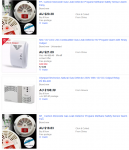
We've got the second one from the top. Works as far as I can tell (tested with lighter). It has a relay that can operate a remote shut-off valve if you have one. The green LED is rather bright and lights up the galley floor in the dark - handy! :)

Nothing in them that warrants a price over €25. All of them require a warm-up time for the sensor (they all use the same type of sensor, a standard component).
 
We've got the second one from the top. Works as far as I can tell (tested with lighter). It has a relay that can operate a remote shut-off valve if you have one. The green LED is rather bright and lights up the galley floor in the dark - handy! :)

Nothing in them that warrants a price over €25. All of them require a warm-up time for the sensor (they all use the same type of sensor, a standard component).

Yngmar

When you say " second one from top" do you mean the one priced at $21.09 pictured in comment #1 above?
 
How stupid can people be? I woke up this morning to read the headlines

Eleven people hospitalised with carbon monoxide poisoning after grill used inside


Eleven people — including nine children — have suffered carbon monoxide poisoning after an open charcoal grill was used inside a house.
Two adults and five children are currently in a serious condition after the incident at a residence in South Hobart, a spokesman for the Department of Health said in a statement.


It's not just land lubbers who are stupid. Further down the same article


Carbon monoxide poisoning has been deadly in Tasmania — in 2016 the bodies of two men were found in a boat at a marina at Prince of Wales Bay near Hobart.
An investigation found the pair had died of carbon monoxide poisoning as a result of a poorly installed portable power generator and the absence of a carbon monoxide detector.
 
Peel industries Mornington Vic, I've had 2. 1st was dedicated 12v but played up when step down transformer for shore power wasn't good, they looked at it and even replaced parts free of charge, in the end I purchased another unit that works on a range of voltages, no problems. my unit has 2 sniffers and an on/off solenoid. Whitworth s sell them but you should be able to deal direct. your welcome to the old one
 
We've got lpg and CO alarms, but I wouldn't put all that much faith in them.
They rely on components which are not rated to 100% humidity.
Many boats are very humid inside while they're shut up during the week.

The main thing to rely on is proper installation and regular checks to know that the system is sound.
Plus common sense in operation, don't use the cooker without some ventilation etc.
 
Top