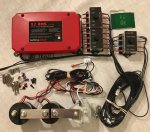
Lithium 304Ah Build

good morning all,

re-read the thread and planning on checking two things next week:

A. 200-250kgf (or whatever) springs say 50mm long that I can thread at the ends of my studs bolting together the pack. Assuming I manage to find data and matching springs, I could get one on each bolt at one end, tighten them to be say 10mm compressed when at 40% SOC and see if they are wobbly at 10%SOC... Or maybe start with them just tight and holding at 10% and see how/if they compress at 95%. will have to ask a couple of mech.eng colleagues though.
B. see if log of overall charging (or consumed if you wish) Ah can be had. If so would be easy to divide it by the bat Ah rating and get a crude number of cycles the battery has gone through. Would it make sense, are the BMSs you're using keeping such a log? Should be fairly easy on the diyBMS I'm using.

cheers

V.

PS. someone must get the time to create a cut and paste of various posts on all these threads and maybe ask for a sticky, or put it somewhere else with the link on top of the main lifepo threads!
 
What do you guys do for a BMS? I am not aware of a marine grade BMS. They seem to have PCBs open to atmosphere or am I looking at the wrong kit?

Only the 123Smart BMS has boards on each cell. I have those and, once they were connected up I supplemented the conformal coating with Plastik70 which sprays on. Mostly they are enclosed units. I'll let others respond who have used them but all are enclosed units.
 
most pcbs are open to atmosphere I think. A non-mosfet BMS could be in sealed boxed. Could do mine but probably wont bother considering the lack of oxidation on other pcbs on the same area - rarely over 40% humidity inside.
One could use one of these "laquer" sprays for PCBs a tenner a can.

I'm using diyBMS an opensource project which has developed strongly and does (imho) what needs to be done. Also communicates with victron gx /cerbo / raspberry pi running VenusOS and BMS can instruct in realtime what the (victron) chargers/mppts/inverters do, limit current, limit voltage, stop charging/discharging all together. Also 4 relays to run contactors or whatever else you'd like (like the peltiers and fans in your case ? )
all depends on other kit you have and redundancy policies you're happy with I guess
 
Only the 123Smart BMS has boards on each cell. I have those and, once they were connected up I supplemented the conformal coating with Plastik70 which sprays on. Mostly they are enclosed units. I'll let others respond who have used them but all are enclosed units.
diyBMS also has individual pcbs on each cell, that does the measuring of voltage, temp and passive balancing at 1.2A which I think is one of the highest in the market.
 
diyBMS also has individual pcbs on each cell, that does the measuring of voltage, temp and passive balancing at 1.2A which I think is one of the highest in the market.

Ah - I don't know that one. Yes 1.2A is a good passive balancing rate. Some passive balancing rates in drop-in battery BMSs are pathetic. 123Smart has 1amp.
 
most pcbs are open to atmosphere I think. A non-mosfet BMS could be in sealed boxed. Could do mine but probably wont bother considering the lack of oxidation on other pcbs on the same area - rarely over 40% humidity inside.
One could use one of these "laquer" sprays for PCBs a tenner a can.

I'm using diyBMS an opensource project which has developed strongly and does (imho) what needs to be done. Also communicates with victron gx /cerbo / raspberry pi running VenusOS and BMS can instruct in realtime what the (victron) chargers/mppts/inverters do, limit current, limit voltage, stop charging/discharging all together. Also 4 relays to run contactors or whatever else you'd like (like the peltiers and fans in your case ? )
all depends on other kit you have and redundancy policies you're happy with I guess
We are looking at a refrig option for far greater efficiency. If we can develop it we can use solar to keep lithium batteries cool over the summer when boat is on the hard and also keep batteries at circa 22degC during normal use. Not much call for this in the UK but out here heat is a problem
 
We are looking at a refrig option for far greater efficiency. If we can develop it we can use solar to keep lithium batteries cool over the summer when boat is on the hard and also keep batteries at circa 22degC during normal use. Not much call for this in the UK but out here heat is a problem
interesting project, fully doable imho. If you can afford to insulate the area that they'll fit and you get a number of simple peltier plates with their diffusers/fins/whatnot and a couple of fans to circulate the air within the casing and fans outside to extract the produced heat, you should be fine and would practically cost you nothing as you have excess solar when you're not there and boat is locked in the hard.
I like the peltier as it's stupid simple, NOT good enough for a fridge but you don't want a fridge in the first place, and dirt cheap. Bet you don't want to make the enclosure much bigger than the batteries, just need a bit of air to circulate and cool. Then you can use a couple of relays from a bms like the one I'm using (4relays onboard) so that it can turn on and off the devices/fans according to cell module temps and/or pcb monitor modules temps.
Bet it will work just fine!
 
Todays progress....

I got the lid to shut properly (the grommets through the lid where hitting the top of the box rebate). Some gentle dremelling required!

I also connected the RS485 port to a Raspberry pi. I wanted and RS485 version as I want to keep the bluetooth on the UART port and hence have both.

Some faffing later I got jdbtool to work; GitHub - sshoecraft/jbdtool: JBD BMS Linux utility (for anyone else edit the Makefile and change these);

BLUETOOTH=no
MQTT=no


then; make, make install

I will see if I can get MQTT to work later (needs openssl lib and a MQTT lib I think).

And then you can do things like list all the settings with (there is an easter egg in this output for those following closely);

pi@raspberrypi:~/jbdtool $ jbdtool -t serial:/dev/ttyUSB0 -r -a
DesignCapacity 30000
CycleCapacity 30000
FullChargeVol 3550
ChargeEndVol 3000
DischargingRate 1
ManufactureDate 11132
SerialNumber 0
CycleCount 0
ChgOverTemp 3381
ChgOTRelease 3281
ChgLowTemp 2721
ChgUTRelease 2751
DisOverTemp 3481
DsgOTRelease 3431
DisLowTemp 2631
DsgUTRelease 2731
PackOverVoltage 1460
PackOVRelease 1400
PackUnderVoltage 1000
PackUVRelease 1200
CellOverVoltage 3650
CellOVRelease 3500
CellUnderVoltage 2500
CellUVRelease 3000
OverChargeCurrent 15000
OverDisCurrent -15000
BalanceStartVoltage 3450
BalanceWindow 1
SenseResistor 1
BatteryConfig SCRL,BALANCE_EN
NtcConfig NTC1,NTC2,NTC3
PackNum 4
fet_ctrl_time_set 30
led_disp_time_set 30
VoltageCap80 3329
VoltageCap60 3322
VoltageCap40 3291
VoltageCap20 3266
HardCellOverVoltage 3800
HardCellUnderVoltage 2300
DoubleOCSC true
SCValue 89
SCDelay 400
DSGOC2 31
DSGOC2Delay 320
HCOVPDelay 8
HCUVPDelay 16
SCRelease 30
ChgUTDelay 2
ChgOTDelay 2
DsgUTDelay 2
DsgOTDelay 2
PackUVDelay 2
PackOVDelay 2
CellUVDelay 2
CellOVDelay 2
ChgOCDelay 10
ChgOCRDelay 32
DsgOCDelay 20
DsgOCRDelay 60
ManufacturerName DGJBD
DeviceName JBD-SP04S034-L4S-200A-B-U-R-H
BarCode
GPS_VOL 2500
GPS_TIME 10
VoltageCap90 3330
VoltageCap70 3325
VoltageCap50 3301
VoltageCap30 3280
VoltageCap10 3220
VoltageCap100 3350
 
What do you guys do for a BMS? I am not aware of a marine grade BMS. They seem to have PCBs open to atmosphere or am I looking at the wrong kit?

Look at my posts earlier (the one with the pictures). My BMS is in the box (on the right).
 
interesting project, fully doable imho. If you can afford to insulate the area that they'll fit and you get a number of simple peltier plates with their diffusers/fins/whatnot and a couple of fans to circulate the air within the casing and fans outside to extract the produced heat, you should be fine and would practically cost you nothing as you have excess solar when you're not there and boat is locked in the hard.
I like the peltier as it's stupid simple, NOT good enough for a fridge but you don't want a fridge in the first place, and dirt cheap. Bet you don't want to make the enclosure much bigger than the batteries, just need a bit of air to circulate and cool. Then you can use a couple of relays from a bms like the one I'm using (4relays onboard) so that it can turn on and off the devices/fans according to cell module temps and/or pcb monitor modules temps.
Bet it will work just fine!
We are looking at something a little more sophisticated.
 
in the cooling tech or in the automation to keep the bank at set temps?
Both. Looking to keep batteries at circa 22-25degC. Sea temperature here is 27. In summer we can see sea temperature of 30degC.
I have already experimented with Peltier. Not impressed. They use a lot of power. You need several of them when cooling a battery bank. Not easy to install in a satisfactory way. Hard to distribute the cooling effect.
Once we get a little more advanced in the development we can share the information. For now we are keeping cards close to our chest.
 
Both. Looking to keep batteries at circa 22-25degC. Sea temperature here is 27. In summer we can see sea temperature of 30degC.
I have already experimented with Peltier. Not impressed. They use a lot of power. You need several of them when cooling a battery bank. Not easy to install in a satisfactory way. Hard to distribute the cooling effect.
Once we get a little more advanced in the development we can share the information. For now we are keeping cards close to our chest.
OK, no worries, not going to be doing something like that in my setup, so just idle curiosity.
I agree they are bad consumers, but since you wont be building a fridge with things going in and out and door opening and closing I doubt the needs are going to be large at all. If the insulation is good, consumption should be v.small since heat generated by the operation of a bank charged via solar is going to be nil. Leave you to it, good luck.
 
Greg, are you familiar with this:

Home · Louisvdw/dbus-serialbattery Wiki

you mention a raspberry pi, maybe use it to connect all your Victrons together and let them be instructed by the BMS?

Yes I have. That is the plan. Thanks for highlighting.

I need to install the Victron OS on a pi then play with that. This weekends aim was to fettle the lid and check the hardware RS485 port worked by cabling it up. Also tested were the very cheap RS485 USB dongles from Aliexpress. Thankfully it all works.

Will work on the OS side as/when now I can ssh to the PI from the lounge.
 
Top