Lithium 304Ah Build

Mk2 redesign Part II

Another idea was to use 15mm wide “Car Wiring Loom Tape”. This is used on the wiring loom on our car so will help with any abrasion issues. I had tried spiral wrap or GF tubing but none worked well in my view. For example, the spiral wrap could trap the small wires. I wrapped up the balance leads, temp sensors, RS485 and Bluetooth UART cables as well as taping them down. This stuff is very sticky (to itself). You do not wish to remove it ... However there should be no issues with abrasion.

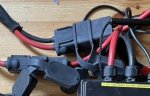
The new 200A BMS does not have mounting holes, which is a shame. The C- and B- lugs are also flush with one side, so once you put a bolt on there is now a protrusion of a bolt head height. I got some Stormguard Extra Thick Weatherstrip (8mm thick) from Screwfix and taped the BMS to this. The object here was to add a gap between the end plate for ventilation! Then added some super strong double sided tape (used for number plates) to attach this to the GP10 cell end panel. The BMS is 10mm from the side without the B+ Cable. As the 35mm B- cable has some tension to it I used two bits of packing tape to tape the BMS on. This stopped it moving as well as giving somewhere to tape the Bluetooth UART to. There is now a good airflow gap around the BMS.

There are some concerns the BMS may overheat as it has nowhere to dump energy. This could be true and we shall need to see. Allot of the commercial “drop ins” have similar designs or the BMS in lid area so they could suffer the same issue. If it is an issue, in the first instance the BMS will shutdown as it has an over temp setting on three temp sensors and secondly we can look at changing the design if this is a problem. During my low C (0.04/12.5A) discharge testing it was very hard to see any increase above ambient with both an IR gun and thermal camera. I presently do not have high C rate loads so this is a mute point. When I get a Victron Multiplus II 3000kva inverter we shall see!

Another improvement was adding longer tails to the Anderson connectors (300mm instead of 150mm) to make installing them easier. It also helps allot when assembling as the lid can be slid off the box down the tails out of the way. It would have been better to have been even longer (350mm~400mm) to get the lid completely out of the way, however there is a cost and space tradeoff.

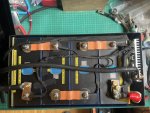
You may notice a change in the + and - Bus bars. These are the supplied bus bars chopped in half and M6 tapped. The + one is angle inwards so that it gives a little lateral movement of the main positive tail. Also this means it can change the angle and hence distance to the centre line and line up with the gland. This +ve tail is very close to the gland and terminal and is fitted last. I ended up redoing the heat shrink longer so that it was easier to get it onto the gland. I needed some jiggling!

Bar testing, next is the saga of the battery box reconfigure. Its a multipart saga of long paint drying times, poor templates, Covid and many attempts.
 
Testing results

I purchased a 180W battery tester from Aliexpress, however this one had a fault where it would not pull more than about 5A which makes it useless testing 304Ah cells! So I purchased a 150/180W Adjustable USB Constant Current Electronic Load Battery Voltage Capacity Tester, Electronic Load Charger Discharge Resistance Capacity Tester from Amazon.

I set this to 12.5A which is 0.04C rate approx. The 12.5A is based on my average higher loads (Fridge+Autopilot). You set a cutoff voltage which was either 2.5V when testing single cells or left when testing a battery to test the Low Battery cut off of the BMS.

Testing 304Ah cells takes over 24hrs. It is also interesting to note battery capacity varies allot with temperature (+/- 1Ah per 1C approx). Formal testing for the data sheet and individual cell tests by the manufacturer are done at a controlled 25C.

I tested all cells from 3.65V to 2.5V and recorded the results. I then matched/batched the cells and put the four largest in the first battery and the next four into the second. The logic here was to ensure that one battery was larger than the other as this should get more effective capacity as mixing them would give mean capacity and cells would be left with capacity when one cell forced the BMS to do a low cell cutoff.

Here are my results from testing the completed packs. Another interesting note is that Batteries test higher than the lowest cell. Also what I would expect to be the higher capacity Battery is actually slightly lower. I do not have an explanation for this. The Serial No. is a notional Serial number I have give these to identify the build/config in my notes.

Worth noting these are notional 304Ah cells, so they are testing above their rated/built capacity (3% above). This is not uncommon with the better sellers to supply cells that meet or exceed their capacity.

DateSerial No.Built Av Cap (Ah)Built Lowest cell Cap (Ah)Test (A)Test CActual CapacityDelta to avg (%)Watt hrs (Wh)
9-Jun-202220220602001310.9308.712.50.04312.3100.44%3994.04
7-Jun-202220220602002312.5310.812.50.04311.5299.69%3983.17
 
Battery box reconfigure

My boat does not have isolators near the batteries. It does have a 1-2-Both switch near the main electrical panel, around 4m of 25m2 cable away from the batteries. Also, there was lots of writing directly attached to the battery terminals. These were often without fuses. Nothing was labelled. I wanted to change this so that I could; a) Easily disconnect batteries; b) Switch off batteries c) Have them properly fused d) Knew what they were. All these changes are not dependant on LifePo4.

This meant reconfiguring the battery box wiring. I built a daughter board to make this easier to fit off the boat and avoid lots of holes in a bulkhead. I chose the wrong time to make this board as the paint was taking over 24hrs to dry in colder weather and it took several weeks to get the board ready. I needed a second attempt as my template did not take into account some other protrusions. A bout of Covid also delayed this another month. In the end I decided to make a bigger panel to accommodate everything as I was running out of space. Finally I also decided to remove the Engine start isolator and fuse holder to a different location to save space.

LifePo4 batteries require fuses that are fast acting and have the ability to have a very large interrupt rating (ie not arc when there is a large current flow). See this post for more details. T-Class fuses meet this. Getting T-Class fuses at the moment is tricky and they are not cheap. Also the Fuse holders are large and again not cheap. I purchased 300A Blue Sea Fuses and installed BEP 225-400A fuse holders on 35mm2 tails.

I purchased three 300A Isolators on Aliexpress to enable me to switch off any of the Batteries.

I also purchased some Heavy Duty Bus Bars. Two sorts 4xM8 and 2xM10 with 6xM6 bolts. The larger ones are to connect the batteries to the House cables and also the 6xM6 bus bars so that I can connect the “near battery” loads. For example I have the Windlass (via its own trip), Bilge pump, Shunt power and B2B charger.

I doubled up the connections between the -VE Load Bus bars, Shunt and Battery Bus bars. I was also careful to make the cable lengths the same and also to connect things in a way the batteries were equidistance. I repeatedly measured all the cables to ensure the resistance was small and the same between the different runs.

I plan on connecting the standard 70A alternator to the Engine Start battery, a Red Start 1800 AGM battery. Using the bus bars will interconnect the Victron 30A B2B charger to the LifePo4 house Bus bar. I also have two sets of solar. The Victron 75/15 MPPT can do a LifePo4 profile so will be connected to the LifePo4 Load Bus bar. The others are a 6V MPPT to match the 6V Solar Panel, these are non-programmable. These will be connected to the engine start battery. This will then charge the LifePo4 via the B2B.

I plan on adding another 25mm2 cable to/from the 1-2-Both Switch to give an effective 50mm2 although using two wires has a lower rating than a single wire of the same cross section. I will replace the Battery charger with an inverter. If using a 3000kva model this should draw 250A. The two 25mm2 wires should be fine. The 1-2-Both switch is mounted on the locker which holds the Battery charger as well the solar MPPT Regulators. These regulators are wired to the 25mm2 cable going to the batteries. The inverter is another project!
 
  • Like
Reactions: vas
Some more pictures…

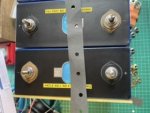
Here is the wet and dry sandpaper with hole punched holes.

72C6F7BB-4132-4334-B5E8-CE330F8C1DD6.jpeg

Then using a 6mm standoff/spacer cleaning the terminals.

8DE4104E-BA45-4EBB-9D82-416AD0A4D87B.jpeg

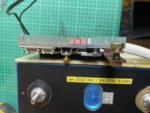
The BMS attached with double sided sicky tape and foam to make a standoff from the FR4/GP10 plates

76381ED6-26BF-4F33-A38B-3D9097EF685A.jpeg

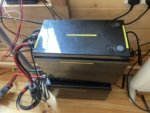
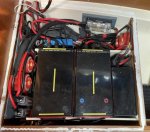
A completed pack in the box. Also shows balance leads and other cables wrapped in the automotive electrical tape. 35mm cables to the SB175 Anderson connectors are also attached.

3B896E57-EF69-4717-A080-806456A185EC.jpeg

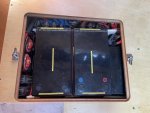
Two assembled packs

E834E529-EE2A-451D-BED6-1EA0810C06DA.jpeg
 
Last edited:
The electrical board and testing.

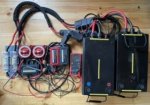
The idea id that sources on left, loads on right. T class fuses on far left. Top red isolators. To the bottom is a Victron Shunt. To the right is the positive and negative load bus bars.

0F700DA4-A7F3-435F-883D-A2D7C4723AA1.jpeg

Close up of SB175 Anderson connectors with boots.

E8D00F24-F8C1-463F-B2B0-FE91C3E531D2.jpeg
 
Last edited:
Final Fit

I assembled all the packs and then boat daughter board in Le Shed and tested the connections. I did multiple tests with my Internal Resistance meter and bar one connection which I re-tightened, they all seemed good end to end.

I then spent quite a while onboard sorting the boat wiring. It transpires that there is allot of redundant wiring. For example the battery charger live above the 1-2-Both Switch. It could be connected to the back of that (or a Bus bar near there) which would have been a 300mm run. Instead the cables are feed around 4M and directly mounted to the battery terminals. Similar story with the old, Nav station voltmeter. I bundled all these up once I had confirmed them.

I then spent quite a while relabeling everything with black on yellow 6mm Brother TZe label tape. The yellow contrasts well against the black and red cables and also makes it easy to spot a label. I attach this in the same orientation as the connector and about 150mm from the end. I also cover this with a clear heat shrink. This gives a nice neat label that should never come off.

It took a surprisingly long time, partly because I did not have a mains powered heat gun to do the heat shrink. I also had to remake many of the ends as lug sizes were different, which was not a bad thing as many had corroded as they had no heatshrink and the original cable is not tinned.

In the pictures below you will see a Work In Progress. I have not completed the cable tidying / securing. As you can see it is quite a tight install in this area. There is not much room on this boat! I may move the Engine start battery to be above the engine in the future as this will give more space.

I may move the Victron Battery 2 Battery charger to be above the 1-2-Both switch which is a far better ventilated space. Also the addition of small computer fans helps a lot with their efficiency and output. This video from Mispronounced adventures has more details.
 
And some pictures onboard

With locker lid off. To the right is the Start battery, its isolator and fuse. The blue box top middle is the B2B Charger. The board is mounted to the left. Boat wires come in either from the top left (main pos and neg) or bottom left (engine neg and bilge pump).
DD7E98A5-F961-48D3-8A51-EC5F8428ABF1.jpeg

With lock top attached. Yes its tight.
2AFB93BD-DDBB-46D1-9807-A99D7EFC5578.jpeg
 
And some pictures onboard

With locker lid off. To the right is the Start battery, its isolator and fuse. The blue box top middle is the B2B Charger. The board is mounted to the left. Boat wires come in either from the top left (main pos and neg) or bottom left (engine neg and bilge pump).
View attachment 139269

With lock top attached. Yes its tight.
View attachment 139268
too tight for my liking tbh!
looks v.good though. If you don't plan to demand large currents it would be perfect.
 
If I do get a largish inverter i plan to remove the cells and board and test heat at home with my IR and thermal camera.
 
sorry, just seen it Greg,

for sure ventilation around the BMS. Having the BMS stuffed in a sealed box would have me worried if I was to draw some serious amps out of the battery.
I mean my BMS doesn't have mosfets, so taking 90-100A is fine, nothing heats up (except the Multiplus but it's elsewhere!)
I cannot believe that discharging your sealed box at 50-60A wont introduce some serious heat (OK, assume at least half hour constant use as when I run my watermaker) There's no way for the heat to escape.

Cabling if I can easily access/move/remove bits, it's fine, just cannot see how that is done in this setup.

cheers

V.
 
I get what you mean @vas. This is little different from many "drop in replacement" models I have seen from Will Prose and others teardown videos where they also stuff a BMS in a box (BattleBorn do the same). I have not seen any issues under high C discharge tests/videos, although they must be getting warm.

I would argue this is a slight improvement in these ways;

  1. This BMS has a large heat sink on the both sides (inc fins)
  2. It has temp sensors internally and externally (two) will cut out if it gets very hot - other BMS have this also
  3. My BMS is vertical at the side. Most others I have seen are horizontal on the top of the case. I would assume being on the side and vertical allows a little/tiny amount of airflow in the case
 
indeed, although you have to question how much air is in there, and what happens once it circulates for half an hour, the whole air available and the cells and the plastic casing start heat up (and in a way the casing helps ? dissipate heat to the locker)
as I said above, all that is theoretical unless you try and suck serious amps for long time (which will be sorted by the BMS shutting down!)

V.
 
Top