Lithium 304Ah Build

At least 30 degC is not 40deg C ... and so on. I think people generally take the hit on longevity caused by higher ambient temperatures. As you say, it is the combination of high ambient temperature, high rate of charge and discharge and the percentage of time at high SOC which cause degradation. I have a fan that is thermostatically controlled but that is only of value with high C charging or discharging when the pack exceeds the ambient temperature but the most I charge at is 0.3C which raises the temperature fairly minimally so I've never used it being UK based. A fairly common solution is to have the pack adjacent to the main cabin so it shares the temperature that is tolerable to the human occupants who will do their best to keep the air cool by whatever means.

Will Prowse has a good summary of the issues in this video ...
Our lead bank is in the saloon. Since we spend all our time in the cockpit we leave the saloon cushions off over the battery box and leave the battery box lid off. The temperatures I quoted are for my batteries under this scenario. If I cover the batteries the batteries spend most of their time over 30degC even though the battery box is ventilated. The sea temperature is 27degC so little cooling effect from pulling ventilation air from the bilges.
 
Our lead bank is in the saloon. Since we spend all our time in the cockpit we leave the saloon cushions off over the battery box and leave the battery box lid off. The temperatures I quoted are for my batteries under this scenario. If I cover the batteries the batteries spend most of their time over 30degC even though the battery box is ventilated. The sea temperature is 27degC so little cooling effect from pulling ventilation air from the bilges.

Sounds like you may be doing all you can. You may not be able to leave LFP cells in your will, in that case but may still find the investment worthwhile (with the emphasis on 'may'). I'm surprised more low-cost cooling options haven't emerged. For example, I have one of these evaporative coolers for our cabin which works surprisingly well especially if focussed on a small area. The only power cost is the 12 volt fan. Transcool Air-Conditioning United Kingdom
 
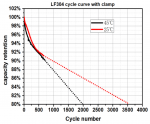
is 25-30C such an issue on LifePO4? The EVE 304 cells that Greg and I have show this:

View attachment 129852

doesn't look too bad to me tbh

V.
One of our problems is we leave the boat in the Caribbean for the summer and fly home for 3 months. Cabin temperature easily hits 45 degC when the boat is on the hard and doesn't cool much over night. You can't leave the boat well ventilated due to critters.
Everybody I have spoken to who left their boat here in a yard for a year or more due to covid has come back to destroyed batteries.
 
is 25-30C such an issue on LifePO4? The EVE 304 cells that Greg and I have show this:

View attachment 129852

doesn't look too bad to me tbh

V.
It looks pretty bad to me when I know I am going to be seeing battery temperature in the 30s. It's winter. Ambient temperature will be rising. We often see 30/35 degC cabin temperature as we get towards the spring.
 
in which case you stick to FLA unless it makes sense to built a peltier fridge box and enclose them there to keep them between 15-20C with the solar you already have deployed (unless you remove and store them)
at a guess 4-5 of these would probably do and would suck 4-5A
 
One of our problems is we leave the boat in the Caribbean for the summer and fly home for 3 months. Cabin temperature easily hits 45 degC when the boat is on the hard and doesn't cool much over night. You can't leave the boat well ventilated due to critters.
Everybody I have spoken to who left their boat here in a yard for a year or more due to covid has come back to destroyed batteries.

That's tricky. The fact that everyone had destroyed batteries is a good reminder that all batteries suffer from higher self-discharge and poorer longevity in the heat but, of course, that matters less if you are not making such a high investment as with LFP. The only options I can see is to store at low states of charge and use a fan at night that comes on by timer to draw cooler air around the pack. With some experimenting with solar controller settings for absorption and float (around 13.3 volts for a nominal 12 volt pack) it is possible to hold the SOC around mid-range and still draw power for a fan or other small load as needed.
 
Storing lithium at a low state of charge is important for their life. I store them between 1/4 and 1/3 capacity. Keeping them cool is not easy in the Caribbean in Summer and temps do get up to 45C. I will probably work on soar gain, ventilation and maybe buy an aircon this summer, but not just for the batteries, for the health in general of the boat and for the efficiency of its mechanic.

By the way, they don’t heat up perceptibly in charge or discharge, unlike lead. My bank is close to ambient temp always.
 
At one point I bought some of these horseshoe shaped packing shims with the intention of increasing air flow between the cells and still allowing mild compression. In the end I didn't use them, since as Zing says there is not much heat to lose during partial C charge and discharge, but they might have a use if a cooler air flow is available even temporarily. https://www.amazon.co.uk/PLASTIC-HORSESHOE-PACKING-WINDOW-PACKER/dp/B01FVQ4WB0/ref=sr_1_21?crid=28SN3IPER57UM&keywords=Spacers&qid=1644071615&sprefix=spacers,aps,73&sr=8-21

Also - 60 watt DIY Peltier kits .... DIY Thermoelectric Peltier Refrigeration Cooling System Kit + Module + Fan L3E6 | eBay
 
Last edited:
Storing lithium at a low state of charge is important for their life. I store them between 1/4 and 1/3 capacity. Keeping them cool is not easy in the Caribbean in Summer and temps do get up to 45C. I will probably work on soar gain, ventilation and maybe buy an aircon this summer, but not just for the batteries, for the health in general of the boat and for the efficiency of its mechanic.

By the way, they don’t heat up perceptibly in charge or discharge, unlike lead. My bank is close to ambient temp always.
We did some experimenting with this overnight last night on a 800Ah 24v lithium bank on a 80ft yacht. Charging at 300amps the batteries started at 30.8degC and 47% SOC. By the end of the charge cycle the batteries were at 34.4 degC. They do heat up but if you are charging slowly with solar over the course of the day you may not see this kind of temperature rise.
 
yep, on the experiments I've done at home (bank just built not on the boat yet) charging the 304Ah at 45Ah, after 5h temp had gone up by 1-2C.
also tried charging at 5A, no change at all after half a day :-)

The graphs don't say that much though, not to mention that imho they are grossly speculative.
what is exactly the concept of cycling a battery? in "normal" days onboard SOC will vary from 50-60% in the morning to 80-90 in the early afternoon. Does that count as a "cycle" to be subtracted from the theoretical 3000 or 4000?
is it? my use is for the foreseeable future going to be 3m each season, even if so, that's 90cycles per year I hope I'll outlive them. if you do 9m a year still it's 10yrs to loose 20% of the capacity, doesn't mean you have to change them then if they are still enough for your needs.
Dunno, all these graphs and numbers don't give the full story I think.

V.
 
yep, on the experiments I've done at home (bank just built not on the boat yet) charging the 304Ah at 45Ah, after 5h temp had gone up by 1-2C.
also tried charging at 5A, no change at all after half a day :)

The graphs don't say that much though, not to mention that imho they are grossly speculative.
what is exactly the concept of cycling a battery? in "normal" days onboard SOC will vary from 50-60% in the morning to 80-90 in the early afternoon. Does that count as a "cycle" to be subtracted from the theoretical 3000 or 4000?
is it? my use is for the foreseeable future going to be 3m each season, even if so, that's 90cycles per year I hope I'll outlive them. if you do 9m a year still it's 10yrs to loose 20% of the capacity, doesn't mean you have to change them then if they are still enough for your needs.
Dunno, all these graphs and numbers don't give the full story I think.

V.
What environment does the boat/batteries sit in during the period you don't use the boat? Since heat kills them my concern is how to keep them cool. The temperature measurements that we took are only telling us battery surface temperature not what is going on in cells. There may well be higher local temperatures we are not measuring.
 
What is exactly the concept of cycling a battery? in "normal" days onboard SOC will vary from 50-60% in the morning to 80-90 in the early afternoon. Does that count as a "cycle" to be subtracted from the theoretical 3000 or 4000?

A cycle is sometimes - more accurately - referred to as an equivalent full cycle (EFC). So that would be 100% of battery capacity even though spread over more than one day. But you can immediately see the problem as a series of shallow discharges to make up the 100% would be less degrading than a complete discharge. So it can only be a rough guide.
 
What environment does the boat/batteries sit in during the period you don't use the boat? Since heat kills them my concern is how to keep them cool. The temperature measurements that we took are only telling us battery surface temperature not what is going on in cells. There may well be higher local temperatures we are not measuring.
in my case, mobo f/b salon sofa/locker temps not lower than 4-5C in the depths of winter (last month for a few days-12-13C seawater), max 30-32 in July. Ambient may well reach 35 but not inside, will be 40 for a week in land, not on top of 26C water. Boat in the water all the time. When at hard, extremes are obvs exaggerated, but that only is a couple of weeks in spring every two years.
Regarding temps, found and read a research paper on prismatic lifepo4 cell temps, don't have a copy at hand, two main conclusions were that best spot to measure temp is stick the thermistor just above halfway the narrow side, as good as any place. Second, temp variations are really small 3-4C, so not to be of any significance. Sorry if you see how they are constructed it's v. difficult to argue that temps can be much higher inside, what inside, it's 70mm in all, some sort of clay/mud type of thing, and sheets of paper thin metal in succession wrapped in a fancy origami pattern.
Highest temps I'd expect are from dodgy connections.
 
A cycle is sometimes - more accurately - referred to as an equivalent full cycle (EFC). So that would be 100% of battery capacity even though spread over more than one day. But you can immediately see the problem as a series of shallow discharges to make up the 100% would be less degrading than a complete discharge. So it can only be a rough guide.
so, 3days of 60%-90% SOC in succession count for one full cycle? doubt it tbh. Thing is for non-liveaboards, discussing the longevity of LifePO4 is imho pointless. I'm 57, boat is 45, no plans to change, who's going to outlast whom?
rather not be the batteries! :D
 
in my case, mobo f/b salon sofa/locker temps not lower than 4-5C in the depths of winter (last month for a few days-12-13C seawater), max 30-32 in July. Ambient may well reach 35 but not inside, will be 40 for a week in land, not on top of 26C water. Boat in the water all the time. When at hard, extremes are obvs exaggerated, but that only is a couple of weeks in spring every two years.
Regarding temps, found and read a research paper on prismatic lifepo4 cell temps, don't have a copy at hand, two main conclusions were that best spot to measure temp is stick the thermistor just above halfway the narrow side, as good as any place. Second, temp variations are really small 3-4C, so not to be of any significance. Sorry if you see how they are constructed it's v. difficult to argue that temps can be much higher inside, what inside, it's 70mm in all, some sort of clay/mud type of thing, and sheets of paper thin metal in succession wrapped in a fancy origami pattern.
Highest temps I'd expect are from dodgy connections.
When prismatic batteries are arranged in packs, the middle packs have only a small external surface area to release heat from. I am familiar with the construction of prismatic and cylindrical cells. In cylindrical cells the heat builds up in the centre of the battery. Since prismatic cells are spiral wrapped I would expect a similar rise in temperature towards he centre of the battery. Surface temperature does not tell the whole story during charging/ discharging. I accept that solar charging at low charge rates reduces battery heating but alternator charging at high charge rates could be another story in a high ambient temperature environment.
 
Need to find data from decent experiment done with probes within the pack. Also need to understand what raising temp to say 40C when charging for 4h every 1week mean in terms of longevity, my guess is not much at all. OK, if the bank is at 40C 24/7 I'd expect a loss.
 
so, 3days of 60%-90% SOC in succession count for one full cycle? doubt it tbh.

What is it you are doubting If a cycle is defined as discharging the equivalent of 100% of the capacity regardless of the number of days? (Except your three days would be 0.9 of a cycle as defined.) You might however doubt that 'cycle' is a really meaningful definition - as would I.

Just to illustrate that, Rod Collins has done very careful capacity testing of his nominal 400ah Winston pack using pretty sophisticated equipment. His 2009 Winston cells have now completed 772 cycles (few lead acid would deliver 300 before death) and on the most recent capacity test it delivered 432ah. In that time many LFP packs would have led tragically short lives. How well the pack is looked after determines long-term health more than cycle numbers. It is sometimes said that no-one knows how long a well looked after pack will last.

End of this paper for details of the testing. LiFePO4 Batteries On Boats - Marine How To
 
Last edited:
  • Like
Reactions: vas
When prismatic batteries are arranged in packs, the middle packs have only a small external surface area to release heat from. I am familiar with the construction of prismatic and cylindrical cells. In cylindrical cells the heat builds up in the centre of the battery. Since prismatic cells are spiral wrapped I would expect a similar rise in temperature towards he centre of the battery. Surface temperature does not tell the whole story during charging/ discharging. I accept that solar charging at low charge rates reduces battery heating but alternator charging at high charge rates could be another story in a high ambient temperature environment.

As a rule of thumb anything up to 0.3C of charging is generally seen as not too problematic heat-wise. I charge at 80 amps by alternator with my 270ah pack (just under 0.3C) and only see a fairly minimal rise in temperature.
 
We did some experimenting with this overnight last night on a 800Ah 24v lithium bank on a 80ft yacht. Charging at 300amps the batteries started at 30.8degC and 47% SOC. By the end of the charge cycle the batteries were at 34.4 degC. They do heat up but if you are charging slowly with solar over the course of the day you may not see this kind of temperature rise.
As a rule of thumb anything up to 0.3C of charging is generally seen as not too problematic heat-wise. I charge at 80 amps by alternator with my 270ah pack (just under 0.3C) and only see a fairly minimal rise in temperature.
These batteries only warm up if charged fast as mentioned (my CALB are rated up to 0.5C), also if the charge is extended at the top end you produse heat and harm, so if you charge at less than 0.3C and go to a 95% SoC max, ideally a little less then you won’t heat them up perceptibly. That is my experience. The peukert rating is about 1.02, and if all that loss goes into heat it is a negligible amount. I can’t think of any other reason why they would heat up in use.
 
Top