Knife sharpening

Gsailor

...
Joined
30 Sep 2022
Messages
1,337
Visit site
So, watching tv as usual (yeah, yeah, that is what us oldies do) saw a chap cut a rope...

reminded me of my one time hobby of sharpening knives - all sorts of bevels.

In the end, I preferred wet stone to oil stone and for a very sharp knife, higher and higher grades of wet and dry sand paper ( up to about 2000 - that is very very fine paper).

Then of course I had to decide which knives went on the boat - stainless or carbide?

Carbide needed oil to stop rust.

It all came to a head when I was crew and had to cut a 1 inch line quickly - I managed it easily thanks to all the prep.

If you have ropes on board you need knives imho (even special ones for prop entanglement).

I acknowledge this could be a contentious subject - I don’t mind- I know a knife is essential - and the more brightly coloured the better - I once foolishly left my mooring with the tiller lashed- I cannot remember why - it was a fast catamaran in a crowded mooring. No time to untie knot - knife in boot and one slice and I had steerage - a “phew” moment - because I had a knife ready.
 
So, watching tv as usual (yeah, yeah, that is what us oldies do) saw a chap cut a rope...

reminded me of my one time hobby of sharpening knives - all sorts of bevels.

In the end, I preferred wet stone to oil stone and for a very sharp knife, higher and higher grades of wet and dry sand paper ( up to about 2000 - that is very very fine paper).

Then of course I had to decide which knives went on the boat - stainless or carbide?

Carbide needed oil to stop rust.

It all came to a head when I was crew and had to cut a 1 inch line quickly - I managed it easily thanks to all the prep.

If you have ropes on board you need knives imho (even special ones for prop entanglement).

I acknowledge this could be a contentious subject - I don’t mind- I know a knife is essential - and the more brightly coloured the better - I once foolishly left my mooring with the tiller lashed- I cannot remember why - it was a fast catamaran in a crowded mooring. No time to untie knot - knife in boot and one slice and I had steerage - a “phew” moment - because I had a knife ready.
Yes, a very contentious subject. I gave up on oil and wet stones for sharpening knives and woodworking tools many decades ago in favour of these diamond "stones" used dry 8" Diamond Whetstone™ Sharpener with Hardwood Box . Mine are over 30 years old and still work perfectly so a good investment.
 
Last edited:
Yes, a very contentious subject. I gave up on oil and wet stones for sharpening knives and woodworking tools many decades ago in favour of diamond "stones" used dry 8" Diamond Whetstone™ Sharpener with Hardwood Box . Mine are over 30 years old and still work perfectly so a good investment.

[Unwelcome content removed]
Yes, I forgot - I have one of those too (although a much cheaper version that probably will not last as long as yours- probably no diamond grit in mine at all 😊-) a four sided object with finer and finer sides- easy to use, no water or towels needed.
 
Last edited by a moderator:
Then of course their is the decision of folding knife or sheath knife- I used to carry both - all brightly coloured- folding knife close to hand, sheath knife in boot and other sheath knives here and there- only responsible adults crewed with me - if children aboard, a whole lot of education would have been needed.
Bring back the Scout movement!
 
Then of course their is the decision of folding knife or sheath knife- I used to carry both - all brightly coloured- folding knife close to hand, sheath knife in boot and other sheath knives here and there- only responsible adults crewed with me - if children aboard, a whole lot of education would have been needed.
Bring back the Scout movement!
You seem to have a knife fetish.
 
You seem to have a knife fetish.
I did have.

I had a boot fetish, a coat fetish, a life jacket fetish, a radio fetish, a hat fetish...the list goes on...

The knife fetish saved my bacon (or boat) that one time.

All oiled and stored now. Will sell one day when I find where I stored them - a simple Swiss Army knife does all I need these days.
 
  • Like
Reactions: Aja
I use a diamond stone to shape my woodcarving tools but stone stones for sharpening. I haven’t got around to trying this on other knives but really don’t want or need them to be that sharp.
 
Now what about my 1897 pattern 1912 officer's sword, it has not been service sharpened but the point is very pointy made by Wilkinson Sword.
Then I have my Solingen sabre for fencing and a couple of Leon Paul foils.

apart from my woodworking chisels I mainly sharpen my kitchen knives with a drystone that came with a Swiss Army Champ, for the chisels and planes I use a diamond stone
 
I use a diamond stone to shape my woodcarving tools but stone stones for sharpening. I haven’t got around to trying this on other knives but really don’t want or need them to be that sharp.
This raises a good point, of course; knives that are looked after really only need “honing” (IIRC) as opposed to re-shaping (taking nicks out of the blade etc).

If my knife was just dull I would perhaps use a very fine wetstone, but would always hone the knife on leather afterwards.

Sometimes, all I ever needed to do was just use the leather strip to hone the knife and test the edge on paper and the job was complete - thanks for reminding me. Took me years to learn and not as many to forget until you reminded me.

It took me years to learn all the proper techniques even though I was first given a one inch bladed penknife aged 5 years (very blunt - the lanyard was more fascinating than the knife almost) and even went through Cubs and scouts without learning the proper techniques (as mentioned herein a few lines ago) many years later.

Proper care did become an art almost for me - and for some proper care is a profession.
 
...but really don’t want or need them to be that sharp.
You will have heard it before no doubt and I imagine it all depends upon the task but...

“a Dull knife is a Dangerous knife” was drilled into me as a Scout possibly.

as in one may apply too much pressure to cut something with a dull knife, slip and cut something that really did not want cutting
 
All this mention of scouts and knives reflects days long gone. Scouts would not be permitted to carry knives now. Or perhaps only when camping in the bush. Even then not encouraged. Scouts has morphed from survival in the bush to survival in the city. ie trying to help boys and girls grow to take their place in a modern society armed hopefully with armour against all the bad influences. But yes does in many cases include sail training and camping. ol'will
 
All this mention of scouts and knives reflects days long gone. Scouts would not be permitted to carry knives now. Or perhaps only when camping in the bush. Even then not encouraged. Scouts has morphed from survival in the bush to survival in the city. ie trying to help boys and girls grow to take their place in a modern society armed hopefully with armour against all the bad influences. But yes does in many cases include sail training and camping. ol'will
I didn’t know scouting had changed so much.

I can realise knife carrying may not be as acceptable (but cannot understand it if on a campground)

We were never without a sheath knife on our belts (I had a beaut of one - Sheffield steel- full tang of course- wide blade - leather sheath - still have it) - used for wood, cooking, rope work...

Also a penknife with things such as a tin opener.

Great days.

Never did it enter minds that the knife was a weapon- it was a tool.
 
All this mention of scouts and knives reflects days long gone. Scouts would not be permitted to carry knives now. Or perhaps only when camping in the bush. Even then not encouraged. Scouts has morphed from survival in the bush to survival in the city. ie trying to help boys and girls grow to take their place in a modern society armed hopefully with armour against all the bad influences. But yes does in many cases include sail training and camping. ol'will
That's pretty much what that awful old racist BP wanted Scouting to be; helping little people to become well-rounded big people. Nothing's changed in that sense, although specifics may have shifted along with societal mores. Learning to whittle bits of wood with a penknife never did me any harm.
 
You will have heard it before no doubt and I imagine it all depends upon the task but...

“a Dull knife is a Dangerous knife” was drilled into me as a Scout possibly.

as in one may apply too much pressure to cut something with a dull knife, slip and cut something that really did not want cutting
true but a pointy knife can be dangerous too. I stabbed myself in the hand with a sharp pointed kitchen knife in the galley years ago (I know, clumsy me) and since then have ground the pointed end off that type of knife for cooking at sea.
 
Bane of my life, picking up a knife that won't even start a tomato. Can't get her to just give the knife a stroke every time is used, she hates sharp knives, which as we all know are safest. Best sharpener for me, the edge of toughened glass, eg car window.
 
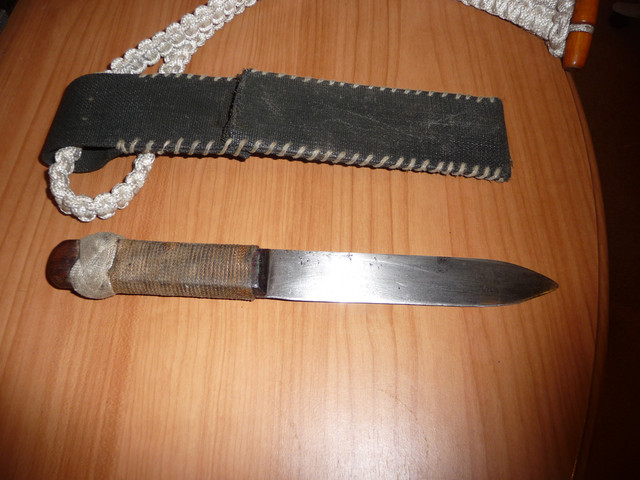
I Joined my first ship at Avonmouth as a 16+ year old Deck Boy and we sailed for Corner Brook Newfoundland the same evening. Out in the Bristol Channel cleaning up the debris from the time in Port, the old Bosun told me to cut away some sacking bundled up on deck, I wasn't carrying a knife and I swear my head is still ringing from the whack he gave me, along with the warning, Never come on deck again without a knife.
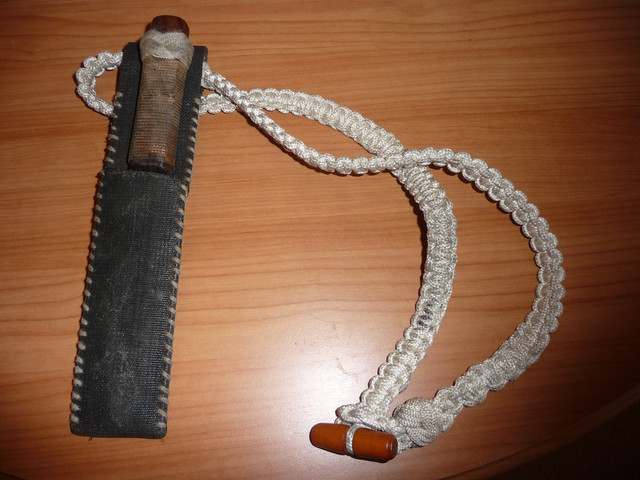
It may seem strange now, but making a knife belt and covering the handle of your deck knife with fancy whipping was a Rite of Passage for Deck Boys and Junior Ordinary Seamen in those days. Until it was done, properly, to a generally approved standard you were still rated below the Ship's Cat....:LOL:
Still got mine 63 years later. :)


I keep a knife at the mast and one at the compass binnacle as emergency knifes. Various other knifes are on board, multi tools, safety knife (blunt tip so it won't stab and puncture). I can sharpen but it is very amateurish and the edge does not hold well, definitely a skill that needs practise.

I recently change over to wet and dry paper on a flat tile, works a lot easier than a stone.

A long time ago the local barber that my mum took my brother and I too, would sharpen his shaving razor on a leather strop. More recently, at a barbers, a travelling sharpening person, was on location with a kit, sharpening all the barbers scissors and blades. He was using a piece of paper to test sharpness.

The shipwrights who worked on my boat, would periodically sharpen hand tools on the boat just using a whet stone. They made it look easy. On YouTube, Tips from a Shipwright, with Louis Sauzedde, hand sharpens with rubbing alcohol, as he thinks it better lubricates the blade. He grinds back with an aluminium oxide stone as it dissipates heat faster. Another YouTuber showed how low cost wood chisels should have their backs ground flat first as many are ground with a bow and are not flat. By doing this first, you get a superior edge.
 
I didn’t know scouting had changed so much.

I can realise knife carrying may not be as acceptable (but cannot understand it if on a campground)

We were never without a sheath knife on our belts (I had a beaut of one - Sheffield steel- full tang of course- wide blade - leather sheath - still have it) - used for wood, cooking, rope work...

Also a penknife with things such as a tin opener.

Great days.

Never did it enter minds that the knife was a weapon- it was a tool.
Just to be clear, carrying a knife in public in Scotland is an offence.

My brother habitually comes north of the border with his Swiss army knife in his pocket. I repeatedly advise him against this.

One day he'll take it out of his pocket to find some change in a shop or something and he'll get more than a gentle reminder from PC Murdoch.
 
Top