Keel question

HitNruN

New Member
Joined
11 Feb 2010
Messages
7
Visit site
During years I've learned a lot from this forum. Now I have new questions regarding the keel of my boat.
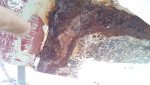
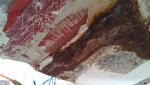
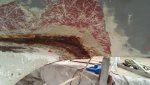
Boat is an S&S design IW 31 (same boat as She 31).IMG_20150725_174250.jpgIMG_20150725_174140.jpgIMG_20150725_174047.jpgIMG_20150725_174010.jpg
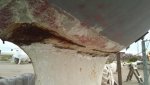
First question is about the keel not being level with the hull as if it was hit to rocks and got separated from the hull but this would cause some cracks, at least on the gelcoat but there are no cracks anywhere. Hull is in perfect condition. The keel to hull joint was laminated with fiberglass to keep it dry but it actually caused a bigger problem. Water found its way through the poorly made lamination and kept the keel wet even on the hard causing lots of rust. So, can the cause of keel not being level with the hull be a thick rust layer that tries to separate the keel from the hull?
The keel bolts seem fine from the inside the boat but very very rusty from the outside. Do I need to change them?
I know this is a millionth time someone asks how to clean the rust but a new opinion might make my day so I ask it anyway. I'm thinking of using an angle grinder sometimes with disks and sometimes with wire brush cup to clean the rust until bare metal. Sandblasting seems to be a very expensive deal even though it surely is the best option in my case. Do you suggest dropping the keel to get rid of the rust thoroughly or is it enough to clean from the outside and put 4 to 6 layers of epoxy barrier paint?
I also am planning to apply phosphoric acid before the barrier coat to eliminate rust returning fast.
Any idea is highly appreciated. Any pics if available would be wonderful if anyone has done this before and took pics during the process.
 
In short, that keel has to come off so that you can see (and deal with) the entry points of the keel bolts into the keel. Using the yard boat hoist to lift the hull off would be the easiest but then you have to think about the mast!
(IMHO looking at small photos.)

Steve
 
We had our keel dropped on advice from the surveyor, and our keel joint was nowhere near as bad as yours! (No offence :encouragement:)

The yard had built a special trolley to accept the keel when it was dropped and the yacht was held in the slings for a over a week ( it was mid-winter so no launches/lifts needed by others) while the keel was completely ground/cleaned back, treated for rust, and the top sealed with 6 layers of epoxy before being bedded in again, over the course of a week, with a soft compound, and tightened each day just a little more so the compound didn't all squish out at once.

There was no need to remove the mast; the yard decided they could stabilise the yacht in the slings with some pretty comprehensive tie-downs, which saved the cost and hassle of mast lowering.

It was not planned for/anticipated work, but the state of the keel joint became very apparent after blasting 12 years worth of antifoul off prior to re-epoxying and coppercoating. It was a very long winter but we finally went on the water earlier this month. Very well worth the job if you plan to keep the boat, as you will have peace of mind, and it's hard to put a price on that.
 
Last edited:
Keel bolts are vulnerable to corrosion where they pass through the hull at the joint. As your keel joint has opened and water has got in the bolts will almost certainly be corroded, particularly as it has been glassed over which keeps the water in. So, no realistic option but to drop the keel, have it blasted, epoxy coated and then rebedded with new bolts. Inevitable consequence of somebody not repairing it properly in the first place.
 
Keel bolts are vulnerable to corrosion where they pass through the hull at the joint. As your keel joint has opened and water has got in the bolts will almost certainly be corroded, particularly as it has been glassed over which keeps the water in. So, no realistic option but to drop the keel, have it blasted, epoxy coated and then rebedded with new bolts. Inevitable consequence of somebody not repairing it properly in the first place.

+1

This is clearly one of the (fortunately quite rare) occasions where a GRP hulled boat's keel absolutely has to come off. There is clear evidence of significant corrosion in the hidden hull/keel/keelbolt area. I have seen a couple of surveys recently recommending "drawing a keelbolt" to check with no external evidence of a problem ( probably a covering statement post 'Cheeky Rafiki' ) that I thought was totally unnecessary, but but this is not that. There is a problem, and you won't know how bad until the keel is dropped.

Unlike a beamy modern Jeanneau 37 with a lot of form-stability (one sailed about 150 miles keel-less a few years ago), a She 31 type is more or less totally dependent on the keel for stability.
 
There's absolutely no question that the keel must come off as others have said. You may have to level the top of the keel with epoxy putty after shot blasting which I'm afraid is the only sure way of getting rid of all the rust. The bolts will have to be renewed. If the rust layer is extensive on the top of the keel there may have been compression of the laminate so take a good look there.
 
Thank you all for the answers. Seems like what I was afraid has happened... Keel will be a project for next summer, I guess.
We aren't allowed to keep mast stepped in our boat yard so mast is off already.
I have some follow up questions...
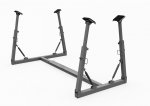
1. When the keel is dropped, can I keep the boat on it's crane until keel is ready to be reattached (will the crane carry the weight of the hull and engine and will the hull stand the weight applied by crane pads)? Hull should weigh about 1700- 2000 kg when the keel is off. There is no way I can keep the boat on slings, because I need to call in a lift and they charge 80 to 150 Euros for 1/2 hours. A pic of the crane is attached.625-SB10004.jpg
2. I guess I will need to have the new keel bolts custom made. Can they be made of 316 stainless steel or does 316ss corrode when it contacts with cast iron keel?
3. Can I use Sikaflex 291 for bedding? I will put a layer of hardened epoxy (with colloidal silica) on top of the keel to level with the hull; when dried, I'll attach it to hull.
4. Can I paint the keel with zinc rich epoxy primer only or do I need to apply phosphoric acid first and than paint with primer?
I am planning an extended cruising therefore I've been slowly preparing the boat ( a total refit that has lasted over a year already). This seems like the second most expensive and difficult process along the way, after the new engine. One of the previous owners did a really poor job about the bottom and a cheap, home made mast collar (many holes in the mast and lots of water through into the bilge).
 
Last edited:
Without the keel attached, your boat would be standing on the pads of the cradle. Over time that's not good for the laminate, but it can be improved. If you get heavy duty webbing straps similar to those use for lifting or those used to strap down a load on a lorry, then take them from strut to strut across beneath the boat it will spread the load almost entirely along the length of the sraps. You might like to also consider making close fitting wooden faorms which can be propped up under the boat to give more support again. It does have the advantage that with the hull up in its normal position in the cradle, you will have good access to the area where the keel is bedded and you can take your time getting it smooth and prepared for when you refit the keel.

In case of bad weather, it would be a good idea to also take straps down from the boat to the frame of the cradle so the wind cannot start to roll it in the cradle. These straps will have to resist the windage of the boat which can be considerable. OK if you have a pierced metal toerail, but if not you can add strength and rigidity by laying a scaffolding pole across the deck, maybe tied to a pair of winches or similar, and then take the straps down from the pole to the frame. Some secondhand anchor chain would be ideal for these! Of course, when you're not working on the underside of the hull, you could put a solid baulk of timber along the keel bed with an acro (scaffolding prop) under each end to take most of the weight in the same way the keel normally does.

Rob.
 
The keel does provide a significant amount of support to a boat sitting in the cradle so, if you remove it, essentially you need to try and recreate that support. This is quite easy and can be done with a cobbled together wooden frame, wooden blocks or even high density polystyrene. The boat will sit quite comfortably for a long time with any kind of reasonable support.
 
You will probably find the keel bolts are actually threaded studs with nuts. This is the normal way of making them using 316 stainless bar, exactly the same as used for prop shafts. An ordinary machine shop will do this - no need to go to anywhere "marine". No problem with corrosion as when you put the keel back on properly with a bedding sealant no water can get to the bolts. Make sure the floors the bolts go through are sound and use large 4mm plates, then washers under the nut. This method is almost universally used by production boat builders.
 
I wouldn't bother with stainless steel especially if they are mild steel originals. There is always the slight risk of crevice corrosion with SS below the waterline or in any oxygen poor environment. Mild steel is more than adequate for this purpose and easy to get made up to match the old ones. If the old ones are galvanised this is easy to get done also.
 
>Get your keel shotblasted while it is off and make sure the first coat of zinc rich epoxy primer goes on within minutes.

Agree it's the only thing that works, having owned a steel boat. Rust killer/preventer doesn't work the rust comes back, from experience., Also the last thing you want use is tu use a wire brush it will leave tiny bits of metal on keel.
 
I wouldn't bother with stainless steel especially if they are mild steel originals. There is always the slight risk of crevice corrosion with SS below the waterline or in any oxygen poor environment. Mild steel is more than adequate for this purpose and easy to get made up to match the old ones. If the old ones are galvanised this is easy to get done also.

Wonder why just about all builders use stainless these days without any corrosion problems. If the keel is properly bedded then little chance of any water getting anywhere near them.
 
Wonder why just about all builders use stainless these days without any corrosion problems. If the keel is properly bedded then little chance of any water getting anywhere near them.

There have been plenty of cases of corrosion of modern keel bolts have there not?

Back to the OP some serious questions need to be asked about why there is some deflection of the keel. either the bolts have rusted so much they are now thin enough to have bent... possible but hard to believe... or there has been some grounding damage, which has cause the original leak and somebody has tried to botch this by glassing over the joint. Yes the keel should come off and bolts be replaced but the real investigation should be to the hull at the attachment point. It should be very carefully sounded for any de-lamination. some grounding damage is very difficult to trace but it will be there. I cant imagine your keel would have ever got to that state if the boat had just sat on a marina berth.

However, dont be disheartened. having the keel off isn't actually that big a deal nor is repairing/ beefing up the attachment point. At worst the latter is a mucky job preparing the inside of hull with a grinder.

I really can't over emphasise the investigation of damage to the laminates enough. ... been there before. keel off, keel back on again.... keel back off, hull repaired, back on again.....
 
Last edited:
No idea but not worth the extra expense since mild steel does not suffer this problem and is cheaper.

I have a good selection of very wasted mild steel keelbolts in my garage. Would never use mild steel - it rusts if water gets anywhere near it. A colleague of mine did his PhD on the subject of wasting in damp conditions and it was his rogues gallery that convinced me to remove the keel of my wooden boat which had only been on for around 20 years - the source now of my collection - one came out in two parts. Stainless now been in for 30 years and no signs of corrosion or movement.
 
I have a good selection of very wasted mild steel keelbolts in my garage. Would never use mild steel - it rusts if water gets anywhere near it. A colleague of mine did his PhD on the subject of wasting in damp conditions and it was his rogues gallery that convinced me to remove the keel of my wooden boat which had only been on for around 20 years - the source now of my collection - one came out in two parts. Stainless now been in for 30 years and no signs of corrosion or movement.

The thing is that mild steel only rusts if lots of water gets in. SS gets crevice corrosion is water gets in, even a little bit. So, the answer is to not let water get in and then both will work fine but the mild steel will be cheap. I checked some keel bolts a few years ago on my boat. They had been in for over 50 years. They were as good as new and so replaced like for like. I have seen stainless steel that appears to be in a dry environment (where there must be a slight bit of water) getting crevice corrosion which seems to set in very fast. It looks like a worm has been eating it. Personally I see no need to use SS in the type of environment where this could happen when mild steel will do the same job and the worst that it can do is rust, which takes a long time and actually protects it once it gets started. The risk with mild steel is where there is 'pumping' of water at the keel joint slowly rusting it but then you should see a rust stain. The first you know of CC in SS is when the keel falls off.

Bottom line, don't let the water in and then no problem either way.
 
Top