JW's Upgrades for 2016 - Anchoring

Neeves I'm afraid you are really losing the plot with the energy based analysis and the statement in your second para. The laws of physics apply regardless of anything a marlow employee etc might say and I agree almost nothing of your post above in the anchoring context. The thing that makes an anchor pull out is force not energy. Sure you can derive force from energy if you know mass/velocity/acceleration/etc values etc but that's going round the houses. Force is the value you must manage (and that system elasticity helps you reduce). But at this point I'm happy to agree to disagree because I don't think debating it with you would be a pile of fun. So I'm voting to call it a day
 
An update

Just got JW back from the boatyard after a lift and usual maintenance.
And fitted the new Rocna anchor so here are some pics you may find interesting.

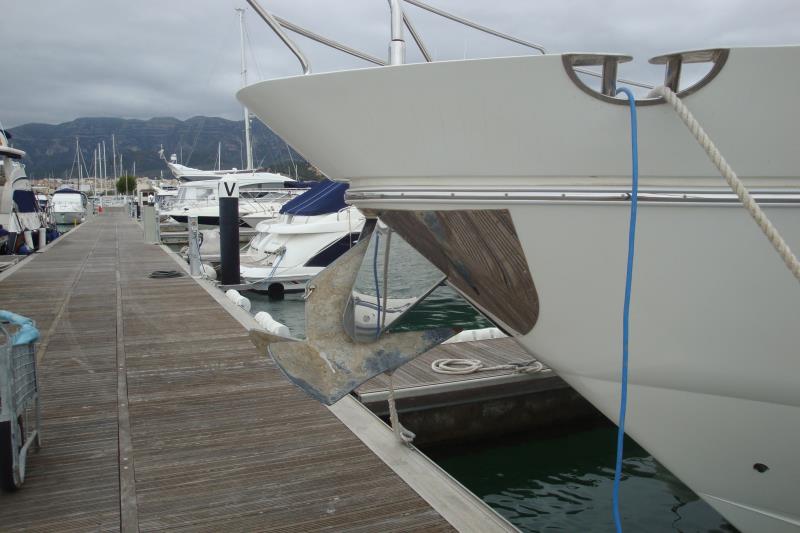
The old Delta set up as supplied by Princess

DSC07306_Small_zpstg7hhrf3.jpg


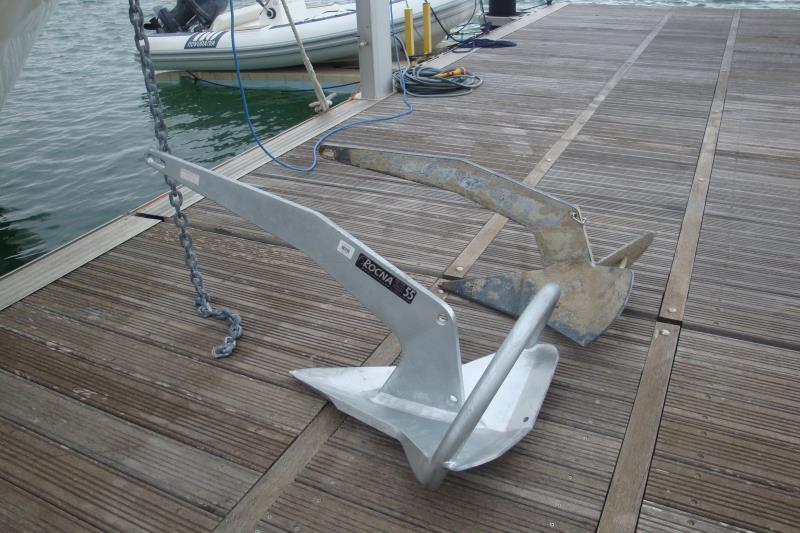
Here are the two anchors - the Delta is 40 Kgs - the new Rocna is 55 Kgs

DSC07309_Small_zpsmcvysbyu.jpg


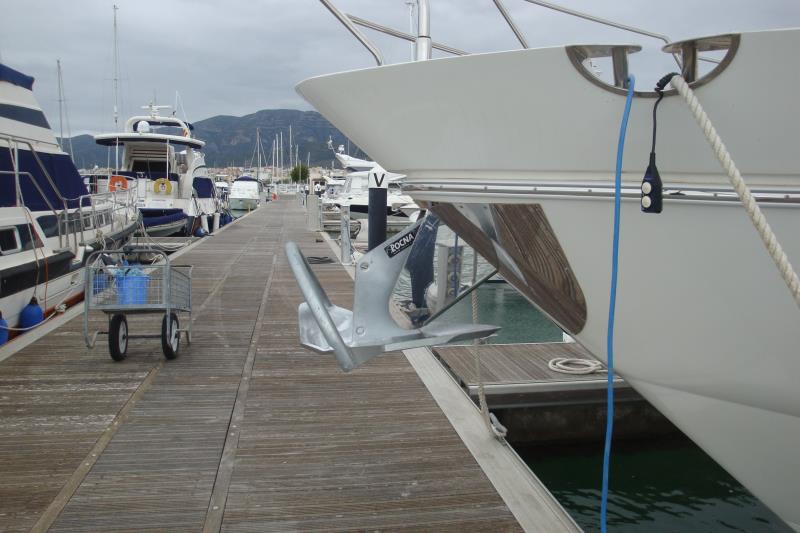
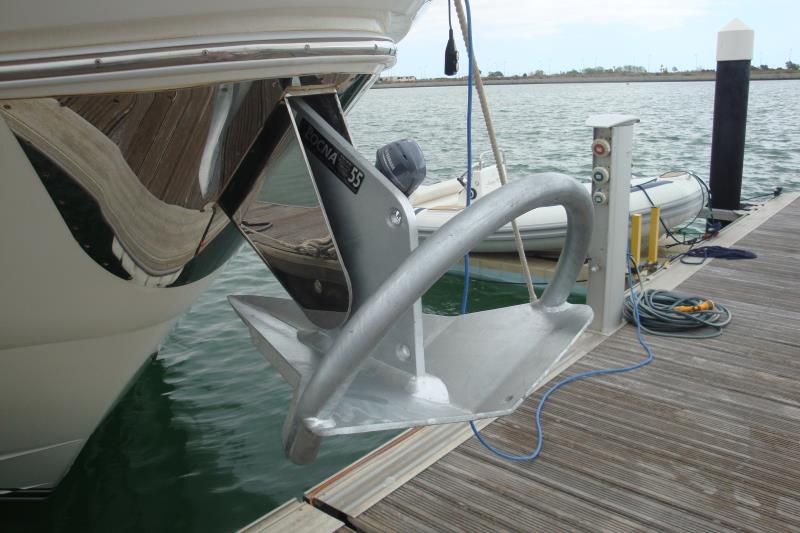
And then the new Rocna on the Princess rollers.

DSC07313_Small_zpsmkz6rwqd.jpg


DSC07314_Small_zps2oqoank2.jpg


All in all - a success.

More pics when I've fitted the new chain stopper.
 
Last edited:
M, am I right in remembering that your chain runs, from the winch to the bow roller, above a steel plate?
If not, beware of fitting that stopper on bare GRP, because I've seen some badly cracked gelcoat under one of those, in a boat where it was fitted.
Not the stopper fault of course - in a sense, it's rather the opposite: it does work and hold well, so it has to be fitted on a surface capable to handle the load!
 
Which chain stopper are you fitting, Hurricane? I'm just about to fit one of these http://www.quicknauticalequipment.com/?lng=en&ms1=13&ms2=1&ms3=90&ms4=287&cs1=01&cs2=&mvp=610&stp=td

Lewmar version of that one
http://www.lewmar.com/node/11663

All the plates are made - top (deck) plate highly polished with holes to match the chain stopper.
I've also had a plate made for under the deck - similar holes already drilled.
So, all I have to do is drill the deck and bolt it up.
 
M, am I right in remembering that your chain runs, from the winch to the bow roller, above a steel plate?
If not, beware of fitting that stopper on bare GRP, because I've seen some badly cracked gelcoat under one of those, in a boat where it was fitted.
Not the stopper fault of course - in a sense, it's rather the opposite: it does work and hold well, so it has to be fitted on a surface capable to handle the load!

Just read this after replying to Mike.
Yep - all will be evident when I post the pics.
Rain due here for a couple of days so might not get it done for a few days.
 
Good going - the Rocna looks a great fit. You're having quite a run on successful projects mike! :encouragement:

When you have installed the stopper, are you abandoning the rope bridle mallarkey?
 
Good going - the Rocna looks a great fit. You're having quite a run on successful projects mike! :encouragement:

When you have installed the stopper, are you abandoning the rope bridle mallarkey?

No, I like the rope bridle so no plans to abandon that yet but, as we all know, things change with new kit.
The main reason for the chain stopper is to give us an instant way of locking the chain.
Remember our windlass isn't as big as yours and I want to keep the loads away from it as much as possible.
My thoughts are that if we need to break out the the new Rocna, we may have to use the engines - thats where the chain stopper might be useful.

BTW - did you see the dinghy in the background on its new dock?
 
M, am I right in remembering that your chain runs, from the winch to the bow roller, above a steel plate?
Correct. The chain runs in a stainless steel channel. Andrea is fabricating a steel structure which will be welded to the channel and on which the stopper will be fitted. I've also had the steel channel lifted, resealed and refixed this winter as there were a few rust marks under it so it should be in good order
 
No, I like the rope bridle so no plans to abandon that yet but, as we all know, things change with new kit.
The main reason for the chain stopper is to give us an instant way of locking the chain.
Remember our windlass isn't as big as yours and I want to keep the loads away from it as much as possible.
My thoughts are that if we need to break out the the new Rocna, we may have to use the engines - thats where the chain stopper might be useful.
My thoughts too. The stopper and the bridle serve 2 different purposes. I plan to use the stopper to lock the chain when setting the anchor to keep the load off the winch and, as you say, to assist with breaking out the anchor if necessary. The one and only time we have used our new Rocna, it was noticeable how much more difficult it was to break out compared to our old Delta and that was in sand. I suspect that in firm clay it might be quite difficult to extract but the jury is out until I've had more experience with it.

I will still use my bridle/shock absorber thingy to stop the chain from putting lateral loads on the bow roller assembly as the boat shears from side to side and to stop the noise of the chain grinding against the bow roller assembly when it does this, which is audible from the forward cabin
 
No, I like the rope bridle so no plans to abandon that yet but, as we all know, things change with new kit.
The main reason for the chain stopper is to give us an instant way of locking the chain.
Remember our windlass isn't as big as yours and I want to keep the loads away from it as much as possible.
My thoughts are that if we need to break out the the new Rocna, we may have to use the engines - thats where the chain stopper might be useful.

BTW - did you see the dinghy in the background on its new dock?
Ok, thanks.
Yes I certainly did notice thr novurania, looking very grand in its floating dock. Great project that- it gets forum upgrade of the year in my books because as well as getting such a great long legged tender you displayed so much tenacity in believing it would fit and you were proved right!

Another thing I noticed was how princess moulded in a channel or "reverse knuckle" in your deck moulding, immediately above your ss gunwale strip. What's it for? Just styling? Those "flared outwards" bow deck mouldings on prin 67, 72,78 look great when installed. Fairline do same on their similar sized boats. much nicer than mouldings that flare inwards like sunseeker. But they are harder to lay up and hard to release from the mould tool, and that mounded channel appears to make them even harder to release. So I'm wondering ( not criticising) why princess went to the trouble.
 
Another thing I noticed was how princess moulded in a channel or "reverse knuckle" in your deck moulding, immediately above your ss gunwale strip. What's it for? Just styling? Those "flared outwards" bow deck mouldings on prin 67, 72,78 look great when installed. Fairline do same on their similar sized boats. much nicer than mouldings that flare inwards like sunseeker. But they are harder to lay up and hard to release from the mould tool, and that mounded channel appears to make them even harder to release. So I'm wondering ( not criticising) why princess went to the trouble.

I think you mean the flared out gunwales.
If so, it was something that I particularly liked when we ordered the P67.
I think it is probably only for aesthetic reasons but it does give the deck a secure "big boat" feel.
From a practical point though, the builder then HAS to mould in proper fairleads for mooring lines etc which then keep lines from scratching the fairing.
The concept follows on throughout the boat to properly formed mid cleats and stern winches etc.
On the Sunseeker Pred they had to install stainless steel strips to prevent the mooring lines scratching.

As to why Princess went to the trouble - I suspect it was a "hang over" from the okd P65 which was also a popular boat in its time.

Anyway, like you, I think it looks great.

EDIT
There are some great advantages - if you drop something on the deck, it doen't roll off.
Shame this concept isn't carried forward to smaller modern boats.
Probably cost prohibitave.
 
Last edited:
I think you mean the flared out gunwales.
M, my understanding of what jfm was curious about is not the whole gunwale, but just the thin reversed "channel" than runs around the whole gunwale, just above the s/s strip, and roughly as large as the s/s strip itself.
In fact, that's bound to create (what I think in EN is called) an undercut in the mould, which makes the hull release more critical.

PS: 'scuse the fussiness, but isn't it a "carry over" rather than "hang over" from P65? Just genuinely curious about possible wordings... :o
 
@ Hurricane, yup, I was referring just to the groove or "reverse knuckle", not to the general flare of the deck moulding (which, like you, I like very much; I have same on my boat, and respect the builders who go to the trouble to achieve it). I was just curious about any reason for Princess to make the groove/reverse knuckle (which as MM says is an "undercut" in mould/tooling terms - gosh his EN is good!). Anyway, it was just idle curiosity on my part, no big deal, and there are probably plenty of mould features on many boats that none of us will ever be able to explain!

@MM, yup, "carry over" is better expression, though EN allows latitude here and in context "hang over" was clear especially as 2 words not one. Without any context, hangover (a single word) means usually the result of lots of fine wine :D

edit: on reflection I think hangover can be written as one word even when used in the "carry over" context
 
Last edited:
Yep - agreed "Carry over" is a much better expression.
I never was any good at English.
(Maybe that should read - I was never any good at English)

Ah - I see what you mean about the "reverse knuckle".
Didn't think that what you were referring to (bad English again).
About 6m aft, the reverse knuckle fades into the gunwale and then inverts to about a constant 30mm down the length of the boat.
Probably gives strength to the gunwale at the bow.
 
Another thing I noticed was how princess moulded in a channel or "reverse knuckle" in your deck moulding, immediately above your ss gunwale strip. What's it for? Just styling? Those "flared outwards" bow deck mouldings on prin 67, 72,78 look great when installed. Fairline do same on their similar sized boats. much nicer than mouldings that flare inwards like sunseeker. But they are harder to lay up and hard to release from the mould tool, and that mounded channel appears to make them even harder to release. So I'm wondering ( not criticising) why princess went to the trouble.

To me looking at the pic (without a visit to Prinny yard ) -it looks like the rubbing strip conceals a join .Its a builders oldest trick in the book to cover /seal a hull and topside join with these .

The rubbing strip if that what we are calling it does not even run round the widest circumference -so whats its purpose ?
That gunwhale section is an add on to the main hull mould -----that's what it looks like to me and explains how it can be popped put of the mould -cos its a separate moulding /piece -later attached to the main Hull below

Not being funny but there are better ways to fit a rubbing strip -without exposed self tappers like that
its looks like a cheap fix a pet hate of mine along with veneered teak .IMHO

Sunseeker + Ferretti (Itama ) fit a strip that have a rubber cover to conceal the screw heads .
 
Last edited:
To me looking at the pic (without a visit to Prinny yard ) -it looks like the rubbing strip conceals a join .Its a builders oldest trick in the book to cover /seal a hull and topside join with these .
.
I think jfm is not talking about the rubbing strake itself but the indentation or channel above it. Again IMHO this is no more than a styling detail designed to break up the bulk of the topsides and trick the eye into thinking the boat is sleeker than it is. Its a trick used in car styling a lot
 
Yep, as Deleted User says, we're at completely crossed purposes Portofino

On rubbing strips generally, I don't think exposed screw heads should be regarded as inferior. Most builders offer a choice on the rubber insert or not on this size of boat. Ferretti do not have the rubber strip these days by default, Fairline use rubber strip for EU market and exposed screw heads for the US market by default, but customer can specify

On bigger boats btw fairline completely hand finish the joint at the bow, which is nicer than any strip imho, and I'm only bothering to mention that because it gives me an excuse to post this nice picture...

cannesshow2013.jpg
 
Top