JW's Upgrades for 2016 - Anchoring

All very interesting....but I think I would prefer to rely on centuries of 'old' fashioned anchoring techniques, than lie in my bunk working out if the maths are correct!

Have to say though the later part of this thread has definately ensured I will drop off to sleep quickly tonight...thanks:sleeping:
 
JFM,

Sorry, but if you are too busy to read - that's your issue, not mine (especially as you can read much more quickly than anyone can type - your comment sounds a bit robust to me). I do not see why your personal issues need impinge on me or anyone else. I think you are suggesting your time is more valuable than mine. I was actually going to point out, again, my snubber arrangement but after your 'robust'' reply I decided it was not worth the effort and deleted the post.

My arrangement is not unusual, I know others with something similar.

We regularly see 1m stretch, but then we anchor in 30/35 knot winds (because there is no where else (not even a marina) and some marinas are inshore of a river bar and crossing the bar in less than favourable conditions makes a 35 knot wind seem quite pleasant. But in sympathy with your hectic lifestyle we are using the most elastic of snubbers, lead climbing rope, which is specially designed to stretch (and not kill a falling climber).

You might have understood, incorrectly, that I'm suggesting that nylon does all the work. This is incorrect. Initially the chain does all the work but progressively the chain and nylon share the effort and eventually the nylon does all the extra - because any benefit of the chain is already 'consumed'. But every 10mm or 100mm or 1m of nylon extension (or whatever) keeps the chain on the seabed for longer.

All yachts move or yaw differently and all yachts move or yaw even in 'sheltered' anchorages - because wind is not stable it gusts and veers (shears). If your yacht is veering then when its veered in one direction all the load is on one snubber and as it swings back the load progressively increases on the other till all the load is on the other - at each extreme all the load is on one side of a bridle. If you bridle angle is narrow the differences might not be as great as I suggest but if the angle is wide (which will reduce yawing) then the differences in load will be 100%. And I always look at worst case - I cannot commend anyone not to look at worst case.

I'm not a fan of Mr Smith for a variety of reasons but I think you are reading too much into his ability with maths. My thesis is very simple - when the chips are down you deploy all your chain (no point in carrying it if you do not use it). You might deploy a second or third anchor - depends on the forecast but you would be silly not to deploy everything if you get caught in a cyclone (though cyclones are forecast so you must be very unlucky to get caught out). So I really do not care about the maths at 10:1 or 12:1. I agree Mr Smith might have questionable reasoning - but that reflects on Mr Smith and his business. But sometimes you cannot deploy all your chain, or the holding is not good - for whatever reason your anchor needs some help then a snubber comes into its own.

If you only anchor in winds of less than 30 knots, with excellent hold - then a snubber is unnecessary - but then so is 100m of 12mm chain, a 55kg modern anchor and a chain lock. The reason you have invested in all this kit is to make your anchoring as safe and secure as possible. A 15m length of nylon (2 off for a bridle) is going to cost you peanuts (you need the extra length for the attachment) - I frankly cannot understand your reluctance nor why you question.

So tell me why you think elasticity through the complete wind range is a waste of time.

edit But reverting to Mr Smith, I disagree with a lot of what he says but think it less than useful to analyse as airing the issues will spark a whole new series of debates (and I'm already off his Xmas card list). However I do agree with the overall thesis, or conclusion - even if he got there the wrong way. close edit
 
Last edited:
Modern Climbing rope
It loses it's elasticity when it's taken
We use to replace after a fall 10-20% elongation can be achieved once or twice -2nd big fall not as much risky .
I would not use this stuff as a constant elastic rope -which if I understand you correctly you appear to thing it is?
They stretch /deform out .
Having been a successful mountaineer aceneded the Eiger, Matterhorn. most of the Chamonix Agiles ,+ much more all over the Alps
Survived numerous falls ,rescued stranded climbers ,brought down bodies -
Yup witnessed 5 deaths from rope failure -( other parties -crap rope )
I,am still alive to tell the tale -
Once climbing rope ,s had a "pull" erh next to useless
Shagged out ropes use for abbing down only -cos it's lost it's stretch and you can leave behind. Only if bothered to carry it up .
In fact a multiple 25+ ab decent on a new rope due to repeated stretch on the decent would shag it .
 
Last edited:
Quite correct,

For artificial climbing walls when a lead rope has sustained one fall - its retired.

A difference is that if a climbing rope fails the individual dies, its simple stuff. Failure standards for individuals is higher than for yachts - if a rope/snubber fails - there is a chain. Lead climbing rope is commonly used as snubbers (by people who sail in high latitudes) - the reason against it is not your fears - but it cannot be spliced.

3 ply will fail, anchor plait will fail. If you want fail proof nylon it will be so oversized to have no elasticity. You need to decide what you want.

I too was a rock climber, you have a good record.
 
I've found this thread very interesting but have some questions. Apologies if they're a bit basic....

When I did my Day Skipper / Yachtmaster (theory) I was led to believe that the reason for letting our plenty of chain was that the chain provided for additional drag on the sea bed. It appears that this was untrue, so is the purpose of extra chain in high winds to:

a) Prevent snatching via catenary?
b) To ensure the shank is flat to the seabed allowing the anchor to lie in its optimum holding position?

In the case of a mixed rode, I assume that you'd have to faff about using a combination of warping drum (for the rope) and the gypsy (for chain)? This would seem to be a major downer for me.

Could the replacement of chain with rope impact the trim of the boat? In my case, I'd hope that adding chain might actually make a small reduction in the bow up cruising angle.

Apropros nothing, has anyone been watching "Gold Divers" on Quest? I noticed that those guys used no chain on their c.24ft dredges and just chucked an anchor over the side.
 
I've found this thread very interesting but have some questions. Apologies if they're a bit basic....

When I did my Day Skipper / Yachtmaster (theory) I was led to believe that the reason for letting our plenty of chain was that the chain provided for additional drag on the sea bed. It appears that this was untrue, so is the purpose of extra chain in high winds to:

a) Prevent snatching via catenary?
b) To ensure the shank is flat to the seabed allowing the anchor to lie in its optimum holding position?

In the case of a mixed rode, I assume that you'd have to faff about using a combination of warping drum (for the rope) and the gypsy (for chain)? This would seem to be a major downer for me.

Could the replacement of chain with rope impact the trim of the boat? In my case, I'd hope that adding chain might actually make a small reduction in the bow up cruising angle.

Apropros nothing, has anyone been watching "Gold Divers" on Quest? I noticed that those guys used no chain on their c.24ft dredges and just chucked an anchor over the side.

add c) to ensure that if the chain does pull tight, the shank angle to the seabed is still low enough for the anchor to work

Most gypsies will handle rope and/or chain assuming the rope is correctly sized, so you shouldn't need to use the drum.
 
When I did my Day Skipper / Yachtmaster (theory) I was led to believe that the reason for letting our plenty of chain was that the chain provided for additional drag on the sea bed. It appears that this was untrue, so is the purpose of extra chain in high winds to:
Yup good point Pete and something I agree with. The more chain you put on the seabed and the heavier it is, the more friction there will be between the seabed and the chain both for reducing the tension on the anchor and resisting sideways movement of the chain

In the case of a mixed rode, I assume that you'd have to faff about using a combination of warping drum (for the rope) and the gypsy (for chain)? This would seem to be a major downer for me.
I think that most gypsies can handle a combination of correctly sized chain and rope but for me as I said above the major problem is how do you choose the optimum combination of rope and chain to suit all depths and scopes you might use?

Could the replacement of chain with rope impact the trim of the boat? In my case, I'd hope that adding chain might actually make a small reduction in the bow up cruising angle
Well it will. On a typical planing boat adding a bit of extra weight in the bow often improves both trim and sometimes speed so I don't really see any downside to a planing boat carrying a load of chain in the bow rather than rope/chain
 
Does anyone know how modern anchors behave in extremis?

On a gut feel I would posit that jfm's 60 tonne boat attached to a Delta via 100m of 12mm chain would drag the anchor before the catenary effect was entirely taken up. This is what ships have always done and the answer is to apply the main propulsive units and go out to sea.

Same boat with a modern anchor which could hold until the catenary was virtually straight: what happens next?

Does the anchor pop and give all the joys of a performance car which has fantastic holding right until it doesn't, thus involving a visit to the armco?

Does the bow simply tear off?

In short, might there be some benefits to an anchor which did not have quite a such tenacious grip on the seabed as might be seen to be a benefit in moderate conditions?
 
Does the anchor pop and give all the joys of a performance car which has fantastic holding right until it doesn't, thus involving a visit to the armco?
I expect under all that tension and with all that elasticity in your rope snubber a modern anchor eventually lets go and fires itself off the seabed like a torpedo and embeds itself in your forward cabin:D Yup there is something to be said for mechanical devices which are a bit more forgiving at the edges of their performance envelope
 
I think that most gypsies can handle a combination of correctly sized chain and rope but for me as I said above the major problem is how do you choose the optimum combination of rope and chain to suit all depths and scopes you might use?
Fwiw, the only mobos where I've ever seen such combination are some trawlers (battleship-style built, but not that big: in the 55' to 70' range), whose ground tackle is completely different from the one we are all used to: a big motorized drum, located in front of the portuguese bridge, and capable to hold 200+ meters of heavy chain, at the end of which there's another 300+ m of steel cable.

So, the combination of chain and cable is not something "chosen" depending on the conditions, it's just a compromise driven by the fact that if you plan to anchor in 50+m of water with an 8+ scope, you obviously have good reasons for not carrying around 500+m of heavy chain, even in boats which by nature are not much weight sensitive.

Btw, Dashew approach is very different in this respect, because he designed his FPB aiming at weight reduction and higher cruising speed, compared to the typical "the heavier the better" trawler boats.

Again, simply fwiw, one thing I never ever saw (or even heard of, before this thread) on any long range mobo is the snubber arrangement that Neeves suggested.
 
So, the combination of chain and cable is not something "chosen" depending on the conditions, it's just a compromise driven by the fact that if you plan to anchor in 50+m of water with an 8+ scope, you obviously have good reasons for not carrying around 500+m of heavy chain, even in boats which by nature are not much weight sensitive.
I didn't mean to say that it was chosen for the conditions, just that the boat owner has to choose the proportion of chain to rope he is going to carry. Obviously you cannot vary the proportion of rope to chain once you've made that choice. One of the points made in the article that neeves linked to was that depending on the proportions, a chain/rope mode did not result in a significant reduction in max tension on the anchor, at least in the examples given. However my point was that whilst certain proportions of chain/rope may not result in a significant reduction of max tension on the anchor with the depths/scope examples given, they may result in a significant reduction with different depths/scopes. Because of that to my way of thinking and especially in a mobo which has no problem carrying extra chain, you might as well have an all chain rode

Yes many sailing yachts do have a part rope/part chain anchor rode, I guess for weight saving reasons, but as I say for most mobos its not an issue
 
Just had a chat with a colleague who's a keen but not terribly experienced sailor. When I asked him what the advantage was of putting more chain out in strong winds his immediate answer was also "to increase friction of the chain against the sea bed".

When I asked him if he used a Snubber his reply was "a what?". Dut he did say that he would thread a line through the chain near the winch and tie this off to a bow cleat (uness it was a charter boat in which case he wouldn't bother)!
 
Not everyone lives in N Wales, in Glencoe nor under the Eiger - in fact most people now live in cities. There is a whole industry here where you convert a warehouse into an indoor artificial climbing wall. Its where youngsters can be introduced to the pleasures of rock climbing and where those that live in a city (and we all know about those who are time short - let's not go there) can hone there skills and keep fit without the boredom of a gym. There is also not the need a 3 hour drive to the nearest rock face (that's for the weekend, the artificial wall is a 10 minute drive for an hour in the evening). I have 3 such walls within 30 minutes drive. Here they are regulated, wherever you are they have not crossed your consciousness and sarcasm does not become you, and after one fall the ropes are retired and are also retired at the end of a specific time period (I do not know what it is).

I have tested well used climbing rope, load cell and tape - and they retain sufficient elasticity for a snubber. They are never to be used for climbing - for the reasons detailed above, but the application is different and they appear perfectly adequate and are not the only option. They will obviously be insufficient for a 60t vessel, you would need larger cordage - anyone with any skill in maths can work it out if they have the time and an open mind.

I suggest if you are actually interested you look at the Fortress anchor website. They did some tests in soft mud and their anchors disappeared below the surface to a shackle depth of 11'. Most modern 15kg anchors will hold at least 2,000kg in a decent sand seabed (a bigger anchor will hold more edit but not 55kg divided by 15kg more - the relationship is not that efficient - think a bit more than 2 times more, maybe 5t, close edit). Provided a modern anchor does not meet a foreign object and it is correctly sized it will set deeply (it will completely disappear along with a few metres of chain) and continue to set, even more deeply with increased load. As Bruce K, I think, mentioned retrieval is the biggest issue with modern anchors after a blow - not will it hold. Items retarding the efficiency of anchors are foreign objects, towels blown off vessels in popular anchorages, seaweed, beercans and chain - the bigger the chain the less effective your anchor (this is why oil rigs do not use chain, its heavy and retards anchor performance). Some anchors are designed that they can catch and hold objects in the fluke, like loose rock, or weed.

And for the witty ones who will quip they are not anchoring an oil rig - but many of you use oil rig anchors, just in miniature

Good luck and best wishes.
 
Last edited:
wherever you are they have not crossed your consciousness and sarcasm does not become you
Not sure of what you mean by that exactly, but Portofino was talking of mountaineering, and you replied "correct, for artificial climbing walls..." [sic!].
Now, having spent several days and nights at high altitude myself, that made me smile, and I couldn't resist posting my admittedly sarcastic question.
Sorry if you found also that offensive, but blimey, talk about being touchy!
Btw, I said that I smiled because I'd call myself just an amateur mountaineer.
A few friends of mine I used to climb with, who are real pros, would consider your association as an insult for good.

Back to the point, re. your suggestion to look at Fortress website, thanks but no thanks.
I'll rather give it a miss, because the whole subject is by now done to death, as far as I'm concerned.
As I said in my very first post in this thread, I never had any troubles in the last 15 years with my 20th (if not 19th!) century ground tackle, so more modern chains or anchors are a solution to a problem I never had, and I'm confident I never will.
Otoh, I can predict anything but the future, so I promise that whenever I'll have a trouble that a long snubber could have avoided, I'll remember this thread and will report here the experience, without forgetting to eat my humble pie.
Just don't hold your breath, in the meantime... :)

Good luck and all the best to U 2.
 
Good call Mapism to bail out. The guy's touchiness dial is turned up too high. So long as you never drop one of your bricks on your foot you'll be just fine:encouragement:
 
I suggest if you are actually interested you look at the Fortress anchor website. They did some tests in soft mud and their anchors disappeared below the surface to a shackle depth of 11'.
You mean the tests that were done in the soft mud of Chesapeake Bay and which just happened to suit the characteristics of the Fortress anchor above all others? I think those tests have been widely discredited
 
.
A boat has a drag coefficient say 0.5. Say 40 knots wind =20m/sec. Say 25msq frontal area =my boat. Density air 1.225kg / metre cubed. That amounts to 3000 newtons horizontal force. Say 300 kg

Now plug that into a catenary calculator eg http://www.spaceagecontrol.com/calccabm.htm?F=3000&a=50&q=3.8&g=9.81&Submit+Button=Calculate. Assume you have 50 m of chain out, none lying on seabed. 12mm chain is 3.8kg per metre. The catenary droop is 4 metres and the chain has 0.8m of stretch left in it. Well 0.8m is similar to 1m so you have approx the same amount of stretch as proposed above, and waaaay more stretch than any actual snubber I have ever seen, without messing around with an actual snubber
:

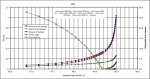
The catenary calculator you reference seems to be specifically for a catenary with the ends in the same horizontal plane. Putting the loads you estimate into a calculation for a catenary between a boat and an anchor, and using 10m as the water depth, the kind of static behaviour you would expect is illustrated in the attached graph. You can see how the load increases rapidly over the last 0.5m of travel away from the anchor.

The exact numbers for the chain you quote would be a bit different, as this calculation uses weight, strength and elasticity correlations with size for ORQ chain [which is a bit bigger than the chain we are considering here].

JFM.jpg

If 10m of 20mm nylon is stuck on the end of the 50m of chain, the force-offset curve looks like this:-
https://www.dropbox.com/s/zteqqjdra4nyk3j/JFM snubber.jpg?dl=0

[Seem to have run out of attachment space on YBW]
 
Last edited:
It would have to be a pretty small anchor and or chain that could be impeded by a beer can.

Get real.

Just passing :)

Ignorance is bliss

Modern anchors have very sharp toes, get real - blunt that toe (with a beer can) and it will not work. A big onewill work, 150kg - but a little one of 55kg - it will not set.
 
Top