JW's Upgrades for 2016 - Anchoring

rgarside

Getting there :encouragement:

A key word is 'static'. The behaviour is not static - its dynamic. The wind gusts, to upto 40% stronger than the average and there are lulls. The wind veers and impinges on the side of the vessel, the vessel veers and the wind veers another way and impinges on the other side. The vessel moves back and forward - its dynamic. The vessel does not sit there with nothing movng.

The vessel moves back from the anchor, the chain lifts, the chain stores energy, the wind lulls, the energy in the chain is released etc. That same energy can be stored in nylon. The suggestion I make is that nylon can store energy effectively upto its point of failure in an almost linear manner - its a question of matching the diameter of the nylon to the size of the vessel - such that the nylon is effective (too thick its inelastic, too thin it might fail or have a short life).

So consider a dynamic environment where it is not the frontal surface area of the vessel but a portion (or all) of the side. Where energy is developed and that energy needs to be 'accommodated'.

As I said, just passing through :)

Best wishes and good luck
 
The catenary calculator you reference seems to be specifically for a catenary with the ends in the same horizontal plane. Putting the loads you estimate into a calculation for a catenary between a boat and an anchor, and using 10m as the water depth, the kind of static behaviour you would expect is illustrated in the attached graph. You can see how the load increases rapidly over the last 0.5m of travel away from the anchor.

The exact numbers for the chain you quote would be a bit different, as this calculation uses weight, strength and elasticity correlations with size for ORQ chain [which is a bit bigger than the chain we are considering here].

View attachment 54077

If 10m of 20mm nylon is stuck on the end of the 50m of chain, the force-offset curve looks like this:-
https://www.dropbox.com/s/zteqqjdra4nyk3j/JFM snubber.jpg?dl=0

[Seem to have run out of attachment space on YBW]
rgarside, many thanks - that is a useful pair of graphs (did you build a model?!)
You're absolutely right that the calculator I linked to assumed both on horizontal plane. FWIW, I thought that was an ok approximation in the circumstances in that it gave benefit of doubt to the nylon rope side of the debate. Reason being that (a) at lower values of "travel away" as you are calling it there will be chain on the seabed in the real world yet it would all be a catenary in my calculator, and therefore I'm making the system stiffer/under estimating the elasticity, and (b) at higher values of travel away, approaching bar taught, the horizontal offset tends to having zero effect (all the chain is off the seabed by then, and at your 5x scope the angle isn't making much difference - in v strong winds you would use more than 5x of course)

Your second graph is interesting too but of course raises debate about parameters. The graph assumes that the 10m of nylon forms part of the catenary (I think) so the parameters ought to be set as 40m of chain + 10 nylon, not 50+10, as your 60m total catenary length flatters the contribution of the nylon, if you see what I mean. Neeves isn't including his nylon in the catenary because he runs it along the side decks so your model doesn't really work for Neeves' set-up. What value are you using for the stiffness of 20mm nylon rope?

Thanks again for those useful and enlightening graphs. Far better than the Rocna guy's analysis
 
rgarside, many thanks - that is a useful pair of graphs (did you build a model?!)
You're absolutely right that the calculator I linked to assumed both on horizontal plane. FWIW, I thought that was an ok approximation in the circumstances in that it gave benefit of doubt to the nylon rope side of the debate. Reason being that (a) at lower values of "travel away" as you are calling it there will be chain on the seabed in the real world yet it would all be a catenary in my calculator, and therefore I'm making the system stiffer/under estimating the elasticity, and (b) at higher values of travel away, approaching bar taught, the horizontal offset tends to having zero effect (all the chain is off the seabed by then, and at your 5x scope the angle isn't making much difference - in v strong winds you would use more than 5x of course)

You can use that calculator to work out the forces in your anchor chain, but you have to "fiddle" the length you put into the calculation, and get the "sag" to equal the right number. The suspended length of your anchor chain is only supported by the boat, so in the calculator you have to put in double the suspended length to calculate the correct forces. In fact, if the anchor chain is beginning to lift the anchor, you have to put in more than double the suspended length. Hopefully this sketch will stand in for any number of words:-
https://www.dropbox.com/s/dzd3ciw9kfew7p0/JFM catenary.jpg?dl=0

Your second graph is interesting too but of course raises debate about parameters. The graph assumes that the 10m of nylon forms part of the catenary (I think) so the parameters ought to be set as 40m of chain + 10 nylon, not 50+10, as your 60m total catenary length flatters the contribution of the nylon, if you see what I mean. Neeves isn't including his nylon in the catenary because he runs it along the side decks so your model doesn't really work for Neeves' set-up. What value are you using for the stiffness of 20mm nylon rope?
The nylon contributes little to the "catenary" behaviour as it is more or less neutrally buoyant compared to the chain. It will shift the offset/force curve along the axis a bit. Changing the total suspended length back to 50m gives this curve:-
https://www.dropbox.com/s/kpu5m9sj5wmj1da/JFM snubber 50.jpg?dl=0

The nylon stiffness used in the calculation is .825 GN/m2 - obviously the stress/strain curve for nylon is non-linear, but within a reasonable strain range this should be good enough for a rough guess. In contrast the chain would be around 64 GN/m2.

The change in stiffness at higher loads resulting from adding a length of nylon will be similar whether it is in the catenary, or along the decks [provided there isn't too much friction!].

Normally, one would want there to be no uplift at the anchor, note that in the case of the 50m of 12mm chain in 10m water depth uplift of the anchor would begin at just over 300kg horizontal load.

The forces in the anchor line are the mean loads from wind and current, some dynamic loads from the shearing about of the boat, and forces due to the heave and pitch caused by waves. The heave and pitch forces can be significant on a mooring line when it has been pulled into the stiffer part of the force/offset curve.
 
Again, simply fwiw, one thing I never ever saw (or even heard of, before this thread) on any long range mobo is the snubber arrangement that Neeves suggested.

Not wanting to start an argument I didn't join in earlier, but in almost 30 years of boating I've also never seen (or heard of) such an arrangement.
 
Last edited:
I thought I had better clarify (which meant another return):

Keeping the 12m of snubber on each side deck is for no other reason than convenience. As far as I am aware others who use long snubbers would deploy that length beyond the bow. We could not quite cope with stowing then deploying that amount of cordage. It is undoubtedly a lot, it would take up a lot of room and it would undoubtedly tangle. Moreover 30'-40' of rope beyond the bow would inevitably drag on the seabed when the wind dropped (issues of abrasion) in a shallow anchorage (and the chain hook would fall off). Having it all on the side decks provides somewhere to store the snubber and its instantly available to use (something convenient will be used).
 
I don't normally pass comment on this sort of thing, this started off as an interesting and useful thread to me but unfortunately has now got rather silly and puerile. Forum stuff eh ? Shame. Don't think I'll be following this one much more.
 
Last edited:
Well that's fine, and everyone mentally signs off/checks out from threads that don't float their boat without announcing it, but it seems to me that you are not getting rgarside's excellent and enlightening analysis of the physics of a catenary
 
Yep, call me Mr Thicko McThick, but the bits that would interest me are so far over my head I can't even see them using a really long step ladder and binoculars !


B**ger, look what you've made me do, I've only just 36 mins ago said I'm not reading this one anymore !:)
 
Last edited:
Yep, call me Mr Thicko M Thick, but the bits that would interest me are so far over my head I can't even see them using a really long step ladder and binoculars !


B**ger, look what you've made me do, I've only just 36 mins ago said I'm not reading this one anymore !:)

As the original OP, I kind of agree with you.

I always try and understand the complexities of any discussion but this one just seems to me to have strayed too far from reality.
I always make my own assessments of problems and solutions to those problems.
This year, I have been snorkelling a lot round our boat and other boats in our anchorages.
Without getting into ANY maths or physics, it has bee obvious to me that increasing my chain gauge fron 10 to 12mm has helped my case enormously,
Likewise, I expect that moving from a "plough" style anchor to a "digging" style anchor will also improve things.
I'm only asking for improvements - I don't expect to find myself at anchor in winds in excess of 40 knots - that would be bad planning IMHO.

I stand by my decision to increase the chain size from 10mm to 12mm and to change the anchor from a 40kg Delta to a 55kg Rocna.
Others on this thread have said that I will notice a big improvement - thats what I'm expecting.
 
You can use that calculator to work out the forces in your anchor chain, but you have to "fiddle" the length you put into the calculation, and get the "sag" to equal the right number. The suspended length of your anchor chain is only supported by the boat, so in the calculator you have to put in double the suspended length to calculate the correct forces. In fact, if the anchor chain is beginning to lift the anchor, you have to put in more than double the suspended length. Hopefully this sketch will stand in for any number of words:-
https://www.dropbox.com/s/dzd3ciw9kfew7p0/JFM catenary.jpg?dl=0


The nylon contributes little to the "catenary" behaviour as it is more or less neutrally buoyant compared to the chain. It will shift the offset/force curve along the axis a bit. Changing the total suspended length back to 50m gives this curve:-
https://www.dropbox.com/s/kpu5m9sj5wmj1da/JFM snubber 50.jpg?dl=0

The nylon stiffness used in the calculation is .825 GN/m2 - obviously the stress/strain curve for nylon is non-linear, but within a reasonable strain range this should be good enough for a rough guess. In contrast the chain would be around 64 GN/m2.

The change in stiffness at higher loads resulting from adding a length of nylon will be similar whether it is in the catenary, or along the decks [provided there isn't too much friction!].

Normally, one would want there to be no uplift at the anchor, note that in the case of the 50m of 12mm chain in 10m water depth uplift of the anchor would begin at just over 300kg horizontal load.

The forces in the anchor line are the mean loads from wind and current, some dynamic loads from the shearing about of the boat, and forces due to the heave and pitch caused by waves. The heave and pitch forces can be significant on a mooring line when it has been pulled into the stiffer part of the force/offset curve.
Rgarside, many thanks, that is very enlightening. Yes I see exactly your point that you need to x2 the anchor chain length when using the calculator at the point where the anchor is just about to see a lifting force - it's not obvious but kinda obvious when you point it out (!). That of course means there is more droop and stretch in a catenary AOTBE than I was calculating, making the relative benefits of nylon (at a practical rope gauge) in the system even smaller cf a chain catenary

You used .825 GN/m2 for the stiffness of nylon rope. I dunno your data source but that makes sense to me and sort of implies 30% stretch at yield (ignoring non linearity that occurs as you approach yield) which is a more widely used figure than the 40% bandied about on here. (It's actually 31.8% if you just plug in the yield stress quoted by rope suppliers eg 81400 newtons for 20mm dia quoted here https://www.jimmygreen.co.uk/p/tech...echnical-articles-/rope-breaking-strain-guide)

Thanks again for the maths and graphs
 
Last edited:
I don't expect to find myself at anchor in winds in excess of 40 knots - that would be bad planning IMHO.
Bingo.

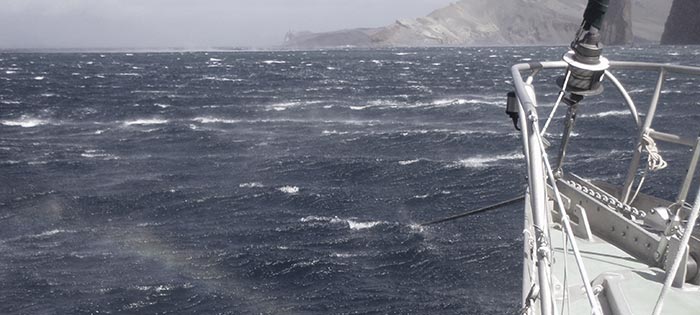
Actually, in fairness towards Neeves, the link he posted mentioned an Antarctica anchorage.
And based on what I learnt during a recent visit to the International Antarctic Centre in Christchurch, I suspect that it doesn't take such a bad planning to be caught in even stronger winds, without any realistic chances to run for cover anywhere.

Otoh, even if I'm sure that there are good reasons for cruising to Deception Island and beyond, with all due respect for anyone who go there (and prepare their boat accordingly), I reckon that at least for the rest of this life I will stick to my usual cruising grounds.

Which, just for the records, are documented below (taken not later than this afternoon), together with the pic in Smith's webpage, just for comparison.
Goes without saying that if anyone prefer the second to the first, who am I to argue? :)

Floating.jpg

deception-island.jpg
 
Yup, the thing is indeed brilliant.
There's much more than this still frame obviously, but being the pilot also a great video composer, I'm sure it's worth waiting till he will have time to post a proper clip! :cool:
Btw, the good news is that he managed to get back the Phantom safe and sound also while cruising, in spite of the fact that he got it just before coming to CF, so he's still learning all the tricks...
 
Ts ts ts,
Awful seamanship P., anchor scope must be almost 2:1 in this drone pic. :p

Bloody excellent pic though, looking forward to the clips!

V
 
Rgarside, many thanks, that is very enlightening. Yes I see exactly your point that you need to x2 the anchor chain length when using the calculator at the point where the anchor is just about to see a lifting force - it's not obvious but kinda obvious when you point it out (!). That of course means there is more droop and stretch in a catenary AOTBE than I was calculating, making the relative benefits of nylon (at a practical rope gauge) in the system even smaller cf a chain catenary

You used .825 GN/m2 for the stiffness of nylon rope. I dunno your data source but that makes sense to me and sort of implies 30% stretch at yield (ignoring non linearity that occurs as you approach yield) which is a more widely used figure than the 40% bandied about on here. (It's actually 31.8% if you just plug in the yield stress quoted by rope suppliers eg 81400 newtons for 20mm dia quoted here https://www.jimmygreen.co.uk/p/tech...echnical-articles-/rope-breaking-strain-guide)

Thanks again for the maths and graphs


For elasticity of nylon cordage, admittedly American, please try this link:

http://www.yalecordage.com/pleasure-marine-ropes/anchoring-mooring-specialty/nylon-brait.html

This data agrees with similar information from Marlow.

I do wonder what is the source of Jimmy Green's data and that of your 31.8%?

Nylon does not stretch linearly, but its as near linear as makes no difference in this discussion.

Best regards
 
Ts ts ts,
Awful seamanship P., anchor scope must be almost 2:1 in this drone pic. :p

Bloody excellent pic though, looking forward to the clips!

V
LOL, you maybe missed one of my post in Hurricane thread on his trip to Sardinia, where I showed one of my preferred anchoring techniques, with 1:1 scope! :cool:
http://www.ybw.com/forums/showthread.php?421307-Sardinia-Summer-2015&p=5405668#post5405668

Btw, this morning I can't see the second pic that I linked from PSmith website anymore.
I guess I saw it at the time of posting because it was cached in my PC...
For those interested to the comparison, here's the link to the pic.
http://www.petersmith.net.nz/boat-anchors/images/deception-island.jpg

PS: very nice new avatar, V!
 
LOL, you maybe missed one of my post in Hurricane thread on his trip to Sardinia, where I showed one of my preferred anchoring techniques, with 1:1 scope! :cool:
http://www.ybw.com/forums/showthread.php?421307-Sardinia-Summer-2015&p=5405668#post5405668

yes, missed it! Didn't have the time to check the Sardinia summer thread in detail, I've got it listed as a winter night project :p

I'll try it next week when I'm out (and if the weather's like it was last couple of times) Only I have a 15kg chinese Bruce copy on 8mm chain so I may drop a small pile of chain straight down and see :p

PS: very nice new avatar, V!

thanks, will work on it a bit more, maybe remove a bit of sea left and right and have MiToS slightly larger.

V.
 
For elasticity of nylon cordage, admittedly American, please try this link:

http://www.yalecordage.com/pleasure-marine-ropes/anchoring-mooring-specialty/nylon-brait.html

This data agrees with similar information from Marlow.

I do wonder what is the source of Jimmy Green's data and that of your 31.8%?

Nylon does not stretch linearly, but its as near linear as makes no difference in this discussion.

Best regards
There are loads of web statements saying yield stretch in nylon rope =~30% but they are 3 strand and you're using 8 (sorry if I missed your stating that earlier) so perhaps that accounts for the 40% (or perhaps not; see Marlow comment below). The curve in your linked-to graph of course has a gradient in the useable range that corresponds to about 30% not 40%. The 40% is only achieved by the gradient increase as the yield point is approached and you move into the non linear part.

Marlow say 30% here for 8 strand nylon (scroll down a bit)http://www.marlowropes.com/technical/physical-properties.html - I didn't dig too deep and maybe they say 40% somewhere else (you got a link?)

I guess it is all a bit academic as 30/40% doesn't change much in this debate but your linked-to 40% graph seems an outlier to me

I'd guess but don't know that JG's claim of 81400N to break 20mm nylon comes from Liros, the rope manufacturer.

The 31% comes from simple maths - if 81400N breaks 20mm dia nylon and E for nylon is .825 GN/m2 (using jgarside's figure which I x-checked above, then the answer is 31.something percent, the arithmetic being:

Extension = 81.4KN/(cross sectional area x 825000 KN/m sq). Cross section area of 20mm dia = .000314 m sq. I trust you can see that the answer must be dimensionless because all the dimensions cancel out. Answer = 0.314 = 31.something %
 
Last edited:
The Liros catalogue gives a working stretch of 20% for 3 strand nylon, and a break strength of 8140kg for 20mm. So roughly, assuming linear (which its not) and assuming 40%+ at break then the WLL of 20mm is 4t. or a 2t WLL (and 20% stretch) for 14mm. So if you consider the maximum load on a vessel is 1t and you want a 20% extension (at that maximum load) then 10mm would offer that facility (20% stretch at a WLL of 1t). If you think a snubber of 10mm a bit paltry, then the 14mm might be a better option - but 20mm too inelastic (as the loads will never be 4t - hopefully)

But its not about maximum load - its about energy and ability of the snubber to transfer that energy from 'imposing' on either the chain or the vessel.

The ability to absorb energy is contingent upon length, longer cordage can absorb more, and size (diameter or weight per unit length). Smaller cordage has a greater ability to absorb more energy but has a lower finite limit. So a 10m length has the ability to stretch 2m (WLL).

Energy absorption of nylon cordage:

at a tension of 300kgf and 1000kgf

10mm 1131 and 7814 joules
14mm 750 and 5813 joules
20mm 490 and 3383 joules
24mm 392 and 2706 joules

The data is a bit dated now, late 1990s, ex Marlow and I know of no link (private communication with a then employee).

You know the characteristics of your vessel - simply plug in mass and velocity (of the vessel as it moves at anchor). You will find that by choosing the correct size then 10m of nylon will have the potential to absorb all that energy and that the chain would not need to move at all. In reality its shared, at low wind speeds the chain absorbs most of the energy at high(er) wind speeds (just when your anchor needs all the help it can get) the nylon takes an increasing share as the catenary straightens.

Nylon is primarily about weight, weight of nylon per metre (say). Construction does come into it (see kermantle) but multiplait and 3 strand are very similar.

On the assumption you want to keep the chain as near horizontal as possible then a snubber that can absorb all the energy of the moving vessel would be advantageous and might be cheaper than adding more (heavier) chain and might work if it is not possible to deploy the ideal (or available) length, and weight, of chain.

Have a great evening or day.
 
Top