
Is yacht handling

Out of interest, how would you do a "Med moor" if single handed? I can't imagine how you'd do it, as you need to be at both ends of the boat at once. You need someone on the bow to drop the anchor and let out chain, and then someone on the stern to get the shore lines on. In anything of a current or wind, you need someone on the helm; on a boat that responds poorly in reverse like mine, you need someone on the helm in any situation. I can just about imagine doing it two-up - one on the helm, the other dropping the anchor and then coming to the stern to handle lines - but I can't visualize a way to do it single handed.

If I ever go to the Mediterranean, I think I'd better anchor off!
If you have a remote anchor control it is not that much more difficult than if there are two of you. Sort out the anchor so it is ready to drop, make sure all your stern lines are ready to deploy. Check out where you are going into, normally people about so ask them if they wouldn't mind taking your lines. Then reverse as normal, letting the anchor down and be ready to pass the stern lines to the person waiting there.
Would be more difficult if you had a centre cockpit boat I would assume!
 
One of my major irritations when we were in the eastern-Med was that we'd regularly come into a harbour and notice several obviously cruising/livaboard yachts already moored-up with occupants in the cockpits; they would look-up and recognise our yacht as being 'one of the fraternity' and quickly assemble on the quay to assist. Even if we subsequently got it wrong, we'd be jovially reassured that it was 'just one of those things/particularly tricky today/could've happened to anyone'. However, should an equally obvious charter yacht appear ten minutes later and who was more likely to need some help, it was rare to see anyone leaping ashore to assist, until of course it'd actually gone tits-up, at which point the skipper would be getting a whole heap of conflicting advice, intermingled with abuse and all of it at high volume. Don't berate the novices for getting it wrong, try to assist before it turns into snagged chains and abuse. I appreciate that there are those who know it all/can't be told/consider such offers as a slight to their manhood, but for the most part, we found that a polite and early offer of advice and/or assistance was generally accepted in the spirit which it was intended; whereas we never saw anyone ever get bought a beer for hurling abuse at a struggling novice.

That said, getting yourself securely moored in a safe spot at Fiskardo (our favourite was tied bows to the wall immediately below the ferry ramp) early on a Sunday afternoon - is it still first-night port of choice for the charterers? - then settling down in the cockpit with a few cold beers as the afternoon breeze picks-up is hard to beat for entertainment value.
Suspect that at least one contributor to this thread would be leading such a pack. Often astonished by the arrogance of such people - and not confined to those with British accents!
 
Out of interest, how would you do a "Med moor" if single handed? I can't imagine how you'd do it, as you need to be at both ends of the boat at once. You need someone on the bow to drop the anchor and let out chain, and then someone on the stern to get the shore lines on. In anything of a current or wind, you need someone on the helm; on a boat that responds poorly in reverse like mine, you need someone on the helm in any situation. I can just about imagine doing it two-up - one on the helm, the other dropping the anchor and then coming to the stern to handle lines - but I can't visualize a way to do it single handed.

If I ever go to the Mediterranean, I think I'd better anchor off!
It is a pleasure to watch some of the seasoned Greek skippers do exactly that. One of the guys who looked after my boat out there was a past master using the ferry technique of dropping the anchor (with the remote from the cockpit, spinning the boat round whacking it into reverse, backing up to the quay and dropping the windward line on a bollard then stepping off with the other line - all in one smooth movement!
 
Out of interest, how would you do a "Med moor" if single handed? I can't imagine how you'd do it, as you need to be at both ends of the boat at once. You need someone on the bow to drop the anchor and let out chain, and then someone on the stern to get the shore lines on. In anything of a current or wind, you need someone on the helm; on a boat that responds poorly in reverse like mine, you need someone on the helm in any situation. I can just about imagine doing it two-up - one on the helm, the other dropping the anchor and then coming to the stern to handle lines - but I can't visualize a way to do it single handed.

If I ever go to the Mediterranean, I think I'd better anchor off!
I'm not sure how it would work out on a single engine boat but it's not that difficult with twin engines. I always work the anchor myself from the flybridge helm anyway and when I'm single handed I just take it back within a few metres of the quay and hold it on the anchor and in reverse while I go down to secure the stern lines.
 
Out of interest, how would you do a "Med moor" if single handed? I can't imagine how you'd do it, as you need to be at both ends of the boat at once. You need someone on the bow to drop the anchor and let out chain, and then someone on the stern to get the shore lines on. In anything of a current or wind, you need someone on the helm; on a boat that responds poorly in reverse like mine, you need someone on the helm in any situation. I can just about imagine doing it two-up - one on the helm, the other dropping the anchor and then coming to the stern to handle lines - but I can't visualize a way to do it single handed.

If I ever go to the Mediterranean, I think I'd better anchor off!
It's certainly a bit of a faff, but it can be done - even without a remote windlass. Drop the anchor a little further out than normal and get it set in the right direction, then get ready for mooring. I've only ever done it one or two handed so I drive in to just off the quay, stop the boat and step off with both lines with weight of chain holding the boat off, if there's an anchor person they can haul in a bit. Single handed once the anchor is set I'll ease the clutch so that the boat can pull the chain itself, and do much the same. In either case, if the boat needs tickover in fwd gear to hold it off the quay whilst I'm knotting, so be it, just need to know that there's something I can get one line around before doing it properly. Laying alongside a neighbouring boat works too, but I prefer not to if possible. The foregoing assumes that there's not a good breeze blowing into the berth or a major crosswind.

My favourite crash watch in the Ionian was 'big' Vathi on Ithaca because the crosswind was reliable and usually fairly strong at beertime....
 
Has no-one used a control line on the anchor rode ? I have a windlass with clutch etc. - but prefer the line as I can cleat off ready to adjust rode later and remove line.

Basically based on depth and guess of length needed - you lay out chain / rode on deck. Guess a length you can let go before need to control ... at that point attach your line to the chain / rode at the winch near you.
make sure you have mice long lines for shore ... if you can get boat next to you to take a line to shore for you - then even better.

Drop anchor at point you decide ... as you back in ... chain is running till it gets to the control line ... you now have a full boat length of line you can ease to let boat back in further ... if boat next to you can take a line to shore - magic .. if not keep going as far as you can ... and get a line ashore.
Now its a job of adjusting anchor rode / stern lines till you are happy.
 
At the right moment, you wack it into reverse at high revs and then straight into the slot between the other boats. A burst of forward with a bit of rudder to align the stern just before you reach the dock.
Well, I've never had to experience the joys of a Med moor, but that sounds to me like the point at which the forward/neutral/astern cable decides to detach itself. But I suppose it's the as fast as you must bit of "as slow as you can, as fast as you must"
 
If you have a remote anchor control it is not that much more difficult than if there are two of you. Sort out the anchor so it is ready to drop, make sure all your stern lines are ready to deploy. Check out where you are going into, normally people about so ask them if they wouldn't mind taking your lines. Then reverse as normal, letting the anchor down and be ready to pass the stern lines to the person waiting there.
Would be more difficult if you had a centre cockpit boat I would assume!
Unfortunately, I don't even have an electric winch - manual winch only. And to answer points others have mentioned, I have a single screw and a fin keel, so directional stability and rudder authority in reverse are both poor. I can see that the only chance would be to set the anchor first, then reverse back against the chain - but without a means of controlling the length of chain, I still have no means of keeping the head straight. How does the control line someone mentioned work? I guess I could rig a line from a sheet winch aft to let chain out from the cockpit, and attach it to the chain with a chain hook. Fortunately I do have a tiny sugar scoop, so stepping ashore with stern lines is feasible, once in position.

But it seems to me that the Med moor is really designed around the capabilities of a well-crewed boat! I will probably never have the boat handling skills to drop the anchor and judge it just right to let it swing me round into position.
 
... "Med moor" if single handed? I can't imagine how you'd do it, as you need to be at both ends of the boat at once. ..

If I ever go to the Mediterranean, I think I'd better anchor off!

When you see it done by someone wot can, it is a joy to behold; we'd a couple of friends who were experts, but they'd both got boats well suited/rigged for the task and perhaps even more importantly, they both knew their boat and its foibles intimately. It's one more handicap that the charterer has to contend with; he might've been 'brilliant by the end of the week' when he was on holiday last year, but is likely to soon discover that the boat he's got this time around likes to be treated differently. Advice on 'how you do it' - there's some on this thread already and no doubt there'll be more to follow - invariably needs to be followed with caution as the reality is that it all depends on the boat and indeed the prevailing conditions. Perhaps the best way to avoid Med-mooring disasters is not from knowing 'how to do it' but from knowing and recognising when 'not to try doing it' in the first place; yet another advantage the livaboard/cruiser has over the charterers is the time to anchor off/go somewhere else and visit tomorrow/next week instead.

The only 'how to' advice I've ever been comfortable/consistent in giving is: when you're approaching the quay make sure to get the upwind mooring line deployed & secured first - the other can wait - or better yet, take the line from the lee quarter/bow to an upwind dock cleat; secondly, don't assume that the helpful yottie-type who's on the quay offering to take your line has even the first idea of what to do with it when he gets it and even if he does, there's a good chance that he'll do what he/she thinks best, rather than what you've asked them to do with it anyway.

Also, always remember if/when it's gone tits up, you can take some consolation from the fact that there are two sorts of Med-mooring folk: Those who've [Inappropriate content removed] at some time or another and those who're lying about it; though I guess I should amend that to three now that I know there are those 'exceptions which prove the rule' like Mr Cassandra, who apparently got it right the very first time and has been doing it faultlessly ever since.
 
Last edited by a moderator:
It is a pleasure to watch some of the seasoned Greek skippers do exactly that. One of the guys who looked after my boat out there was a past master using the ferry technique of dropping the anchor (with the remote from the cockpit, spinning the boat round whacking it into reverse, backing up to the quay and dropping the windward line on a bollard then stepping off with the other line - all in one smooth movement!
The Greek mooring technique is such a pleasure to watch when it is done correctly. I have actually seen it done with a yacht without a reverse gear.
I have tried it a few times with moderate success but it's near to an art when performed properly.
 
When you see it done by someone wot can, it is a joy to behold; we'd a couple of friends who were experts, but they'd both got boats well suited/rigged for the task and perhaps even more importantly, they both knew their boat and its foibles intimately. It's one more handicap that the charterer has to contend with; he might've been 'brilliant by the end of the week' when he was on holiday last year, but is likely to soon discover that the boat he's got this time around likes to be treated differently. Advice on 'how you do it' - there's some on this thread already and no doubt there'll be more to follow - invariably needs to be followed with caution as the reality is that it all depends on the boat and indeed the prevailing conditions. Perhaps the best way to avoid Med-mooring disasters is not from knowing 'how to do it' but from knowing and recognising when 'not to try doing it' in the first place; yet another advantage the livaboard/cruiser has over the charterers is the time to anchor off/go somewhere else and visit tomorrow/next week instead.

The only 'how to' advice I've ever been comfortable/consistent in giving is: when you're approaching the quay make sure to get the upwind mooring line deployed & secured first - the other can wait - or better yet, take the line from the lee quarter/bow to an upwind dock cleat; secondly, don't assume that the helpful yottie-type who's on the quay offering to take your line has even the first idea of what to do with it when he gets it and even if he does, there's a good chance that he'll do what he/she thinks best, rather than what you've asked them to do with it anyway.

Also, always remember if/when it's gone tits up, you can take some consolation from the fact that there are two sorts of Med-mooring folk: Those who've [Inappropriate quoted content removed] at some time or another and those who're lying about it; though I guess I should amend that to three now that I know there are those 'exceptions which prove the rule' like Mr Cassandra, who apparently got it right the very first time and has been doing it faultlessly ever since.
Perfect summary of reality.

Best bit is that the naysayers get proved right by their own standards and the charterers have a wonderful time plus a good few stories about their "nearlies" to keep going in the winter dinner parties.
 
Last edited by a moderator:
Suspect that at least one contributor to this thread would be leading such a pack. Often astonished by the arrogance of such people - and not confined to those with British accents!
What a strange comment ,little do you know , it was I,20 years ago that helped set up a RYA training school. The then owners used my line of moorings in Poros to keep their boat on in the bay.I also taught a few of its now Greek /Albanian instructors how to sail and am still a good friend of its head instructor, Mark
I also know a few of its past students .
unfortunately it's a business that needs to pass people and need them to say nice things that it's instruction is so good,it passed X percent of its students.


The op was a question about standard training of British students and RYA syllabus plus an anecdote , absolutely nothing about shouting, but ,there again,some on here need to post 5 paragraphs on every subject posted.
 
Last edited:
When I lived in Siracusa I was invited out sailing by an old guy who had probably been boating there since Archimedes was a lad. All the boats in the marina were berthed stern to. We had a cracking sail, apart from the 2nd in command going overboard on a gybe, but on the way back in to the marina I was concerned by how close he was motoring to the bows of moored boats. Sure enough he got an anchor line round the prop and ended up going over the side with mask and snorkel and proceeded to cut the line, the owners of the boat in question were aboard and didn’t seem unduly concerned about their now detached anchor lying on the marina seabed. Finally back at his berth he dropped anchor and reversed at speed, despite his gap having closed up. No extra fenders out a nautical version of bumper cars ensued ending up with us back in position with various dings and scratches inflicted on all boats concerned.

Well and truly put me off any ideas I had of buying a boat there and keeping it in the marina o_O
 
...in Siracusa...old guy who had probably been boating there since Archimedes was a lad...boats berthed stern to...dropped anchor and reversed at speed, despite his gap having closed up...

:unsure: What's the problem? He was Italian and since there are no words in the Italian language which express the concept of a too narrow/non-existent space on a quay...
 
When I lived in Siracusa I was invited out sailing by an old guy who had probably been boating there since Archimedes was a lad. All the boats in the marina were berthed stern to. We had a cracking sail, apart from the 2nd in command going overboard on a gybe, but on the way back in to the marina I was concerned by how close he was motoring to the bows of moored boats. Sure enough he got an anchor line round the prop and ended up going over the side with mask and snorkel and proceeded to cut the line, the owners of the boat in question were aboard and didn’t seem unduly concerned about their now detached anchor lying on the marina seabed. Finally back at his berth he dropped anchor and reversed at speed, despite his gap having closed up. No extra fenders out a nautical version of bumper cars ensued ending up with us back in position with various dings and scratches inflicted on all boats concerned.

Well and truly put me off any ideas I had of buying a boat there and keeping it in the marina o_O
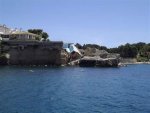
I was wondering if he owned this villa off to your port side of the entrance to Syracuse bay....

FB_IMG_1589526933466.jpg
 
What a strange comment ,little do you know , it was I,20 years ago that helped set up a RYA training school. The then owners used my line of moorings in Poros to keep their boat on in the bay.I also taught a few of its now Greek /Albanian instructors how to sail and am still a good friend of its head instructor, Mark
I also know a few of its past students .
unfortunately it's a business that needs to pass people and need them to say nice things that it's instruction is so good,it passed X percent of its students.


The op was a question about standard training of British students and RYA syllabus plus an anecdote , absolutely nothing about shouting, but ,there again,some on here need to post 5 paragraphs on every subject posted.
And was answered (by me) in one sentence in post#6. In fact was really surprised that somebody with all your experience setting up sailing schools and teaching instructors should even be asking the question. so not unreasonably assumed you were just using it as an intro to your gripe bout incompetent charterers.

If all you wanted to know was what the syllabus contained then the sensible thing would be to go onto the RYA website and read it.
 
Top