In mast furling. Desirable?

True, but most of those are just minor nuisances, while the disadvantages of in-mast such as weight aloft and risk of jamming are persistent and potentially serious. I don’t think I would be considering it as an option under about 38’, and even then, the option of electric winches might make a traditional rig just as attractive. These rigs have obviously matured in the last 20 yrs, but I don’t think they have reached the level of furling jibs as being the obvious choice.
I find it strange that a long list of negatives get dismissed as "minor" and yet 2 issues, one of which is definitely not an issue and the other rare are claimed to be "persistent and potentially serious" without any concrete evidence to support the claim.
 
Interestingly the stability manual for our boat doesn't differentiate between slab and in mast furling versions in the same way as there are three separate sets of data for the 3 keel options available.

It does contain a note warning you to reef in wind greater than F3 though.
 
That is mostly subjective. The weight aloft is overstated. While it does apply to the original add on type where sticking the extra extrusion on the back has a serious impact on weight aloft and therefore on stability on boats which often had poor stability to start with. This only applies to a few old boat converted 30 or more years go. It doe NOT apply to modern boats of the last 30 years or more designed to have in mast. Difficult to imagine the world's top designers not being aware of the potential issues and designing their boats to meet the required stability requirements. Don't see any evidence of boats being lost or compromised because of in mast. Again not one owner on this thread, some of whom have serious passage making boats have mentioned stability.

Baggy sails - yes, but easily avoided by having the sail made with more stable cloths such as Vectran as I did.

Reduced sail area - yes, but not really the problem you might think. Most modern boats have large sail areas, particularly mains which need reefing early and first slab reef cuts sail area by typically 25%+ whereas furling mains are typically between 5 and 10% less than a slab main on the same boat. This can be reduced further as some have noted by having a battened sail which also allows roach or to a lesser extent by having a reinforced leech like I had which increased the sail area with a bit of roach (rather than the common scalloped leech in cheap sails). Again as others have noted a well cut sail is very amenable to shape adjustment using the outhaul. It will also hold its shape well when reefed and allow infinitely adjustable sail area.

What is so difficult about ensuring the boom angle is correct for furling or reducing sail? that is what the topping lift and or rod kicker is for. Never experienced problems with the wrong angle.

Reducing sail area quickly is easy. Pull the bit of string that winds the sail in while controlling it with the outhaul. Easy with 2 people and not so difficult alone if you set it up like I did with the reefing line on the starboard side of the hatch and the outhaul on the port. Stand in the companionway and do it. Of course my boats were relatively small at 10m and 11.5 and it gets a bit more awkward with some of today's ultra wide twin wheel 12m boats.

All the negatives come from people who do not own boats with in mast and although they are often keen to tell you about all the tricks they use to make their slab reefing work they seem unwilling to accept that you just have to learn a few simple techniques to get the best out of a different set up.

So, in mast can work perfectly well on a boat that was designed for it, and if you're willing to use more expensive sail materials and/or change sails more often.

You asked me to provide a list of the disadvantages and I did so. I didn't say that they were insurmountable or that they made in mast an inferior option. I do think it's true that in mast is a bit less idiot proof.
 
Yes, although because of the lack of battens the cost of the Vectran sail was little different from a similar size battened sail in premium Dacron and will last longer.

The thing about the "disadvantages" is that they are held up as both real and a barrier. The stability bit for example derives from such statements a "the mast must be heavier" or "think of all that extra weight of the sail when furled in heavy weather", bur is never supported by any facts nor evidence that people have got into trouble because of it. Much of it derives from a magazine article over 30 years warning of the dangers of adding in mast (and jib furling) to boats never designed for it. Calculations were done for a 1970s design that had poor stability and quite rightly showed a significant impact. Then a story of a boat with a behind mast furler that failed the inclining test for coding, ie poor stability, without of course saying whether a sister ship without would have passed. Such stories get repeated and become "fact". On the other hand as in Post#82 builders do not differentiate in the stability requirements for the RCD, nor do the stories of all the boats with in mast successfully completing ocean crossings and circumnavigations without capsizing!

Idiots should not be sailing - at least those who seem incapable of learning to understand how their boat works.
 
It’s a shame that in boom isn’t seen more widely on larger yachts -it’s on the xc42 for example and you see it on jongert for example but it is slow to rotate the boom but we see few comments on its ease of use perhaps due to the costs and few xc sailors around .If there is one disadvantage to stackpack on a larger main it’s attaching the halliard and putting the sail cover boot on -issue 1 can be addressed by having a clip on the lazyjack line to tie back the halliard but I can see that for those of a certain age or limited mobility zipping the stackpack or clipping the boot cover on front around mast can become tiring activity to be avoided. It always strikes me as a slow process to stow an in mast though compared to to a stackpack drop head to wind .
 
It always strikes me as a slow process to stow an in mast though compared to to a stackpack drop head to wind .
Obviously slower than just dropping the sail into the stackpack, but that ia all you have to do. Engine on tickover, boat 20 degrees off the wind on the starboard side, autopilot on, pull in the sail. Job done. Of course if you need to keep your crew occupied when you chug up the river they will miss having to put all the sail and lines away. On the other hand if you are a geriatric who just wants to go for a sail with minimum fuss then a furling sail wins hands down. When I had my Bavaria it was around 40 minutes from home to sailing - 15 minutes to the club carpark, 5 minutes down the pontoon, 20 minutes to start the boat up, leave the berth, out of the haven and sails out. Similar time on return.
 
I've got a friend with in-boom and it's taken quite a lot of fiddling around to get it to work. It's very demanding on boom angle- the sail will bunch up either towards or away from the mast unless the angle is exactly perpendicular.
It does seem popular on superyachts and obviously can be made to work.

One question- why aren't furling mains more common on cats? Where we sail, huge numbers of people choose catsb(Lagoons, Leopards, Balis) because they're happy to trade performance for comfort and convenience. You'd think a furling main would be an obvious choice. But it's very very rare, even on really big 50ft+ cats costing over $2m.
 
If you get a boat with a standard stack-pack as fitted from the factory, then you will most likely have plastic sliders that go up and down in a track in the mast.

Plastic sliders are not ideal, they break regularly, stick in the track, and deteriorate over time - OK for a small main, but problems increase with mainsail size. I chartered a SO409 in Feb this year with a stack-pack and sliders, 3 sliders were broken but were repaired by the Charter Company while I waited. The sail still required a lot of effort to raise, and dropping it was certainly not the case of "release the halyard and it stows itself in the stack-pack in seconds". So keep on top of the maintenance of the sail, sliders, and keep the track clean - they break and stick as a matter of design.

If buying a boat with a stack-pack, but without a ball bearing system, then the sail will be harder to raise, may require someone at the mast to pull it down, and if you want a stack-pack that functions as all the posters here claim, then prepare for the required investment.

If you truly want the best sail performance, and a "perfect" stack-pack that functions as described in this thread, then what you really need are ball bearing cars and a fully battened main.

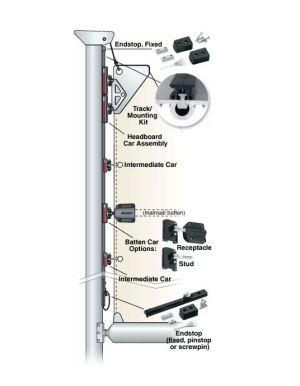
So .... to retrofit ball bearing cars with a fully battened main, you need something like a Battcar System from Harken ...
1757409282434.png
This requires a considerable investment.

A new sail in order to have the right headboard, and battens that slide into batten cars. A track also has to be fitted to the mast (the track plus fasteners increases weight aloft by about the same as the aluminium furler tube in an in-mast furler). Obviously only the cars come down when the sail is stowed - but if you are lucky, in-mast reefing was offered as an option by the manufacturer, so there is no concern about the extra weight aloft. (A Selden in-mast extrusion is approx 300g per metre heavier on a 45ft boat compared to the slab reefing version, this difference is dependent on overall mast size.)

To avoid visiting the mast when reefing, single line reefing with the relevant blocks and leads will also be needed, if you are unlucky and the boat is older, then there will be reefing horns on the boom to which the tack of the reefed sail will need to be attached - this requires co-ordination with the main halyard to ensure the tack stays on the horns, unless you are lucky and have captive reefing horns, but in that case you need another trip to the mast to shake out the reef.

And the story doesn't end there, google the forum for Ronstan cars, Selden cars, and other keywords associated with fully battened mains and you will find numerous discussions about how to make the reefing and hoisting/lowering function as intended. One solution even mentions Pledge furniture polish.

IMO, stack-packs are not a simple panacea for mainsail reefing - they also need understanding, plenty of practice, and regular checks and maintanance. I grew up hauling mainsails up and down on my parents various boats, also changing foresails, (well before furling or stack packs and roller bearing cars), then I moved on to chartering a mix of in-mast and stack-pack ... my experience has pushed me towards in-mast, but every sailor needs to make up their own mind and go with what they prefer. There is no right answer - and "you're going to die when your in-mast jams" is just nonsense - it's a risk that is on a paar with being clobered by the boom, falling head-first onto a winch, or disappearing off the stern while having a pi$$. Sailing is a risk, live with it or give up.

... but for your entertainment, a few quotes from the forum ...

I would agree with the sentiment on ball slides. When I purchased my yacht (Rival 41C) she was fitted with wheeled batten cars very similar to the Rutgenson (if not actual Rutgenson). Mast head rig, big straight stick, Kemp design.

The wheels were flat on most of the cars and they added more friction. You could see the cars juddering and jamming as the sail was hoisted. I am unaware of the age of the system but that winter I reverted back to plain sliders and standard battens (old main so just had the sail re-cut) as the shear hassle of hoisting or reefing was not worth continuing with the system.

Only 1 problem - when we got caught out once after running for hours before a strengthening wind and turned to windward we couldn't heave to and depower the main enough to drop it easily. Had to go to the mast and fight it down. That was the effect of the full battens keeping an aerofoil shape in the top of the main at all times.

Like daverw, I see no point in leaving the cockpit unless absolutely necessary. My lazyjacks only go 3/4 way back on the boom and so the problem only occurs during the first part of the hoist. There was a thread a while ago about widening the lazyjacks by having their block halfway out on the crosstrees, but I think the general conclusion was that by risking over-tensioning them when the boom moves this was not worthwhile. In the end, we have to do what works best on our own boat, though there is never a time to stop learning.
 
Just to add to that from a different angle, My project GH still had a roller reefing boom (remember that?) which a previous owner had converted to slab crudely with the leech line lead forward to a cleat on the boom and a lashing with a caribeenir for the tack. I have converted to single line in a similar way that I did on my old Eventide 30 years ago with lines lead aft. Using good blocks I have managed to keep the friction levels down, but I was surprised by how poor the the track slides were even with new slides and a clean and well lubricated track slot. The solution for that was a Tides Marine track and slides. I have not tried it all in anger yet, but it had better work as I have spent over £3.5k so far just in hardware, stackpack and running rigging!
 
I've got a friend with in-boom and it's taken quite a lot of fiddling around to get it to work. It's very demanding on boom angle- the sail will bunch up either towards or away from the mast unless the angle is exactly perpendicular.
It does seem popular on superyachts and obviously can be made to work.

One question- why aren't furling mains more common on cats? Where we sail, huge numbers of people choose catsb(Lagoons, Leopards, Balis) because they're happy to trade performance for comfort and convenience. You'd think a furling main would be an obvious choice. But it's very very rare, even on really big 50ft+ cats costing over $2m.
1. In-mast is also "very demanding on boom angle". Boom needs to be quite level or folds develop in the sail as it comes in or out.
2. I don't personally like in-boom furling. You lose the outhaul control. The boom becomes massively heavy. A plus is that the whole system is accessible at boom level with no bits up the mast like with in-mast, but doesn't seem worth the other drawbacks in my opinion.
3. Cats have mainsail-driven rigs with small jibs (because of staying and mast position), and so the disadvantages of in-mast would be much more impactful than they are on monos. And lacking backstays, there is no limit on roach. So cats typically have big roachy mainsails and vestigial jibs. That won't work with in-mast furling.
 
If you get a boat with a standard stack-pack as fitted from the factory, then you will most likely have plastic sliders that go up and down in a track in the mast.

Plastic sliders are not ideal, they break regularly, stick in the track, and deteriorate over time - OK for a small main, but problems increase with mainsail size. I chartered a SO409 in Feb this year with a stack-pack and sliders, 3 sliders were broken but were repaired by the Charter Company while I waited. The sail still required a lot of effort to raise, and dropping it was certainly not the case of "release the halyard and it stows itself in the stack-pack in seconds". So keep on top of the maintenance of the sail, sliders, and keep the track clean - they break and stick as a matter of design.

If buying a boat with a stack-pack, but without a ball bearing system, then the sail will be harder to raise, may require someone at the mast to pull it down, and if you want a stack-pack that functions as all the posters here claim, then prepare for the required investment.

If you truly want the best sail performance, and a "perfect" stack-pack that functions as described in this thread, then what you really need are ball bearing cars and a fully battened main.

So .... to retrofit ball bearing cars with a fully battened main, you need something like a Battcar System from Harken ...
View attachment 199131
This requires a considerable investment.

A new sail in order to have the right headboard, and battens that slide into batten cars. A track also has to be fitted to the mast (the track plus fasteners increases weight aloft by about the same as the aluminium furler tube in an in-mast furler). Obviously only the cars come down when the sail is stowed - but if you are lucky, in-mast reefing was offered as an option by the manufacturer, so there is no concern about the extra weight aloft. (A Selden in-mast extrusion is approx 300g per metre heavier on a 45ft boat compared to the slab reefing version, this difference is dependent on overall mast size.)

To avoid visiting the mast when reefing, single line reefing with the relevant blocks and leads will also be needed, if you are unlucky and the boat is older, then there will be reefing horns on the boom to which the tack of the reefed sail will need to be attached - this requires co-ordination with the main halyard to ensure the tack stays on the horns, unless you are lucky and have captive reefing horns, but in that case you need another trip to the mast to shake out the reef.

And the story doesn't end there, google the forum for Ronstan cars, Selden cars, and other keywords associated with fully battened mains and you will find numerous discussions about how to make the reefing and hoisting/lowering function as intended. One solution even mentions Pledge furniture polish.

IMO, stack-packs are not a simple panacea for mainsail reefing - they also need understanding, plenty of practice, and regular checks and maintanance. I grew up hauling mainsails up and down on my parents various boats, also changing foresails, (well before furling or stack packs and roller bearing cars), then I moved on to chartering a mix of in-mast and stack-pack ... my experience has pushed me towards in-mast, but every sailor needs to make up their own mind and go with what they prefer. There is no right answer - and "you're going to die when your in-mast jams" is just nonsense - it's a risk that is on a paar with being clobered by the boom, falling head-first onto a winch, or disappearing off the stern while having a pi$$. Sailing is a risk, live with it or give up.

... but for your entertainment, a few quotes from the forum ...
Indeed!

It is not that simple to make a slab reefing main work well, with or without lazy jacks and/or stack pack. But well-lubricated ball bearing batt cars are the watershed between crappy, sticky action and slab reefing bliss. I've used the Harken ones and can't say enough good about them. They transform the process.
 
If you get a boat with a standard stack-pack as fitted from the factory, then you will most likely have plastic sliders that go up and down in a track in the mast.

Plastic sliders are not ideal, they break regularly, stick in the track, and deteriorate over time - OK for a small main, but problems increase with mainsail size. I chartered a SO409 in Feb this year with a stack-pack and sliders, 3 sliders were broken but were repaired by the Charter Company while I waited. The sail still required a lot of effort to raise, and dropping it was certainly not the case of "release the halyard and it stows itself in the stack-pack in seconds". So keep on top of the maintenance of the sail, sliders, and keep the track clean - they break and stick as a matter of design.

If buying a boat with a stack-pack, but without a ball bearing system, then the sail will be harder to raise, may require someone at the mast to pull it down, and if you want a stack-pack that functions as all the posters here claim, then prepare for the required investment.

If you truly want the best sail performance, and a "perfect" stack-pack that functions as described in this thread, then what you really need are ball bearing cars and a fully battened main.

So .... to retrofit ball bearing cars with a fully battened main, you need something like a Battcar System from Harken ...
View attachment 199131
This requires a considerable investment.

A new sail in order to have the right headboard, and battens that slide into batten cars. A track also has to be fitted to the mast (the track plus fasteners increases weight aloft by about the same as the aluminium furler tube in an in-mast furler). Obviously only the cars come down when the sail is stowed - but if you are lucky, in-mast reefing was offered as an option by the manufacturer, so there is no concern about the extra weight aloft. (A Selden in-mast extrusion is approx 300g per metre heavier on a 45ft boat compared to the slab reefing version, this difference is dependent on overall mast size.)

To avoid visiting the mast when reefing, single line reefing with the relevant blocks and leads will also be needed, if you are unlucky and the boat is older, then there will be reefing horns on the boom to which the tack of the reefed sail will need to be attached - this requires co-ordination with the main halyard to ensure the tack stays on the horns, unless you are lucky and have captive reefing horns, but in that case you need another trip to the mast to shake out the reef.

And the story doesn't end there, google the forum for Ronstan cars, Selden cars, and other keywords associated with fully battened mains and you will find numerous discussions about how to make the reefing and hoisting/lowering function as intended. One solution even mentions Pledge furniture polish.

IMO, stack-packs are not a simple panacea for mainsail reefing - they also need understanding, plenty of practice, and regular checks and maintanance. I grew up hauling mainsails up and down on my parents various boats, also changing foresails, (well before furling or stack packs and roller bearing cars), then I moved on to chartering a mix of in-mast and stack-pack ... my experience has pushed me towards in-mast, but every sailor needs to make up their own mind and go with what they prefer. There is no right answer - and "you're going to die when your in-mast jams" is just nonsense - it's a risk that is on a paar with being clobered by the boom, falling head-first onto a winch, or disappearing off the stern while having a pi$$. Sailing is a risk, live with it or give up.

... but for your entertainment, a few quotes from the forum ...
We have the Harken Batcar system. It works extremely well.
 
I was moored near a 82ft yacht that had completed a world rally. Being only two up and sloop rig. in mast furling was a necessity. Most other yachts in the rally had in mast. It was felt that boom reefing caused more problems as it was difficult to align the luff of the sail with the mast slot. Particularly in lively conditions.

Good luck to anyone who wants to fit in mast . No matter what size of boat.
Apparently, you tend to sail more as it's easier to get it up and down
Or should I say in and out. 😃
 
Just out of interest, does your boat have a furling headsail? Lots of people on this thread talking of needing to get the last 0.1kt from their sails - which I fully understand - but if that’s the argument then surely hank-on headsails would be the ideal?

I think you have to assess all sailing boat conveniences on an individual basis. Roller furling headsails have most of the drawbacks of roller mains but a lot more advantages.
 
Cats have mainsail-driven rigs with small jibs (because of staying and mast position), and so the disadvantages of in-mast would be much more impactful than they are on monos. And lacking backstays, there is no limit on roach. So cats typically have big roachy mainsails and vestigial jibs. That won't work with in-mast furling.
Good observations, thanks.

I wonder if in future the brands like Bali, who regard sailing performance as far less important than ease of use, will aim to introduce furling mainsails. It would need quite a change in approach to the whole rig to work well.
 
Good observations, thanks.

I wonder if in future the brands like Bali, who regard sailing performance as far less important than ease of use, will aim to introduce furling mainsails. It would need quite a change in approach to the whole rig to work well.
In boom reefing is the future for multis. The DF40 has it, and I think it’s an option on the new 36. Popular on Gunboat cats too.
 
In boom reefing is the future for multis. The DF40 has it, and I think it’s an option on the new 36. Popular on Gunboat cats too.
My mate has it as an after market on his Lagoon. It's been pretty troublesome, but he is quite new to sailing. I think he's figured out how to keep the boom at the right angle and how much tension to keep on everything and it's working a bit better now. He did say that when he lost the power to his electric winches he was unable to use his mainsail at all.

I do have the impression that furling (of any sort) does seem to depend on rather a few things going right.

Of course slab reefed mains can cause trouble too. I've had some issues with a sticking main halyard and at one point had to climb the mast underway. Not fun, but it's relatively simple to go up and cut the halyard. I'm not sure what you're supposed to do with a furling main that's stuck, other than take a knife to the sail itself.
 
Indeed!

It is not that simple to make a slab reefing main work well, with or without lazy jacks and/or stack pack. But well-lubricated ball bearing batt cars are the watershed between crappy, sticky action and slab reefing bliss. I've used the Harken ones and can't say enough good about them. They transform the process.
An alternative is the Tides Marine track system I have fitted. Quite popular around here (S Coast) and recommended by several of the popular sailmakers. We chose it rather than full length battens and batten cars partly on cost grounds and partly because the main is low aspect ratio and the view was that full length battens would be too long. Also so I was advised the better batten cars would not fit the old Proctor mast track. Certainly works well in terms of hoisting and dropping. Very smooth and little effort required, just a final tweek with the winch.
 
Top