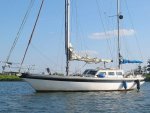
If you were going to sail around the world on a sub 40ft yacht, what would you pick?

I think I am right in saying that for a “commercial” / charter yacht to be coded “O” (unlimited) under MGN 280 she must have watertight compartments and be able to float upright with any one compartment flooded. Code 1 is up to 150 miles offshore and Code 2 is 60 miles offshore, therefore the British Government expects any boat crossing an ocean with paying passengers and/or crew to be able to remain afloat with one compartment flooded, which is the same standard as a cargo carrying merchant ship ( passenger ships are different).

Code 0 is quite rare: most boats in the adventure training business are Code 1 or Code 2.

Here’s an exert from the regulations: (http://solasv.mcga.gov.uk/codes/ndp_code/red_code_final.pdf)

Damage Survivability
This applies to all monohull vessels carrying 16 or more persons and those operating in Area Category 0 or 1, with 7 or more persons, subject to minimum safe manning levels being agreed by the Certifying Authority.
Vessels should be so arranged that after minor hull damage or failure of any one hull fitting in any one watertight compartment, it will satisfy the residual stability criteria below. This may be achieved by fitting water-tight subdivision or alternative methods to the satisfaction of the Certifying Authority. Minor damage should be assumed to occur anywhere in the length of the vessel but not on a watertight subdivision.
In assessing survivability, the following standard permeabilities should be used:-
Other methods of assessing floodable volume may be considered, to the satisfaction of the Certifying Authority.
In the damaged condition, the residual stability should be such that the angle of equilibrium does not exceed 7 degrees from the upright, the resulting righting lever curve has a range to the downflooding angle of at least 15 degrees beyond the angle of equilibrium, the maximum righting lever within that range is not less than 100mm and the area under the curve is not less than 0.015 metre radians. This damage should not cause the vessel to float at a waterline less than 75mm from the weatherdeck at any point. Proposals to accept reduced freeboard or immersion of the margin line may be accepted subject to special consideration.
Space
Appropriated for stores
Appropriated for stores but not by a substantial quantity thereof
Appropriated for accommodation Appropriated for machinery Appropriated for liquids
Permeability % 60
95
95
85
0 or 95 whichever results in the more onerous requirements

Other methods of assessing floodable volume may be considered, to the satisfaction of the Certifying Authority.
In the damaged condition, the residual stability should be such that the angle of equilibrium does not exceed 7 degrees from the upright, the resulting righting lever curve has a range to the downflooding angle of at least 15 degrees beyond the angle of equilibrium, the maximum righting lever within that range is not less than 100mm and the area under the curve is not less than 0.015 metre radians. This damage should not cause the vessel to float at a waterline less than 75mm from the weatherdeck at any point. Proposals to accept reduced freeboard or immersion of the margin line may be accepted subject to special consideration.
 
Coming back to justify my original choice of an Amel Sharki :

Top quality construction
Simple fail safe solutions
Exterior maintenance minimized
Systems organized so that physical strength Is not required
Although not homologated as such its water tight compartments mean that it is virtually unsinkable.
Excellent weather protection behind a hard dodger.

There is a very good French blog called Doug Le which describes an experienced couple's decision methodology in choosing a Sharki as well as their subsequent assessments of its performance.

Some comments :

On a 12 hour sail, modern boats may arrive an hour before us but we will arrive refreshed and rested.
On a rough Atlantic crossing we arrived ahead of a J boat which left at the same time because it was constantly being slowed by wave action whereas the Sharki's displacement enabled it to keep ploughing on.

This would not be a boat I would choose as a young man but, at my age, its characteristics seem ideal to me.
 
Last edited:
You claim to be a naval architect or at least claim to know something about designing boats. Do the sums yourself to calculate how much foam is needed to ensure boats are unsinkable. Then you will understand why almost nobody does it. 30 years ago two European builders did build boats that were unsinkable but they had significant negative features as a result. Neither of these builders is still in business.

You can't seem to get it into your head that sinking - or rather having a boat that claims to reduce the almost negligible chance of it occurring is not high on the priority list of most buyers.
On the comfort factor, foam does help a lot - go have a look in a marina when there's snow on the ground and see which liveaboard boat melts last ...
Same in the tropics the other way round but harder to quantify . Downside is it's a bit of a pain if you want to weld on some new fittings where there's foam below, bigger job than a quick grind/weld/paint.
 
On the comfort factor, foam does help a lot - go have a look in a marina when there's snow on the ground and see which liveaboard boat melts last ...
Same in the tropics the other way round but harder to quantify . Downside is it's a bit of a pain if you want to weld on some new fittings where there's foam below, bigger job than a quick grind/weld/paint.

Don't have any problem with adding foam for insulation, particularly with thin shells like metal boats. It is the notion that somehow this can make a boat unsinkable. Those that have tried (Sadler and Etap) both used an inner hull and injected closed cell foam in the void. Obvious consequence was a significant reduction in internal volume and storage space plus on some boats issues of delamination. Interesting thing is that AFAIK, although several thousand boats were built using this method none have ever been involved in an incident that tested unsinkability for real. There were however demonstrations that the boats would still be habitable and capable of making progress. Remember one in particular around 1980 with a Sadler 26 in the Swash channel outside Poole.

Remember also Andrew Simpson doing some calculations for adding enough foam to keep an Achilles 24 (as you may know a long slim low volume boat) afloat. It came to close on 3 cubic metres. To be effective most would have to be above the waterline.
 
Remember also Andrew Simpson doing some calculations for adding enough foam to keep an Achilles 24 (as you may know a long slim low volume boat) afloat. It came to close on 3 cubic metres. To be effective most would have to be above the waterline.

That's a bit of a puzzler. Intuitively I would have said that the amount of flotation required to stop a boat from sinking would simply be its weight- in fact a little less than that to account for the volume of the (flooded) boat. So for an Achilles it would be a little over a cubic metre.
 
That's a bit of a puzzler. Intuitively I would have said that the amount of flotation required to stop a boat from sinking would simply be its weight- in fact a little less than that to account for the volume of the (flooded) boat. So for an Achilles it would be a little over a cubic metre.

I think that the argument is that it’s not enough for it to ‘just float’ as a semi submerged object. It needs to maintain some semblance of stability and be floating enough to be ‘better than a liferaft’
 
Given how easy it is to spray foam insulate a boat, and how much more comfort it gives ,both in the tropics and high latitudes , as well as making plastic and aluminium boats unsinkable, I don't know o why one wouldn't spayfoam insulate, for a circumnavigation.

Well, yes, you do want to insulate for cold climates but no need to spray ... my boat ( GRP ) is insulated with 6mm silver backed closed cell camping mats..... works good....

Doubt they will keep the boat afloat though......

Cold climate?.... mas aqui ... http://www.cruiserswiki.org/wiki/Chile
 
That's a bit of a puzzler. Intuitively I would have said that the amount of flotation required to stop a boat from sinking would simply be its weight- in fact a little less than that to account for the volume of the (flooded) boat. So for an Achilles it would be a little over a cubic metre.

Memory was a bit out, so I found the original article and calculations. As John says just offsetting the weight is not good, so Andrew used 1.5 times the displacement (based on work done by a guy called HF Kay) and it was actually 2.25 cu metres - although that is based on the design displacement and does not include any gear and stores.

The full article is in PBO Feb 2003 pp 52/3
 
Last edited:
A Bowman 40 or a Vancouver 36 would be high on my list.

I like the idea of a Pogo too but how will it fair when you really load it up with all that living stuff plus extra tanks and the boat is 2 to 4 inches deeper in the water!
 
Albin Vega! We’re hoping it gets us to the caribbean and we’ll see if we want (or can afford) to go the long way back home ?
 
You claim to be a naval architect or at least claim to know something about designing boats. Do the sums yourself to calculate how much foam is needed to ensure boats are unsinkable. Then you will understand why almost nobody does it. 30 years ago two European builders did build boats that were unsinkable but they had significant negative features as a result. Neither of these builders is still in business.

You can't seem to get it into your head that sinking - or rather having a boat that claims to reduce the almost negligible chance of it occurring is not high on the priority list of most buyers.

Of all the many people ho have cruised long distances on my boats, all were extremely happy with the design . My only critics are those who know least about them.
One common mistake in calculating how much foam a boat needs to float it ,is by naively assuming you need enough to float the boat's dry weight.
Fibreglass weighs around 95 lbs pr cubic foot, water around 64. Thus, fibreglass submerged in water weighs roughly 2/3rds of its dry weigh. Half inch fibreglass dry weight is around 4 lbs per sq ft. Submerged ,it is around 2.6 lbs per sq ft. That takes just over half inch foam to float it.
Douglas fir is roughly half the weigh of water. So every pound of wood interior weight is roughly a pound of buoyancy.
Of course, you would have to do a 50% overkill on foam thickness, to compensate for ballast, engine, etc . 1 1/2 to 2 inches of foam is a huge overkill, but wouldn't take up a significant amount of interior, not enough to matter. Useless, inaccessible voids, well above the reach of bilge water, may as well be filled with foam.
I once read in a British magazine, about plastic, foam cored 48 footer, which was holed in the English channel, filled with water, but wouldn't sink, due to the foam core.
Bruce Cope, of Cope Aluminum Boats in Parksville BC, told me of a new 35 ft aluminium boat they had on a grid, freshly spray foamed. While the tide was out ,they went for a few beers. Someone had forgot to close a thru hull. By the time they got back ,the boat was full of water. They took a picture of the whole crew standing on deck, with the boat still having a foot of freeboard.
There is a steel landing craft at the head of Scotty Bay on Lasqueti Island, near here.They tried to sink it, but it wouldn't sink, because it had too much spray foam in her .She is the only abandoned steel boat on the shore I know of ,on this coast
Even if you never hole a boat, the peace of mind and hugely improved comfort is well worth it. People who live on plastic, uninsulated boats here, are always amazed at how much more dry and comfortable foamed boats are. Many have sprayfoamed their plastic boats, or plan to do so before winter. Even cored ones.
The reason so many stock boats are not made unsinkable, is because they try make them as cheap as possible, to maximize profit margins.
 
Last edited:
Albin Vega! We’re hoping it gets us to the caribbean and we’ll see if we want (or can afford) to go the long way back home ��

Great cruiser! The book "Log of the Mahina is a great read, on cruising in a Vega. The author, Tom Neale, said he spent a lot of time cruising with a reef in the main, to overcome the weather helm.
Another solution would be to put an outboard rudder on a skeg. She has the perfect transom rake for that. That would enable you to use a bullet proof trimtab on the rudder type, self steering rig, eliminating windvane failures. The windvane rig could be easily built for under $50. The skeg could be used for engine cooling , eliminating heat exchanger , salt water pump, salt water intake, thru hulls, strainer, etc
 
Bruce Cope, of Cope Aluminum Boats in Parksville BC, told me of a new 35 ft aluminium boat they had on a grid, freshly spray foamed. While the tide was out ,they went for a few beers. Someone had forgot to close a thru hull. By the time they got back ,the boat was full of water. They took a picture of the whole crew standing on deck, with the boat still having a foot of freeboard.
.

Was the owner lining them up to walk the plank or was he going to hang them from the yardarm?
 
The reason so many stock boats are not made unsinkable, is because they try make them as cheap as possible, to maximize profit margins.

As usual statements that you make such as this are absolute rubbish. The two boat builders who successfully built unsinkable boats were at the lower end of the price spectrum and operated profitably for many years.

Obviously builders seek to maximise profits independent of the price level they operate at. Otherwise they go bust.

The reasons builders don't offer boats with enough buoyancy to remain usable if holed are first because there is no consumer demand for it, second it is technically difficult to achieve without compromising structural integrity and interior volume. However it is worth noting that in reality GRP boats are extremely difficult to sink firstly because it is difficult to hole the hull and secondly there are many parts of the hull that are watertight and provide buoyancy. Of course the crew can make a big difference by finding and stemming any breaches as many survival accounts show.

Your assertion that the GRP contributes buoyancy is false. The foam has to offset the weight of water which the boat displaces. Read the article I referred to - Practical Boat Owner Feb 2003 and you will see your assumptions are just plain wrong. BTW the author is a well respected Naval Architect who is currently 10 years into a circumnavigation in a boat of his own design and construction. It is of course not made of steel, but wood epoxy composite. I would happily trust my life to one of his boats.
 
Last edited:
As usual statements that you make such as this are absolute rubbish. The two boat builders who successfully built unsinkable boats were at the lower end of the price spectrum and operated profitably for many years.

Obviously builders seek to maximise profits independent of the price level they operate at. Otherwise they go bust.

The reasons builders don't offer boats with enough buoyancy to remain usable if holed are first because there is no consumer demand for it, second it is technically difficult to achieve without compromising structural integrity and interior volume. However it is worth noting that in reality GRP boats are extremely difficult to sink firstly because it is difficult to hole the hull and secondly there are many parts of the hull that are watertight and provide buoyancy. Of course the crew can make a big difference by finding and stemming any breaches as many survival accounts show.

Your assertion that the GRP contributes buoyancy is false. The foam has to offset the weight of water which the boat displaces. Read the article I referred to - Practical Boat Owner Feb 2003 and you will see your assumptions are just plain wrong. BTW the author is a well respected Naval Architect who is currently 10 years into a circumnavigation in a boat of his own design and construction. It is of course not made of steel, but wood epoxy composite. I would happily trust my life to one of his boats.

You claim that fibreglass weighs the same out of water, as submerged in water?
RUBBISH!
 
You claim that fibreglass weighs the same out of water, as submerged in water?
RUBBISH!

You are talking at cross purposes. No one doubts that fibreglass weighs less in water than out.

What is complete and utter rubbish is your theory about spray foam insulation making GRP or Al boats unsinkable. Given enough foam it might be possible but It really isn’t that simple and the fact you make such a wild claim and don’t understand the complexity of the problem shows your ignorance of Naval Architecture and the basic tenets of boat design.

If you make such elementary mistakes and ridiculous claims that are plain wrong, how do you expect anyone to take you seriously?
 
Top