Identifying VHF antenna cable type

A temp/perm solution.
Check braid condition just below deck level.
If manky its a new cable run. :(
If OK, mebbe a deck fitting will solve the problem for now or forever depending on your keeness.
View attachment 192736
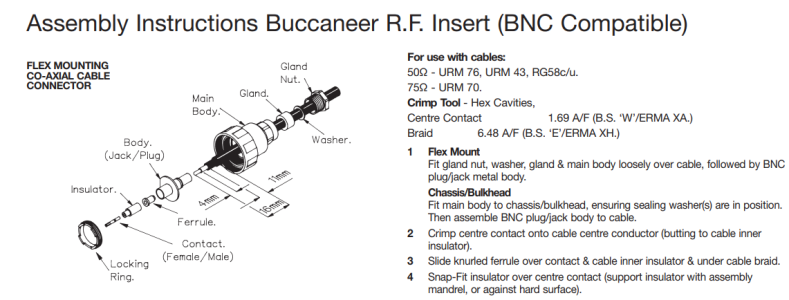
This is obviously PL but other plugs are used.
Ps.....Every joint made loses you a bit of RF output at the aerial.

Thanks @oldgit. I have a strong suspicion as to which way this is going, given that the the braid in the picture is only about 10 inches from deck level as it is. If I go back much further there won't be enough tail to work with - so it feels quite likely to me that we're in new mast wire territory...

As a stop gap, I think I'm going to try and crimp on some PL259 connectors so that I at least have some kind of connection to the masthead antenna (rather than use the screw / solder approach, as I suspect the braid might not hack it!).

It might also be time to bring my stubby AIS pushpit antenna out of retirement as a temporary / backup antenna - this issue has probably emphasised to me the benefit of having an independent antenna mounted somewhere...
 
A temp/perm solution.
Check braid condition just below deck level.
If manky its a new cable run. :(
If OK, mebbe a deck fitting will solve the problem for now or forever depending on your keeness.
View attachment 192736
This is obviously PL but other plugs are used.
Ps.....Every joint made loses you a bit of RF output at the aerial.
The loss for a PL259/SO239 connector can be 1dB for a poorly matched one.

So having 2 in series like this can lose you over 1/3rd of the power from the radio - quite a significant range reduction.

Having one on the output of the radio can be mitigated against by tuning the output.
 
The loss for a PL259/SO239 connector can be 1dB for a poorly matched one.

So having 2 in series like this can lose you over 1/3rd of the power from the radio - quite a significant range reduction.

Having one on the output of the radio can be mitigated against by tuning the output.
Out of interest (and I don't honestly understand how dB relates to signal strength) - what dB level would you be starting with from the radio / AIS output? Would just be good to put the 1dB loss into context as to what sort of relative impact that has overall.

If I do end up getting the cable up the mast replaced, I guess I would have an option to run the new length of wire all the way back through the boat to the VHF, rather than putting a join at the base of the mast. The join would inevitably have to appear the next time the mast comes down, but that is hopefully 7-10 years from now!
 
Out of interest (and I don't honestly understand how dB relates to signal strength) - what dB level would you be starting with from the radio / AIS output? Would just be good to put the 1dB loss into context as to what sort of relative impact that has overall.

If I do end up getting the cable up the mast replaced, I guess I would have an option to run the new length of wire all the way back through the boat to the VHF, rather than putting a join at the base of the mast. The join would inevitably have to appear the next time the mast comes down, but that is hopefully 7-10 years from now!
dB is a logarithmic ratio; it is 10 log10 (S1/S2) where S1 and S2 are output and input, respectively. So it doesn't have an absolute value. A cable or connector that loses 3db is halving the signal; 10dB is reducing it to a tenth of its starting value. The signal level at the radio is what it is; you want as small a loss in the cable and connectors as possible. Even 1dB loss is 25% loss of signal power.
 
dB is a logarithmic ratio; it is 10 log10 (S1/S2) where S1 and S2 are output and input, respectively. So it doesn't have an absolute value. A cable or connector that loses 3db is halving the signal; 10dB is reducing it to a tenth of its starting value. The signal level at the radio is what it is; you want as small a loss in the cable and connectors as possible. Even 1dB loss is 25% loss of signal power.
Thank you!
 
At the risk of incurring the wrath of many others here, I just don't understand all this faffing about. Just get a new antenna, complete with cable and replace everything between masthead and VHF radio.

You can't afford to mess about when you're dealing with what could prove to be life-saving equipment.
 
Thank you!
The reason they're used is that engineers are lazy, converting to dB allows you to add and subtract gains and losses rather than multiply and divide.
At the risk of incurring the wrath of many others here, I just don't understand all this faffing about. Just get a new antenna, complete with cable and replace everything between masthead and VHF radio.

You can't afford to mess about when you're dealing with what could prove to be life-saving equipment.
Agreed, cutting back coax is not a good idea, if it's had water in it it needs replacing. I don't like the antennas that use a vampire tap in to the centre conductor as they need special coax with a ferrule and are not meant to be made and remade but are when the mast is removed for maintenance. If you're using an antenna with a connector, it makes sense to get the best possible coax and to use BNC at the bottom of the mast connection with good selt amalgamation tape used on joins. Also have a drip loop at the top and bottom of the mast to reduce the water that runs down the cable.

When choosing coax, you need to keep in mind the loss, the physical diameter and the minimum bend radius (bending too much opens the weave on the outer conductor). For the cost of chandlery RG58, there are better options available from specialist suppliers like Nevada radio or Martin Lynch. Explain it'll be in a marine environment, needs to be a similar size to 58 and they'll give you some options.

The more power you can get to the antenna, the more chance your distress calling will be heard at a distance.
 
Personally I’d use something like Messi & Paoloni Hyperflex 10 or maybe Ultraflex 7 which is slightly thinner if you need it. Both have very low loss and are much more flexible than something like RG8. M&P connectors are also excellent quality and substantial.

One thing to bear in mind is that RG58 is not an electrical or RF standard, it’s a physical description of the cable size. Just because something is labelled RG58, that does not tell you anything about its performance. Something labelled RG58 could be reasonable quality or really poor with not much copper in the core or shield (or worse use copper clad steel or aluminium).

In any case, RG58 is only really suitable for short patch leads at VHf frequencies, not for a 20m run up a mast. It’s often supplied with antennas because it’s cheap, but can have substantial loss over that distance. Even good RG58 will lose about 3dB over that distance which is a 50% power loss at the antenna.

At the risk of incurring the wrath of many others here, I just don't understand all this faffing about. Just get a new antenna, complete with cable and replace everything between masthead and VHF radio.

You can't afford to mess about when you're dealing with what could prove to be life-saving equipment.
The problem is that many antennas are supplied with crap quality coax and connectors because it’s cheap to do so. As you say, it’s a safety item, so worth doing it with components that are of known quality and performance.
 
Ok thanks all - lots to consider and not sure it makes it easier for me to make a choice when I don't fully understand this stuff. I'll see what the local marine electrical company suggest - but I do suspect the default is probably just to install standard quality RG58 on most installs.

I didn't realise RG58 was about dimensions only - so it makes sense there might be lots of variation in quality if that's the case!

At the risk of incurring the wrath of many others here, I just don't understand all this faffing about. Just get a new antenna, complete with cable and replace everything between masthead and VHF radio.

You can't afford to mess about when you're dealing with what could prove to be life-saving equipment.
Just for the record @Beelzebub I will definitely do this - now that I know it's compromised, I'm not prepared to risk it long term.

However until I can get it done (I can't do mast climbs - too big, heavy and scared of heights!) I want to see if I can get something working that will suffice for local coastal sailing. I'm also keen to make sure that when I do get the job done, I get it done properly! Getting it done with the mast up may constrain my options and I may just have to take the compromise on e.g. cable thickness or how easy it is to route it down, until the mast next comes down and I can properly re-do everything through the mast. I will probably take the opportunity to put a separate AIS antenna on the top spreaders when I do.
 
When choosing coax, you need to keep in mind the loss, the physical diameter and the minimum bend radius (bending too much opens the weave on the outer conductor). For the cost of chandlery RG58, there are better options available from specialist suppliers like Nevada radio or Martin Lynch. Explain it'll be in a marine environment, needs to be a similar size to 58 and they'll give you some options.
Thank you - I've always wondered what the reason for the tight bends was! This now makes complete sense! I certainly have some tight bends where my patch cables are connected into the VHF, Splitter, and AIS behind the electrical panel.

Just to share one of those lessons you learn - I bought some short patch cables to use between VHF, Splitter and AIS - and ended up getting RG213 (because it was listed as very low loss etc.). Fitted them, and they're so thick and stiff that ended up having to bend them through 180 degress just to get them into the sockets so I am fairly certain I have undone any potential benefit of those just by bending them!
 
Personally I’d use something like Messi & Paoloni Hyperflex 10 or maybe Ultraflex 7 which is slightly thinner if you need it.
The Ultraflex 7 looks interesting. Ultraflex 10 it says is same dimension as RG213, which I think is going to be a challenge for the space in the mast. But Ultraflex 7 looks like it could do the trick....
 
Thank you - I've always wondered what the reason for the tight bends was! This now makes complete sense! I certainly have some tight bends where my patch cables are connected into the VHF, Splitter, and AIS behind the electrical panel.

Just to share one of those lessons you learn - I bought some short patch cables to use between VHF, Splitter and AIS - and ended up getting RG213 (because it was listed as very low loss etc.). Fitted them, and they're so thick and stiff that ended up having to bend them through 180 degress just to get them into the sockets so I am fairly certain I have undone any potential benefit of those just by bending them!
Yep - co-axial works like a long capacitor - the power is transferred as electromagnetic energy in the dielectric spacer between the inner and outer conductor - if you bend it too hard the spacer is squashed (which causes reflections) and/or the braid is opened and the RF leaks out. In some cases, this is wanted (e.g. a leaky feeder in a tube tunnel to allow WiFi use) but in your case definitely not wanted.

As said, contact the RF suppliers listed. For the same price as Chandlery RG58 of unknown quality, they'll have more options from Mini-8 to M&P Ultraflex.
 
Yep - co-axial works like a long capacitor - the power is transferred as electromagnetic energy in the dielectric spacer between the inner and outer conductor - if you bend it too hard the spacer is squashed (which causes reflections) and/or the braid is opened and the RF leaks out. In some cases, this is wanted (e.g. a leaky feeder in a tube tunnel to allow WiFi use) but in your case definitely not wanted.

As said, contact the RF suppliers listed. For the same price as Chandlery RG58 of unknown quality, they'll have more options from Mini-8 to M&P Ultraflex.
Thanks - great explanation.
 
I managed to get some PL259s crimped onto the remaining antenna cable. Was fairly pleased to be able to converse with the VTS antenna about 10nm away at Sheerness, which is certainly sufficient for me to be able to do some coastal sailing this weekend.

I also have a Surecom SWR meter and ran some tests on the cable with the new connectors.

Using the SWR meter, I checked VHF->Meter->Antenna cable. This bypasses the fairly long (and bendy) run of coax inside boat between mast base and electronics cabinet), and also the VHF splitter I’ve been using as part of the setup.

To my surprise the SWR reading was 1.04 on 1W and 1.54 on 25W. The meter measured 0.4W of power on 1W, and 20W of power on 25W. Seemed to suggest that for a corroding coax up the mast, the transmission is still reasonable?

I then tested AIS->Meter->Antenna cable - 5W transmissions again reading SWR of about 1.05 and transmission power of 3.5W (from a 5W B+ AIS transceiver).

I then tested VHF->Quark-Elec Active Splitter->Meter->Antenna Cable. Quite shocked to see that a 1W transmission from the VHF wouldn’t even register on the meter, and on 25W, a power reading of 6.5W…

Firstly, I don’t know if it’s usual to get that level of power loss from the VHF and AIS to the antenna - about 20%-30% power loss?

Secondly - it would certainly seem that simply adding the splitter into the mix is causing very significant power loss, which I am assuming now points to my splitter being up the creek…
 
I’m looking at purchasing the new cable for my masthead VHF. Ultraflex 7 looks good compared to LMR240, in terms of flexibility for its size. However bend radius spec is almost twice that of RG58 45mm vs 25mm for RG58. LMR240 is 38mm.

My slight concern is that where it comes through the deck, I will necessarily need to bend through 90 degrees to get it to run along the headlining, and this will probably be a radius of less than 45mm.

Q1. Does the potential loss of bending Ultraflex 7 might tightly outweigh the losses from using RG58 for its 25mm bend radius spec?

Q2. Internet seems to suggest that LMR240 is quite stiff, but it does have comparable loss to Ultraflex 7 and a slightly lower bend radius spec. Does anyone have experience of working with LMR240 and know how much of an issue the stiffness is for using up a mast / on a boat?

Thanks for your help in navigating the myriad of choices - keen to make a good decision given I don’t want to be replacing this for another good few years!
 
Top