Hydrovane

If you want a vane gear that works under all conditions buy a Monitor. Hydrovane is a complete POS, IMHO. I've been shipmates with both, plus Wind Pilot. The Monitor is vastly superior to both. You pays your money and takes your choice ....
That’s a very controversial claim. When I first used the Hydrovane I wasn’t sure about it. A few minutes experience and I’ve joined the ‘wouldn’t be without it because it’s brilliant’ brigade. It’s got several advantages over Monitors and other servo gears. Calling it a POS is plain stupid as hundreds of satisfied long distant cruisers would agree.
 
Whether deliberate or not, your comment "seems" to suggest that a wind vane is less suitable for short trips. If so, I would dispute that. I often use my Aeries whilst sailing in the Blackwater. Takes 3 minutes to set up at the start of a trip. Then can be engaged at ease when under way. About the same time as it takes to get my autopilot on deck & plug it in & turn on the electrics. I do accept that I still use the autopilot for motoring ( unless it is quite windy, in which case the Aeries does work OK)
That is not what I intended - if you read the whole post. An autopilot as I said is far more versatile and is the first choice for most for typical coastal cruising - and I only raised it because the OP asked for suggestions for an autopilot. The key question therefore is what does he intend using the boat for. Note of course (as you see in post#9) he has a centre cockpit wheel steered boat which makes most windvanes difficult to install and use, although a Hydrovane is easier. So it is a question of priorities and choosing the piece of kit that suits the intended type of sailing. Both are expensive bits of kit - new each is £5k+ so even more important to be clear on priorities.
 
  • Like
Reactions: srm
That is not what I intended - if you read the whole post. An autopilot as I said is far more versatile and is the first choice for most for typical coastal cruising - and I only raised it because the OP asked for suggestions for an autopilot. The key question therefore is what does he intend using the boat for. Note of course (as you see in post#9) he has a centre cockpit wheel steered boat which makes most windvanes difficult to install and use, although a Hydrovane is easier. So it is a question of priorities and choosing the piece of kit that suits the intended type of sailing. Both are expensive bits of kit - new each is £5k+ so even more important to be clear on priorities.
Totally agree. We’ve been very happily with an autopilot for many years (including lots of cross channel stuff). But it’s not been a wheel pilot but a proper in built autopilot.
 
Whether deliberate or not, your comment "seems" to suggest that a wind vane is less suitable for short trips. If so, I would dispute that. I often use my Aeries whilst sailing in the Blackwater. Takes 3 minutes to set up at the start of a trip. Then can be engaged at ease when under way. About the same time as it takes to get my autopilot on deck & plug it in & turn on the electrics. I do accept that I still use the autopilot for motoring ( unless it is quite windy, in which case the Aeries does work OK)
Me too. My Monitor is put into action almost as soon as the boat is under sail.

It is very easy to set up and needs no maintenance. Also there are no aluminium components, which I think is an advantage.

The only thing I have against it is that it's an ugly thing.

When motoring I use a simple Navico tiller pilot.
 
Whether deliberate or not, your comment "seems" to suggest that a wind vane is less suitable for short trips. If so, I would dispute that. I often use my Aeries whilst sailing in the Blackwater. Takes 3 minutes to set up at the start of a trip. Then can be engaged at ease when under way.

+1
Apart from when I'm hoisting/dropping the sails, I barely use my electronic autopilot.
Even when coastal sailing.
You do have to keep an eye on it when rounding a headland (possible wind shift), but most of the time I leave the helm to 'Carly' (Pacific Windpilot).
 
I think the Windpilot would be a pretty smart choice too - and my only steer ( see that ?🤪) is that if buying new then that is the one I would consider first next time around .. they’re beautifully made and continually evolved ..

The main reason I never considered a Hydrovane is that I would not be able to remove its rudder while underway.
The boat can have a mind of her own when it comes to close quarters maneuvering in confined waters and the last thing I need at that time as an extra rudder in the water complicating things.

I had a Monitor on my previous boat and when it worked it was brilliant, but getting it to work properly was a bit of a black art.
Installed a Pacific Windpilot on my current boat and I most say I'm chuffed to bits.
Well made, reasonably priced and above all: easy to use.
 
Last edited:
The main reason I never considered a Hydrovane is that I would not be able to remove its rudder while underway.
The boat can have a mind of her own when it comes to close quarters maneuvering in confined waters and the last thing I need at that time as an extra rudder in the water complicating things.

I had a Monitor on my previous boat and when it worked it was brilliant, but getting it to work properly was a bit of a black art.
Installed a Pacific Windpilot on my current boat and I most say I'm chuffed to bits.
Well made, reasonably priced and abova all: easy to use.

Over the years there have been a couple of work arounds for removing or lifting the rudder whilst underway but I agree it can be a pain in the arse.
 
I’ve always thought of the ‘big three’ as Monitor, Hydrovane and Aries, though it seems to me that Windpilot could/should be added to that list - you see them on a lot of boats these days.
 
That’s a very controversial claim. When I first used the Hydrovane I wasn’t sure about it. A few minutes experience and I’ve joined the ‘wouldn’t be without it because it’s brilliant’ brigade. It’s got several advantages over Monitors and other servo gears. Calling it a POS is plain stupid as hundreds of satisfied long distant cruisers would agree.
Could you expand on the advantages as you see them please John?
 
Could you expand on the advantages as you see them please John?
For a centre cockpit boat like ours, no steering lines to some sort of drum on the wheel.
It’s a completely independent system
Can be used as an emergency rudder
Offset fitting is no problem (ours is offset from the centre slightly. )
It’s robust (you don’t hear of many breaking down.)
It’s compact and easy to service.

I’ve used other wind vane systems and none are perfect. Hydrovanes aren’t perfect but they’re quite good. My comment originally was to question why anyone should describe Hydrovane (one of the most successful wind vane systems manufactured and sold) as a POS.
 
It's all horses for courses.
My first windvane was a Navik, which is a servo pendulum. On my 27ft boat it worked perfectly. We didn't ever worry about balancing sails, it just worked. Steered to windward better than a human, and never accidentally gybed us when running. Cannot praise it highly enough. Used it all the time, day sails, coastal passages, short tacking up a channel, etc.

On our current boat we chose a Hydrovane. Primarily for the reasons John states above- we're also a centre cockpit and doing long distance sailing, so the lack of lines across the cockpit and the backup rudder are big selling points.

But I miss the Navik. The Hydrovane does its job, but only after you've got the sails perfectly balanced and the correct amount of helm dialled in. And if the wind strength changes a lot you have to account for that. It can go for days without intervention, then you'll spend a whole watch babysitting it- or just give up and stick the autopilot on if the wind is really being fickle.
We call it Signourney, because it's always weaving around. The Navik just stuck to the course like a train on a track, but the Hydrovane will yaw around 5-10⁰ either side. It's not uncommon to backwind a sail occasionally when running wing on wing- generally in lighter winds and bigger waves. Maybe we should have needed Hydrovane's advice and bought the newer, larger, rudder.

The autopilot is fantastic. If I had to choose only one, it would win by a mile. I'm talking about a proper below-decks linear drive unit, so it's literally one press of a button to engage, and it instantly gives you back control if you have any failures in the steering gear other than the shaft and rudder themselves.
The only downside of the autopilot is the power consumption. We have enough solar to keep up with it on sunny days, if it's not working too hard, but most of the time we can't afford the power to run it.

Re Hydrovane costs- we paid £1650 for a secondhand unit, then had to get the vane re-covered (by a relative, not sure what cost would have been otherwise) upgrade to a longer shaft (£750), get the old rudder bored out to fit the new shaft (£100), and replace a missing bracket, plastic cover, and misc smaller parts (£300).
So the extra costs added up but we're still way ahead of buying a brand new one.
Fitting wasn't too difficult, I did it with the boat at anchor over the course of a few days. Hardest part was cutting down the mounting tubes without putting the grinder through the dinghy!
 
Over the years there have been a couple of work arounds for removing or lifting the rudder whilst underway but I agree it can be a pain in the arse.

Taking the rudder *off* underway is easy - pop the pin and it drops out. Fitting it underway is a PITA, though I have done it successfully a few times while hove-to (and clipped on).

I also use the autopilot and HV together at times - the autopilot does the coarse steering and the HV trims the weaving, cutting the power consumption of the under-deck linear unit considerably.
 
Another vote here for the Hydrovane. From my experience it was a product that just worked. The difficulty is I can imagine it doesn't work as well in all applications as its efficacy is intrinsically linked to the underlying behaviour of the boat it's strapped on to. That's even before you get around to sail balance. Fortunately for us it was used on a long keeled 35ft boat that tracked well anyway so the Hydrovane didn't have to work too hard. It also tolerated less than perfect sail balance for us. Below about 8kts of wind it struggled a bit but I expected that as the boat was 10t.
I had an interesting conversation with a bloke who upgraded to the newer shaft and larger rudder on his 36ft boat (Rival maybe?). He felt it was a backwards step as the bigger Hydrovane rudder was almost too sensitive and made the boat prescribe much more of an S shaped course when pushed in the gusts. This happened even when the Hydrovane was on the lowest sensitivity setting. I think the larger rudder upgrade by Hydrovane was driven by the fact that they were being strapped to ever larger vessels so the original size became somewhat under sized thus affecting performance of the unit.
As to the OP's original question, yes the Hydrovane is probably well suited to a Westerly 33. In fact we bought our Hydrovane for a Westerly Discus but ultimately changed boats before fitting it to a Tradewind 35.
It's very difficult to pre determine what wind vane self steering will best suit what boat as there is most definitely not a 'one size fits all' product out there. I do think that most options favour older designs of boat with greater lateral resistance in the keel design. Modern boats tend to be more 'performance' orientated and wind vane self steering may be a little bit slow reacting to the changes in direction as the wind oscillates up and down. This isn't a criticism of newer boats btw just an observation.
 
The boat can have a mind of her own when it comes to close quarters maneuvering in confined waters and the last thing I need at that time as an extra rudder in the water complicating things.

The hydrovane keeps my boat running perfectly straight in reverse. Trying to come out of La Rochelle inner basin early one morning, I just couldn't get the stern out. I had half the town up - so much for my quiet exit. Then, getting some sense, I used the hydrovane as a rudder and the boat magically eased itself out.

But it is a nuisance trying to fit the rudder if you are not in a dinghy at the stern.
 
Taking the rudder *off* underway is easy - pop the pin and it drops out. Fitting it underway is a PITA, though I have done it successfully a few times while hove-to (and clipped on).

I guess it would depend of what your transom looks like.
On more modern boats with a sugar scoop or open transom I suppose it could be done.
But I don't sail one of those.
 
I guess it would depend of what your transom looks like.
On more modern boats with a sugar scoop or open transom I suppose it could be done.
But I don't sail one of those.
Neither do we…. And although we have a boarding ladder that I can JUST put the Hydrovane rudder on from, we’ve usually got a dinghy suspended on davits completely in the way when we’re in normal cruising mode.
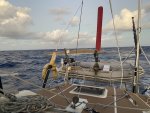
CD3E7704-D0DC-4A2E-9478-AD70114E85E3.jpeg
(The bit of land we’ve just sailed past in the above phot) was a large clump of Sargasso seaweed.
 
I've found the easiest way to install the Hydrovane rudder, whilst hanging off the boarding ladder with one hand, is to have a second person holding the safety line to the rudder. They can then adjust the tension to lift or lower the rudder whilst I try to get the pin in place. Hopefully before my arm falls off. It's not much fun...
 
Top