Hull leaks

Interesting article in this month's Classic Boat on glass/epoxy sheathing a clinker Stella.

Reminds me: way back in the late 70's and 80's there was a fashion for putting a fero/cement skin on old wood boat hulls to give them a new lease of life. Seemed to make sense at the time, are there any still around?
 
Reminds me: way back in the late 70's and 80's there was a fashion for putting a fero/cement skin on old wood boat hulls to give them a new lease of life. Seemed to make sense at the time, are there any still around?


I know one, a big Victorian yawl named “Willow Wren”that was at Burnham; she is now owned in Flensburg and is going strong:

2B487CFB-48D4-4D6F-B18F-C51A8F9925D9.jpeg

Since this was taken by my friend Volker Gries I hope he doesn’t mind me using it here.

I’ve been on board her; she is lovely, and well looked after. Her rig has varied over time, she has been a ketch, a cutter, a yawl with a lug mizzen, and now she’s a cutter again!

Victorianische Segelyacht Willow Wren: data, photos, videos, history of the sailing ship

The idea, iirc, was to build a ferro hull using the wooden boat as a “form”; the mesh was stapled to the wooden planking and the internal fittings of the wooden boat were retained but all the strength came from the new ferro hull and all the rig loads were transferred to it.

Eric Tabarly did the same thing but using GRP on his father’s Fife, “Pen Duick 1”.

This is different to sheathing a wooden hull with glass, which is commonly considered the kiss of death for an old boat.
 
Last edited:
Before lifting I would want to actually see where the water was coming in, and before doing anything rash like stripping paint I would want to be absolutely 100% certain it wasn't the stern gland / stuffing box letting the water in, or even an engine cooling system leak.
I have had a stuffing box leak "quite a lot" on one boat and knew someone whose 'orrible plastic fishing boat nearly sank because he'd had the thing serviced and they hadn't done up the hose clips on the exhaust hose so was filling up the bilges. But he deserved that because he wasn't a nice man!
 
aaarghhh! No!!!
Read the article first. This is not done in the same way as in the past - which does usually invite your response! This is done by Wessex Resins with a process that uses a flexible resin compound in the lands then each plank is individually sheathed with a strip that overlaps the next one. Claimed to be reversible by heating and peeling off. Certainly looked good.
 
because he'd had the thing serviced and they hadn't done up the hose clips on the exhaust hose so was filling up the bilges.

Sometimes it can be a simple thing.

Many years ago I launched my boat in the spring. She was nice and dry for a few days of gales so I set off one night (because of tides around the headlands) for a 50 mile or so single handed passage to her summer mooring. Motored out, set the sails, jumped down below to stop the engine and landed in around six inches of water. Fairly obviously the problem was associated with the engine as all had been dry until it was started.
Pumped out and dried everything once engine was stopped. No more water so had a pleasant, very light wind, sail back to the mooring. Inspecting at leisure found that I had removed the salt water impeller for the winter and had not put the cover on correctly when refitting it so the engine was pumping sea water direct in to the bilge.
 
Might just say , that if tightening up the Copper Nails tis important to use right size Dolly on the Roves in order to push the Rove along the Nail , and not just squeese the rove on the Nail thus shortening the Nail length ; That will I guess result in drilling out the deformed (shortened) Nail then starting again with a New Copper Nail plus right sized Rove ,which will give a new lease of life to the Craft

Happy Roving
 
Read the article first. This is not done in the same way as in the past - which does usually invite your response! This is done by Wessex Resins with a process that uses a flexible resin compound in the lands then each plank is individually sheathed with a strip that overlaps the next one. Claimed to be reversible by heating and peeling off. Certainly looked good.

Thank you. But still very doubtful.
 
Still worth reading the article in full as the owner explains his reasoning. Particularly notable is that his family has owned the boat almost all its life (it was built for his father) and has previously carried out a full "conventional" restoration, so he knows what he is talking about.
 
I'm unable to access the article, but did see on the Wessex Resins website, that catamaran 'Adagio', built in 1968 is lighter now than when built, having been encapsulated in West epoxy.
I assume that the epoxy for the clinker is 'similar but different', which is something of an eye opener.
 
Both the epoxy and method is nothing like what was done in 1968!

That is the whole point and why I am suggesting that people read about it rather than dismiss it based on what was done in the past - which I agree in most traditional boats particularly clinker, was not a good idea.
 
Think DayDream Believer (?) epoxied a Stella some time back? Massive prep and drying out. Def not the glass/ polyester quick fix that usually dooms the boat.
 
Reminds me: way back in the late 70's and 80's there was a fashion for putting a fero/cement skin on old wood boat hulls to give them a new lease of life. Seemed to make sense at the time, are there any still around?
That was also popular to extend the life of fishing boats in the US. For a few extra years, it was worth the effort.
 
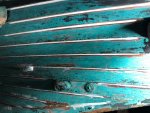
Boat is now out of water having seen state of hull underwater,!
Now all cleaned and all seams being resealed with Ct1.
A labourious job scraping all seams back to bare wood before applying ct1.
Why hasnt someone designed an electric tool for shaving paint off of edges of boards below water line.
 

Attachments

  • IMG-20220814-WA0004.jpg
    IMG-20220814-WA0004.jpg
    589.4 KB · Views: 42
Will be interesting to see how it goes. Will be hard work if you ever need to remove any planks in the future. Spent the day on my back paying seams with red lead putty.
 
Think DayDream Believer (?) epoxied a Stella some time back? Massive prep and drying out. Def not the glass/ polyester quick fix that usually dooms the boat.
He did indeed, but he blasted both inside and out and refastened I believe before coating again inside and out. This would have resulted in tight plank landings and minimal subsequent movement of the timber.
 
Top