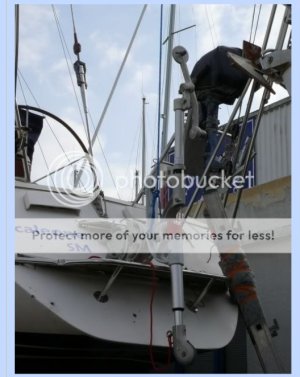
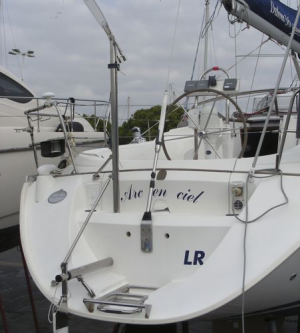
How would you fit a windvane to something like a moody s38, or similar?

Hydrovane will certainly fit. Went across the pond on my friends Moody 38cc which has a very similar stern as the boat pictured. The hydrovane was the best investment he made for the trip. Amazing bit of kit.

Try posting on the moody owners forum, or get in touch with Hydrovane for advice.
I agree. Our Hydrovane steers us very well with the advantage that unlike servo wind vanes, you don’t need the hassle of lines back to the cockpit and wheel.

However servo systems work very well. It just depends what the OP managed to buy.

I admit we do also have a powerful electronic autopilot on a steering quadrant on the rudder stock below decks.
 
The OP was asking about a modern (ish) 38 foot wheel steered boat, hence my comments. Easy to fit a good autopilot and the batteries and charging systems to keep going. Hopefully that boat will allow ram drive below deck, not the wheel pilot versions.

I agree that a tiller pilot on a 30 footer is very different (been there tried that). Hence why most wind vanes are now on small stiller steered boats, not on the type the OP started this thread about.
Indeed. I’m deeply envious of anyone with a below deck AP - I was just pointing out an exception to what you said. If you have a transom hung rudder, tiller steered boat like mine the lack of a rudder post and quadrant necessitates an above deck TP, but as you say that’s not the sort of boat this thread is about so fair enough.
 
I would not rule out a modern boat on the basis of difficulty of fitting a wind vane.
An electronic autopilot is essential for when motoring. And nowadays they can steer much better under sail than a wind vane - and often better than most human helms.
Hence the vast majority of modern boats don’t bother with a windvane, but optimise the autopilot systems. Indeed on the ARC I did, only a very small percentage had wind vanes. And their failure rate was higher than the electronic autopilots.
What may be a better investment is ensuring a good autopilot, and spares (potentially even a dual system if going round the world). Then invest your money in the charging systems instead of- certainly solar but also perhaps hydro (eg Watt&Sea) for ocean crossings.
That’s my view.
I can see no valid reason not to have a windvane on a boat if you intend to cross oceans. If it were me, I would certainly have an autopilot, but the windvane woould be the main workhorse. Have two autopilots as well by all means, a spare will probably be useful, but having two autopilots instead of a windvane makes no sense at all.
 
I agree. Our Hydrovane steers us very well with the advantage that unlike servo wind vanes, you don’t need the hassle of lines back to the cockpit and wheel.

However servo systems work very well. It just depends what the OP managed to buy.

I admit we do also have a powerful electronic autopilot on a steering quadrant on the rudder stock below decks.
Our autopilot was an old belt driven heap. Threw it away. Got a hydrovane

However lots of boats I've delivered had super electric pilots. Until they became sulky things that went on strike. The miserable bunch of electronic grumpers..
 
with those large sugarscoop sterns?
You ll have no problems, at least with a Windpilot.
1000000337.jpg
One of its many advantages is 10minutes you remove two bolts and can take it off leaving the transom almost totally free, when folded it takes the same place of a deflated dinghy, which we hoist over the stern. In the (very bad, sorry) picture, here is only the sort of metal half moon which remains on the transom, all tubes pipes mechanics etc are removed and folded away. Like you being able to mount a wind steering system is one of those strictly necessary elements when looking at a boat, for example I would not consider boats with drop down bathing platforms. I do have a powerful electric pilot I generally use while coastal cruising, but any runs over 1-2days it's 99% wind steering. Also, you can use a small pilot like Tp10 or st1000 with the ram attached to the wind steerkng swinging arm: the pilot gives the signal, the wind steering does the job, with a nominal electric consumption.
 
I would not rule out a modern boat on the basis of difficulty of fitting a wind vane.
An electronic autopilot is essential for when motoring. And nowadays they can steer much better under sail than a wind vane - and often better than most human helms.
Hence the vast majority of modern boats don’t bother with a windvane, but optimise the autopilot systems. Indeed on the ARC I did, only a very small percentage had wind vanes. And their failure rate was higher than the electronic autopilots.
What may be a better investment is ensuring a good autopilot, and spares (potentially even a dual system if going round the world). Then invest your money in the charging systems instead of- certainly solar but also perhaps hydro (eg Watt&Sea) for ocean crossings.
That’s my view.
If you get a lightning strike, you can lose everything with electronics.
A wind vane steering system offers a different kind of back up. We have see plenty of sugar scoop design yachts with Wind pilots because of their ease of installation and compactness when not in use. A friend used to remove his and pack it away when not doing long passages, but that was on a 45ft boat with space to store it
 
I can see no valid reason not to have a windvane on a boat if you intend to cross oceans. If it were me, I would certainly have an autopilot, but the windvane woould be the main workhorse. Have two autopilots as well by all means, a spare will probably be useful, but having two autopilots instead of a windvane makes no sense at all.
We have a powerful below deck autopilot, a spare drive, control head and rudder reference unit. We also have a Windpilot. In addition, we have a tiller pilot that can drive the Windpilot when there is no wind
 
I'm surprised that nobody's mentioned sheet to tiller, which works very well as long as one takes the time to understands the "how to" part of it.
I do also realise that this is far away from the OP's original question, but sheet to tiller isn't concerned by any style of stern, and is a fraction of 1% the price.
 
Sorry, yet more thread drift, but the other benefit of windvane self steering no one has mentioned yet is the sheer wonderment and joy of just watching them working. Mines a hazard to navigation as I spend very little time looking forward when it’s operating.
 
I fitted an Aries to 40ft ARC boat & they used it on most of the crossing becase they had a charging issue & were not competent enough to fix it
They also reported it as being far quieter than the electric one
When was that, a while ago?
When I did the ARC around 2018 there were very few boats with wind vanes - can’t remember the exact statistics but perhaps under 10%.
And in the post crossing gear survey the vanes proved more troublesome than the autopilots.

I know quite a few who have done the big loop (RTW) in the past decade, and none had a wind vane.They all had water makers and plenty of means of charging - solar, Watt&Sea and generators (except a 38 footer who had fuel cell instead of generator.)

PS Geem’s lightening scenario is perhaps the only one that might be an issue - though if two people hand steering is still possible, and have in the past used simple ropes to wheel fairly successfully, as suggested above.
 
When was that, a while ago?
When I did the ARC around 2018 there were very few boats with wind vanes - can’t remember the exact statistics but perhaps under 10%.
And in the post crossing gear survey the vanes proved more troublesome than the autopilots.

I know quite a few who have done the big loop (RTW) in the past decade, and none had a wind vane.They all had water makers and plenty of means of charging - solar, Watt&Sea and generators (except a 38 footer who had fuel cell instead of generator.)

PS Geem’s lightening scenario is perhaps the only one that might be an issue - though if two people hand steering is still possible, and have in the past used simple ropes to wheel fairly successfully, as suggested above.
I had thought about installing a second autopilot and ditching the Windpilot. That was before crossing from Antigua to Azores last year when we experienced the nastiest lightning ever. Thousand upon thousands of strikes all around us for hours. I still wonder how we never got hit. The handheld GPS, phones, etc, all got put in the oven for protection but there is little you can do about the electronics in the autopilot.
 
We have a Windpilot, they do brackets that would easily fit your boat.
Being servo pendulum, they are super powerful. Ours easily steers a heavy 44ft boat.
Unlike the hydrovane, the Windpilot can easily be deployed mid passage and recovered mid passage. These days, we mainly use ours as a back up. It sits on the transom and makes a nice grab handle when getting out of the dinghy😀
We had a Windpilot for some years and loved it. In the Mediterranean wind direction was a bit too variable and it severely hampered swimming off the stern, so it was sold.
 
When I did the ARC around 2018 there were very few boats with wind vanes - can’t remember the exact statistics but perhaps under 10%.
And in the post crossing gear survey the vanes proved more troublesome than the autopilots.
FWIW, I have yet to find **one** cruiser using wind steering (after of course having learnt to use it) which is unhappy with it, the choice is very easy they are all good: Hydrovane Monitor Windpilot etc.
IMHO the ARC is (very) far from being representative of general cruising habits, most of the participating boats are equipped on the lines ''shopping list for turnkey sailing'', people fit the full list the whole lot of equipment they have been convinced is ''must have'' from sailing magazines, blogs and the like, they usually install everything during the few weeks before the start then leave. No wonder sailing magazines articles after the rally are lists of ''what worked and what did not''; no wonder there are few wind steering systems, no wonder people haven t had the time to learn to use it and blame it as ''faulty'', an autopilot is immensely easier. For example, a walk in the Azores marinas during the return transat season shows a completely different picture wrt wind steering.
Besides, the time spent while looking at what other people do or do not to try and find this ''general consensus'' is IMHO much better spent reflecting about what kind of sailing provides most satisfaction to one s self, and follow that direction: it goes from choosing a boat to equipping it, to choosing places to sail to, etc etc; why on earth one should look at what the ''consensus'' is, if it ever exists. Many ARC people are very happy with what they do, there are many people equally happy doing things in totally different ways. :)
 
I've got fairly extensive experience of tillerpilots, quadrant mounted autopilots, servo pendulum windvanes, and auxiliary rudder windvanes. So possibly qualified to make a comment or two.

If I was forced to pick one system only? Below decks quadrant mounted autopilot. They are very very good. We've never even set ours up to steer to the wind, so I know it can be made even better.
The only time I would consider it necessary to add a supplementary system would be on lightly crewed long offshore passages, where a windvane provides possible redundancy in case of a failure in the autopilot or the means of charging it.

We used a Hydrovane for the majority of our E-W Atlantic crossing, and it was reasonably good. I found it much less able to cope with changes in wind strength than either the autopilot or the servo pendulum system we'd used on a previous boat. It simply doesn't have the power of a servo pendulum system, meaning that sail and helm balance is vital. Perhaps it was just our boat, but we found that if the wind picked up it was necessary to dial in a bit more helm to prevent the boat from rounding up. When the wind eased, you had to adjust the helm again or you'd risk going too far off the wind. In steady conditions it was very good, although it did weave around a bit. We generally had to reef the main earlier than usual in order to get the boat balanced, so there's a slight speed penalty there.

The upside is of course the second rudder, and lack of lines in the cockpit.

On our new boat we have a steeply raked sugar scoop stern with overhanging davits and solar panels. I don't think I'm going to fit the Hydrovane. It would get in the way too much, it would prevent us from using the davits, and I'd need very long tubes for the top support. All rather cumbersome.
Instead I will keep an entire spare autopilot system in storage, along with my 60Ah lithium battery which I use for odd jobs. In the event of a lighting strike or similar, hopefully I could be up and running again in an hour or two. And then the battery should give me a few hours of steering while I figure out my next move...
 
Tech changes, usually for the better, it’s as simple as that, and applies just as much to vane or autohelms, as it does to navigation software. We don’t wear oiled canvass waterproofs, healed leather sea boots, kapok lifejackets, navigate with a backstaff and victual with pemmican, although rum has stood the test of time.

It is not an either, or, old or new argument. The fact that we sail by the wind is the biggest contradiction to the improving tech is best argument. On a whole, convenience is king, and push button sailing is convenient where the tech is reliable. Being at sea does require a degree of redundancy and whether that is vane plus auto helm, or dual auto helms it doesn’t really matter.

Understanding your own risks and having thought of the consequences in the context of how you sail, is more important than kitting out with latest tech. Cost also comes into it, and usually cashflow is the limiting factor, as large expenditure probably need to be saved for. If you buy an older boat, and it comes with a wind vane, why change? If that is exacerbated by older charging systems, that may limit the affordability of upgrades.
 
Top