How to start single handing

No. You've still got a crew to trim sails, and all the other non-helming jobs that need to be done. Single-handing means thinking about how you, and you alone, are going to carry out all the necessary jobs. On many yachts (not all) that means having a means to leave the helm while you (for example) tack the jib. For most of us, that means an autopilot or a wind vane, but some yachts will hold a course without a hand at the helm - usually more traditional, long-keel types. But "hogging the helm" is not what it's about - you need to know, be able to anticipate, plan for and execute all the tasks that a crew handles. I'd say that helming is the least and easiest part of single-handing!
 
I started in a marina, by learning how to move around the boat whilst clipped on. Some of the folks on the other yachts thought I had gone crazy!

When you ave convinced yourself that your safety line system works, and you can do all the tasks involved in singlehanding your boat, then you might contact the RNLI and let them follow you out on a flat calm day for a slow safe trip around the harbour. If you survive, then spend a few days making 100% sure your sail controls and all the switches, radios, flare pistols, horn and rockets are easily at hand, but don't move the flares or rockets too near the cooker just because it makes them easy to reach!

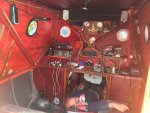
If you look at the pic below, it is of my coffin roll over and pitchpole proof skippers berth, that is designed for single bedding, that's where you control the boat from your bed! So when it's finished, I should be able to reach the switches, no 2 VHF, no 2 GPS, (I always like 2 of everything), 2 battery selectors, small chart table, (If I sit up), and finally, the bottle of rum!
 

Attachments

  • 116339479_643616579587814_8849565437334142787_n.jpg
    116339479_643616579587814_8849565437334142787_n.jpg
    185 KB · Views: 218
[QUOTE="TNLI, post: 7826215, member: 180426" you might contact the RNLI and let them follow you out on a flat calm day for a slow safe trip around the harbour.
[/QUOTE]

I hope the RNLI would politely tell anybody asking for this sort of escort - where to go! They're not there for handholding outside of emergencies.
 
It's very easy, you just want to know you want to do it.

I recommend getting Duncan Wells book Stress Free Sailing and look at his suggestions and go sailing.
And, if you can find them, a series of reprints of John Goode's excellent articles in PBO on handing under sail and power. (Brilliantly illustrated by Dick Everritt)
 
Think ahead and being prepared for problems is the key to singlehanding. A good autopilot is essential and self tailing winches are very useful. I sail singlehanded most of the time and have covered up to 110 miles in a day. Generally the first 100 yards and last 100 yards are the most dangerous of any journey. The sailing bit is fairly easy. A chart plotter makes navigation easy, provided you have checked the tides are right. Even having a drink and sandwich to hand should be part of your planning. The final bit of advice is keep a good watch for buoys and ships, especially under the genoa. It all becomes part of a routine that you settle into and you can relax and enjoy the sailing.
 
On my own yacht with crew both when cruising and racing I seem to rarely helm the yacht myself. I take a turn on the helm:- to give others a break from it, when tea and snacks are served (I can helm and drink tea at the same time), nearly always for the last dozen boats length's in and out of the marina berth (but lately I have a couple of starting to be trusty helm crew for this too), when no one else wants to helm and often if we are sailing very deep downwind. The tiller pilot is often used for long cruising legs, tea and lunch breaks.

If I want to helm I can either do that by choice when sailing solo , take over from the tiller pilot when I wish or on a race day plan it in to the crew role assignments.
 
I'm sorry to disagree but an autopilot is not, and should not be, essential.
It entirely depends on the boat. Many modern designs won't hold a course without a hand at the helm; my not-so-modern 1989 Moody certainly won't. And if I can't hold a course without a hand at the tiller, I can't set sail, as the mainsail can only be set with the boat reliably head to wind; if not head to wind, the battens catch in the lower shrouds, and the friction on the mast sliders increases enormously, despite being lubricated. I doubt whether lashing the tiller would work RELIABLY - the helm loads very quickly as she heels in a gust, and she'd round up without active control of the tiller.
 
Yes , they are very useful and a great convenience but I still say an autopilot is not, and should not be, essential.
For a novice singlehander, I still disagree. Most fin and spade rudder designs do not stay on track like a long keel boat and as most people now sail lighter displacement yachts that almost never stay on track without a hand on the tiller (a wheel can be locked), but we do not know what type of boat the OP is sailing. I have an over sized autopilot and tiller tamer as well. My Fulmar will stay on track for up to a minute without an autopilot - provided the sails are correctly trimmed, certainly not long enough to carry out many things like reef or fit fenders and warps. A good autopilot is like having an extra crew member. As I sail singlehanded most of the time, I am talking from experience.
 
Whether or not it's an autopilot, what's essential is to have some way of fixing the tiller while you do the other stuff like hauling up sails, tacking, making tea, etc. A wheel steered boat shouldn't wander off too much, but a slight gust or a bit of wake can send a tiller over with, err, interesting consequences.

Edit: Snap! Must type faster
 
Top