How do you get aboard your boat

Daydream believer

Well-Known Member
Joined
6 Oct 2012
Messages
23,576
Location
Southminster, essex
Visit site
Not wishing to hijack the thread about guardrail lashings I note a comment by seajet about undoing the guard rail to board the boat.
I have seen may people board at the stern on a mooring stepping from the bow of the dinghy which seems a do or die death leap from an unstable point with no side stability to the dinghy or person
Some come alongside & board alongside the cockpit. However, they hold the upper guardrail as they step over so the body is bent double for a few seconds & balance can easily be disturbed causing a fall. Some undo the top wire so they can step over but now they have nothing to hold at all
On my boat, whether on pontoon or mooring we always board next to the shrouds. This means we have a hand hold high up which gives a higher hoisting point & aids balance whilst stepping over the guardrail. We then sit on the cabin top & hoist up bags from the rest of the dinghy occupants before the last one comes aboard
We think this is the safest way-- Except on my Squib where my daughter slides her rear over on to the side deck ( no guard rail) with her legs in the dinghy then swings her legs round into the cockpit. I tried this & my oilies slid on the deck & as my weight tipped the squib I almost ended up sitting in the sea betwixt squib & dinghy with legs in dinghy
How do others do it
 
Always use the shrouds on a pontoon and point non boaty visitors at them. (we also stow a wooden hook on two step for less agile)

From the tender, usually solo, I tie the painter to the boat midships and drop the dinghy 'round the corner' to the stern ladder.

Holding the rail/yacht and leaning away and pushing towards the boat with my feet locks the two together so no death jumps.

i still see dinghy transfers as the most dangerous manoeuvre I do at sea.
 
Plenty handholds, dual backstay, handrail on sprayhood, shrouds. Dinghy alongside, painter round a stantion onto a winch and step aboard.
Also light cord block and fall attached to a shroud to get heavier bits aboard.
Been living there for years :cool:
 
Having a marina berth, this is no longer a frequent problem, fortunately. When on a mooring or anchored, in quiet conditions it is usually easiest for us to board at the stern and step onto the sugar-scoop where there is a comfortable step. When we had a Sadler29 on a mooring and a pram dinghy, we would usually bring the dinghy to the quarter, passing the painter ahead of a stanchion and round a winch. Being younger then, we would scramble aboard taking a grip on the winch. We could just about step from the dinghy thwart to the toerail. We had a firm non-standard boarding ladder at the stern, but there was often more movement of the boat here.

I think there is much to be said for boarding at the shrouds but modern boats have such large freeboards that some form of step or step-fender is usually needed.
 
Not wishing to hijack the thread about guardrail lashings I note a comment by seajet about undoing the guard rail to board the boat.
I have seen may people board at the stern on a mooring stepping from the bow of the dinghy which seems a do or die death leap from an unstable point with no side stability to the dinghy or person
Some come alongside & board alongside the cockpit. However, they hold the upper guardrail as they step over so the body is bent double for a few seconds & balance can easily be disturbed causing a fall. Some undo the top wire so they can step over but now they have nothing to hold at all
On my boat, whether on pontoon or mooring we always board next to the shrouds. This means we have a hand hold high up which gives a higher hoisting point & aids balance whilst stepping over the guardrail. We then sit on the cabin top & hoist up bags from the rest of the dinghy occupants before the last one comes aboard
We think this is the safest way-- Except on my Squib where my daughter slides her rear over on to the side deck ( no guard rail) with her legs in the dinghy then swings her legs round into the cockpit. I tried this & my oilies slid on the deck & as my weight tipped the squib I almost ended up sitting in the sea betwixt squib & dinghy with legs in dinghy
How do others do it

I have always lashed the dinghy alongside the cockpit, unhitched the ( only) guardrail and climbed aboard either holding one of the cabin top handrails or one of the (twin) backstays

I tried the reverse of your daughter's method when getting into the dinghy. I ended up in water with the dinghy upside down. I swam after the pump, which I'd been using to pump out a week's worth of heavy rain, and the sponge, which I was intending to use to mop out what remained.

I managed to right the dinghy but despite some inbuilt buoyancy it was almost totally swamped.

It was very difficult to climb back on board ........... hence the boat now sports a stern boarding ladder but the outboard prevents its use for boarding from the dinghy

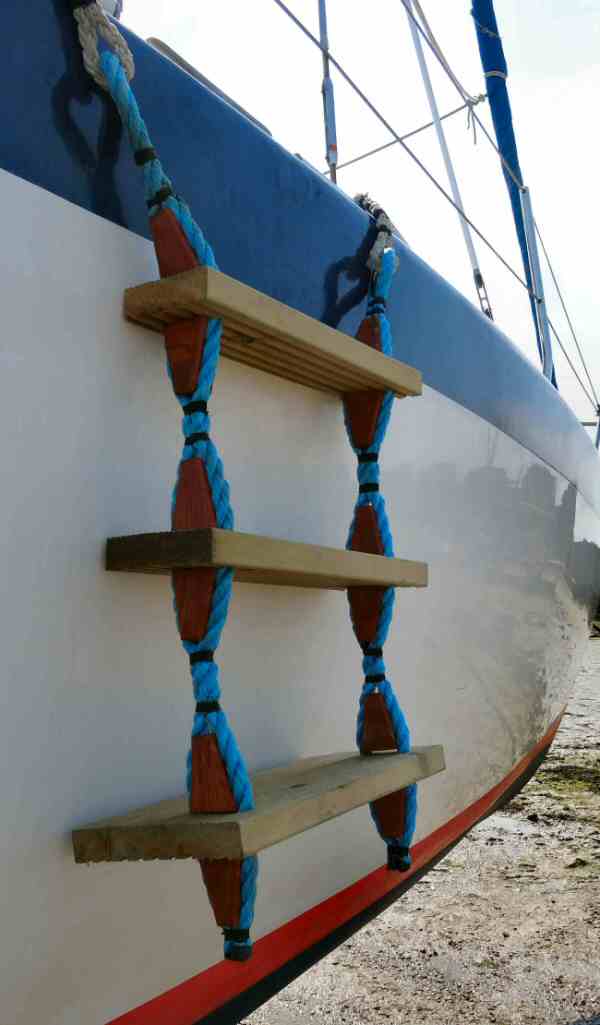
I found this helps. The rope loop just drops over a sheet winch. (Before anybody comments the polyprop was just tho get the length right.)

but it is not ideal.

I now have a more stable dinghy and dont actually need the fender ladder.

My next problem is to work out how to lift the Seagull on board as I can no longer climb aboard with it in one hand .
 
Last edited:
I have a permanently rigged hinged midship boarding ladder, above which are two close-spaced stanchions. The two short guard wires there have Pelican hooks. The retrieval line for pulling up the ladder is taken forward, and made fast to the base of a stanchion, and acts as a grab line when rowing alongside. I dislike transom boarding.
 
No guardrails, or fence as I prefer to call it. Decent bulwarks make it quite safe and reassuring to move around. So easy to use the tender.
 
Midships pilot ladder under the shrouds.

pilotladder.jpg
 
Almost always alongside, perhaps a little aft of the shrouds. Big heave on the upper guard rail with feet pushing tender against the yacht. First step onto toerail second step over guard rail onto deck and a grab onto the coachroof rail.

The heave on the guard rail provides the necessary horizontal momentum. Mine are designed to take it...

At least that's how I always did it before turning 60. Now from time to time I'm content to get just a knee onto the toerail in which case the grab of the coachroof rail becomes more important.

Generally I also have a stern painter attached somewhere. No one else has mentioned this yet. It helps with keeping the stern of the dinghy alongside when I'm swinging the dinghy outboard up and over the guard rail. And obviously keeps the dinghy alongside to fall back into...
 
From a dinghy, tie off to aft clet, drift behind transom, then stand up holding pushpit, drop boarding ladder and climb it.......Keep a good hold on pushpit at all times and centre of gravity over feet, never had a problem at all....So far.......I have been a rock climber for decades, maybe that helps with balance etc
 
Tie rigid dinghy onto midships cleat. Stand up right in it, using guardrail for balance and pulling myself plus dinghy towards boat if necessary. Step onto thwart with left foot, grab handles on coach roof, step on capping rail (of boat, not dinghy) with right foot, step over guard rail, done. Sounds complicated but is really just step, step, over, done.
 
In the marina always at the shrouds. From a dinghy use a combination of the bow and stern painter to hold it across the stern and use the boarding ladder. Now we have a sugar scoop it's even easier (which is why we wanted one).

Incidentally on the last two boats we have bought the boarding ladder was firmly lashed when we acquired them, we never, ever, leave it lashed in the up position as it would be impossible to lower it from the water.
 
Bow and stern painters on the dinghy. Dinghy at the stern where dinghy tubes are same height as bottom step on sugar scoop. Slide bum across.

Where there is pitching then hand on ladder, one foot onto sugar scoop and pull.
 
Rigid dinghy and boarding ladder on transom. Row out, tie painter to cleat on quarter, drift round stern holding on to boat, throw luggage and oars into cockpit, climb ladder, hang on to backstay and guardrail, swing leg over and into cockpit.
 
Shrouds every time. No sugar scoop on our boat.

The main mistake people seem to make when boarding from a pontoon is to try having one foot on the pontoon and a leg right over the guard wires. Much easier to step up onto the gunnel with both feet first.
 
Top