How do you get aboard your boat

I can see how your boat ended up in that position; some joker's nicked the steering wheel ! :)
Don't laugh - I almost did leave a stern-to pontoon last year sans wheel - wheel was stowed below to aid loading all sorts of kit from the stern platform at the beginning of last year. Had the engine started and was removing the shore lines and power cable before I remembered.......
 
From a dinghy, tie off to aft clet, drift behind transom, then stand up holding pushpit, drop boarding ladder and climb it.......Keep a good hold on pushpit at all times and centre of gravity over feet, never had a problem at all....So far.......I have been a rock climber for decades, maybe that helps with balance etc
Same as Tim, but only climbed to Scottish Hard Very Severe, never into all this E stuff.
 
From a dinghy, tie off to aft clet, drift behind transom, then stand up holding pushpit, drop boarding ladder and climb it.......Keep a good hold on pushpit at all times and centre of gravity over feet, never had a problem at all....So far.......I have been a rock climber for decades, maybe that helps with balance etc

I am intrigued by some people who get in over the stern so not picking on you in particular but:-
But what angle is the dinghy to the boat? Do you step of the bow of the dinghy, which must be the most unstable part of the dinghy, or do you try to drag the dinghy across the tide so that it immediately drifts away as you step on.
Also if you keep the centre of gravity over the feet does that not push the dinghy away. Surely it is better to lean away from the boat & push the feet inwards to keep the dinghy tight to the boat. ( Unless stepping off the bow of course)? Then as you step aboard you are leaning back up until one foot has a firm place on the boat & you also have a handhold.
Hence why I like the shroud option so the handhold is high up.
 
It's a very simple question , is it not?
Some interesting points of view however.

I have a little Hunter Ranger 245 which has high freeboard for it's size making boarding difficult alongside.
It has a boarding ladder on the transom.

However, what it also has is a continous rail the whole width of the back of the boat.
This must be stepped over to get on board and also happens to be where the outboard is mounted. It can't really go anywhere else.

So it becomes quite a feat of agility to get on board.
 
I am intrigued by some people who get in over the stern so not picking on you in particular but:-
But what angle is the dinghy to the boat? Do you step of the bow of the dinghy, which must be the most unstable part of the dinghy, or do you try to drag the dinghy across the tide so that it immediately drifts away as you step on.

I've seen it done with the dinghy painter to one quarter of the yacht, and a matching line from the stern of the dinghy to the other quarter. Seems reasonably secure with a flat-bottomed inflatable that the tide can run underneath, but slightly more of a faff to rig up.

Pete
 
I've seen it done with the dinghy painter to one quarter of the yacht, and a matching line from the stern of the dinghy to the other quarter. Seems reasonably secure with a flat-bottomed inflatable that the tide can run underneath, but slightly more of a faff to rig up.

Pete

If by myself in daylight I just tie the painter on one of the backstays and step up quickly, but with others or at night or with luggage then the painter gets tied to one backstay and the dinghy's stern rope (always kept there as a backup rope for for towing) goes to the other backstay so the rib is squeezed side on to the sugar scoop. The backstays are then used if needed as handholds as people and luggage/shopping comes aboard.

Then stern rope tied onto the backstay at full length with spare rope sitting in the dinghy and the painter tied onto a cleat so a couple of meters behind the stern.
 
But what angle is the dinghy to the boat? Do you step of the bow of the dinghy, which must be the most unstable part of the dinghy, or do you try to drag the dinghy across the tide so that it immediately drifts away as you step on.
My preferred method is with the dingy side to the transom - I usually take the engine off the dingy so attach a line to lift it onto the boat and this keeps the dingy arse close to the transom. I then step off the dingy from its middle. If I am single handed I lift the stuff taken the to boat onboard first then use the swim ladder to climb aboard. Haul up the engine and the dingy swings away from the transom ready to be towed on a short passage or lifted aboard for a long one.

The swim ladder is the key. The last owner liked to use a step fender and climb aboard using the shrouds, it just does not work for me.
 
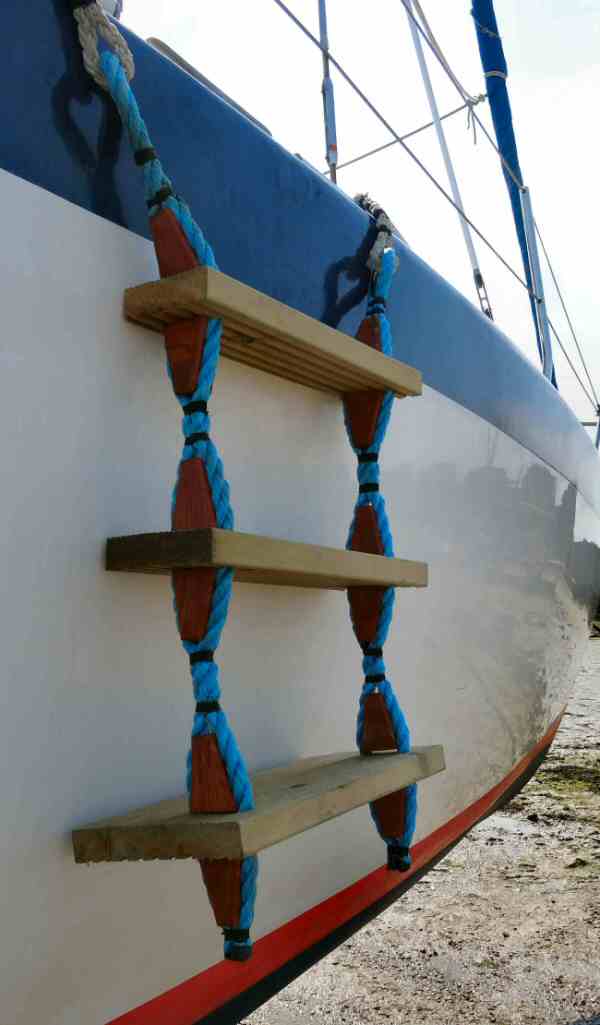
Midships pilot ladder under the shrouds.

pilotladder.jpg

Very nice
 
Very nice

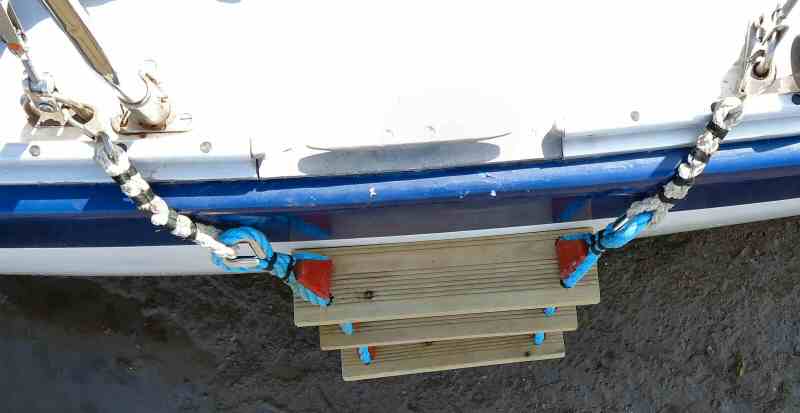
We used to lay the (hard) dinghy alongside the quarter and poking behind the boat. Our swim ladder is on the starboard side of the transom so it was just a step across from dinghy to ladder then a big legover to clear the pushpit. Wife had a couple of hip replacements, I got rheumatoid arthritis and it was just getting too much work to get aboard. I drew up lots of plans for transom gates and gates in the guard wires but they were all a fair bit of work and potentially expensive. In the end I thought I'd try the pilot ladder. Knocked it up from scraps that were lying around and we found it works very well. I always intended (still do) to remake it using rather more seaman like materials.
When we leave the boat the ladder just gets swung up 180deg and the top step hangs over and inboard of the top guardrail. It uses spring clips to attach to the shroud bases so is easy to remove, roll up and stow when underway.

pilotladder2.jpg
 
I tie on to one quarter and manoeuvre the rigid dinghy side on across the transom. Throw oars (outboard too much faff and oars better for you) and rucsac etc into cockpit stand in middle of dinghy and step on boarding ladder, climb it and swing leg over rail. Slightly precarious but haven't fallen in......Yet.
 
Don't laugh - I almost did leave a stern-to pontoon last year sans wheel - wheel was stowed below to aid loading all sorts of kit from the stern platform at the beginning of last year. Had the engine started and was removing the shore lines and power cable before I remembered.......

There's a famous, hopefully true story of a chap with a blue water boat who'd been in some exotic anchotage for a while, so had removed the wheel for partying in the cockpit; unfortunately that was off his checklist when setting to sea - his salvation as he motored out through the other boats was a quickly grabbed mole grip on the steering wheel shaft, but it sounded like it took off a few of his life counts...:)
 
Important note I think;

I mentioned I managed to tip my tender over at the mooring when stepping tinto the dinghy cold, tired and clumsy.

When I mentioned this on our club forum, it turned out I was the 5th experienced owner to manage this.

I and another managed after a HUGE struggle to get back aboard via transom steps - in my case I had a large snapshackle on the bottom of the mainsheet and a strong topping lift for MOB recovery, but they were no use in the end even with the guardrails unclipped and my wearing a harness to clip it onto, as the boat heeled towards me making the mainsheet go choc-abloc and my chum of 1 day didn't know how to work the mainsheet and topping lift - moral there, no such thing as too much briefing.

I eventually got in using the transom step - I was VERY lucky to be wearing a lifejacket / harness, a practice I'd only taken up that season.

Of the rest at our club, another was solo, couldn't get back on his Konsort despite a transom ladder and drifted downtide, grabbed a mooring and was luckily spotted so a rescue boat was sent out.

Another - in his late 60's - was anchored at the top of Sweare Deep - a wide, quiet bit of Chichester Harbour - in January when he went over, he reckoned he'd had it and was going under for the last time when by a miracle a passing workboat from Northney Marina spotted him.

Another was in his tender motoring - actually my old heavy 9' dinghy - when the prop' hit something as he had the tiller over, capsizing it - again in a wide, quiet bit of the harbour.

I always paint the bottom of my tenders yellow so as to show up if I cock it up; a dinghy racing rescue boat spotted it and grabbed him.

The nasty thing about tenders is, they may have buoyancy tanks, but it's not usually possible to right them as one can with a sailing dinghy.

Top Tips;

Paint tender bottoms yellow

Always wear a lifejacket in the tender

If we hadn't been wearing lifejackets, there'd be 5 more moorings available now ! :)
 
Last edited:
On a swinging mooring, I motor up to the stern, and tie on to the port quarter cleat, bow pulled up hard to stern. Stern boarding ladder is immediately to starboard. I then cautiously board via the boarding ladder. I always wear a lifejacket, especially if alone. Any bags I load onto the side deck one by one before climbing aboard.
When on a pontoon I always board at the shrouds, with a fender step to make it much easier. On a Moody 33.
 
I am surprised more yachts nowadays dont have swing down ladders fitted as standard in the gates that form part of the lifelines. Is this because of the weight and could one be retro fitted ?
 
I am surprised more yachts nowadays dont have swing down ladders fitted as standard in the gates that form part of the lifelines. Is this because of the weight and could one be retro fitted ?

Mine is permanently rigged hooked over the upstand of the alloy toerail, and secured with two thumbscrews. A hinge at both (stowed) deck level, and (stowed) rail level, means that when deployed, two rungs are completely under the water. No reason why something similar could not be retrofitted.
 
I am surprised more yachts nowadays dont have swing down ladders fitted as standard in the gates that form part of the lifelines. Is this because of the weight and could one be retro fitted ?

I doubt it's weight, more likely cost and perhaps a lack of imagination from the designers. Bear in mind also that most yachts around the world are moored stern-to, our side-on habits are in the minority. An extra stanchion and a couple of pelican hooks for the UK market is no big deal, a whole new pivoting ladder design might just be too much effort.

No reason not to have a pair made if you can come up with a decent design.

Pete
 
Not wishing to hijack the thread about guardrail lashings I note a comment by seajet about undoing the guard rail to board the boat.
I have seen may people board at the stern on a mooring stepping from the bow of the dinghy which seems a do or die death leap from an unstable point with no side stability to the dinghy or person
Some come alongside & board alongside the cockpit. However, they hold the upper guardrail as they step over so the body is bent double for a few seconds & balance can easily be disturbed causing a fall. Some undo the top wire so they can step over but now they have nothing to hold at all
On my boat, whether on pontoon or mooring we always board next to the shrouds. This means we have a hand hold high up which gives a higher hoisting point & aids balance whilst stepping over the guardrail. We then sit on the cabin top & hoist up bags from the rest of the dinghy occupants before the last one comes aboard
We think this is the safest way-- Except on my Squib where my daughter slides her rear over on to the side deck ( no guard rail) with her legs in the dinghy then swings her legs round into the cockpit. I tried this & my oilies slid on the deck & as my weight tipped the squib I almost ended up sitting in the sea betwixt squib & dinghy with legs in dinghy
How do others do it

Install a proper ladder that can be accessed by a swimmer in the water. In my opinion it is a safety essential, probably above life jackets.

Because of access issues with aging parents, I wen whole-hog and extended the transoms.

dingy%u00252Bboarding%u00252B6.jpg
 
Top