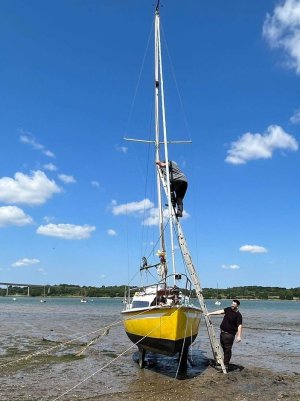
how do you beach a twin keel ?

Make sure you have a means of getting off (and more importantly back on) the boat. Even my 20 foot Vivacity was too high to easily get back on without a ladder or something to step on. It's a very dull wait if you can't get off of the boat!
And a bucket or two of water saved for flushing the head, as long as you aren’t surrounded by families making sandcastles

Edit: If you have a holding tank you may still need a supply of water to flush.
The ground isn’t always soft golden sand, sometimes it turns out to be sticky mud that gets all over the coamings and cockpit, you will be glad of that bucket of water then.
:End edit.
 
Last edited:
And I get upset when dog owners leave carp on the beach! If you don’t have a holding tank go ashore.
Do you think anyone would actually use their head like that while high and dry?
How do you flush into your tank after the water has dropped below your seacock. Not everyone has a freshwater flush supply.
I don’t have a holding tank, but I do have a portapotti in the cockpit locker for beaching. That isn’t stored full of freshwater when not in use, the bucket gets used to fill that if needed.
 
Last edited:
Make sure you have a means of getting off (and more importantly back on) the boat. Even my 20 foot Vivacity was too high to easily get back on without a ladder or something to step on. It's a very dull wait if you can't get off of the boat!

I have one of those folding Lazilas alloy / plastic step ladders that hooks on to toe-rail or special Key Plates fitted to deck.

I also have a plastic folding ladder that does similar ... >

BD3HMA4l.jpg
 
I also prefer the boat to be bow to windward.
That way as the boat is nearly floating I can run the engine in tick over pushing the boat off.

It all depends how many tides you intend to stay.
 
I also prefer the boat to be bow to windward.
That way as the boat is nearly floating I can run the engine in tick over pushing the boat off.

It all depends how many tides you intend to stay.
Seaward. The wind may be coming from the land 😉
 
I have always beached my former boat all over tidal Europe, but reverse in, having dropped the main anchor, checked that it is set and wait until 2 hrs has passed to go aground. Control can be achieved by paying out the anchor rode, slowly. And yes, it can be done single handed. The rate of rise and fall is much greater than in the first hour, and once touched and settled another kedge or long warp to a post/tree maintains your position if for more than the 8-10 hours dried out, is wanted.
I have now bought a small bilge Keeler, and can't see me changing my routine much, the outboard can "steer" when in reverse.
 
If I am leaving the anchor will to to seaward.
Because it is beached the anchor will be were I choose.
Although I normally stow the anchor before the tide comes in when I am leaving.
A good point. Landward anchors need getting in (or placing so readily liftable), before departure if departure wanted the moment she floats or anchor retrieval just pulls boat back up beach.

I always go in forward as current long keeler like most has wierd steering astern, so I have also moved bow anchor once dried out, so that chain is to astern of boat, thus once afloat pulling in anchor heads the bows to seaward and i dont have to go off astern
 
Most of our mooring holders who lay up at our club are bilge keelers. There is no point in messing about with anchors etc. Just makes things difficult
The hard is concrete anyway & if we want to secure a boat we lay a sinker & tie to that
Just motor the boat gently to the hard about 1 hour after HW so tide has started to fall significantly so boat is not left bouncing waiting for the drop.
As the keels touch as square as possible open the throttle a bit to get it to bite & hold the boat there on the engine until secure. No need for anchors etc.
When leaving wait until the engine inlet is well under water & put it on tickover once there is indication that the boat is begining to rock. Open up the revs as she moves & the boat will bounce off with any small swell. No need for anchors etc. We have found that wasting time pulling in ropes etc cause delay & can cause hassle & cause the boat to swing sideways to the shore thus making departure difficult. The anchor does not always bite if not properly set having just been dropped overboard anyway.

It is better to be on the boat in plenty of time. Our harbour master, of all people, likes to cut things fine & twice now has disappeared for lunch,only to come back to find his boat drifting down river. It has caused some mirth to see him chasing after it in his dinghy 300 yds down river following a phone call from club members.
Maybe less amusing if HM boat were to hit another?

Excellent observation re waiting till the engine inlet is properly submerged.
 
A good point. Landward anchors need getting in (or placing so readily liftable), before departure if departure wanted the moment she floats or anchor retrieval just pulls boat back up beach.

I always go in forward as current long keeler like most has wierd steering astern, so I have also moved bow anchor once dried out, so that chain is to astern of boat, thus once afloat pulling in anchor heads the bows to seaward and i dont have to go off astern
How do you protect your topsides against the chain whilst you are turning the boat?
 
My wife is not very fond of drying out at Bembridge....it is a place I have learned many things :).. One thing she does not like is paying out more bow chain in the middle of the night and pulling in on the kedge for an earlier float. If you want the tide to help you back to Chichester you don't want to set off an hour before HW. But my crime to myself on one occasion was to reverse in....it was a lee shore and I wanted the shelter of the cockpit.....rudder grounded before boat stopped. Muppet. Also if you can get to the toilets down off the stern with dry feet great, but a porta potti is a good thing. These things have already been stated but they are the fun bits of bilge keeling!
 
No knowledge or experience yet, hopefully soon, , but I wonder if, with a seaward anchor, it might be worth putting some tension on it, perhaps with the help of weight, or the elasticity of a nylon rode, so that it gives you a bit of a tug out of the bouncy zone on refloating
 
Top