
HHow long is too long (solo sailing)?

Completely agree with @Concerto 's "start well rested" advice. Also with @doug748 's "would not fancy a second night," solo, on a coastal(ish) passage. Would add that my stamina is noticeably improved, on an 18hr+ passage, if I set off in the middle of the day/afternoon, after a lazy morning and large lunch. With the prospect of a daylight landfall. Don't know if that's universal?
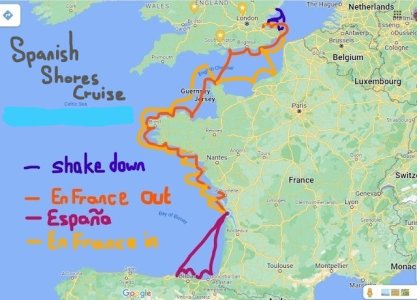
Stargazer 2022 Cruise_LI (5).jpg

The only, potentially, 36hr passage that I do is Gironde/Oleron to Bilbao/Laredo/Santander. In preparation I spend a week or so resting and waiting for weather. Aiming for enough breeze to pull the passage time down to the mid to late 20's of hours. From an angle which allows me to hoist the cruising chute, if it falls light. Because the straight line route is (largely) along the continental shelf drop off, fishing boats (with and without AIS) restrict the ability to take 15 min catnaps overnight. But in daylight, with good vis, I have found them useful. On arrival, I don't expect to move on for 4-5 days.....

I find that 18-24hr passages are much easier on the body, if they can be arranged! Generally I work to a rhythm of 3-4 days in port between passages. Whereas with 12-18hr passages its more like 2-3days ashore. So, if ports are suitably spaced (and scenic), I find that I cover more distance, on a summer-long cruise, with the shorter hops. See more sights too....But there is a particular magic to a night beneath the stars out of sight of land......
 
Last edited:
We too always have someone on watch. I know several people who (even when two or more on board) go to sleep with no one on watch. They rely on radar alarms and AIS alarms.
As others have said, that depends on where sailing. Might be fine mid Atlantic but less so mid Solent.
However, even mid-Atlantic, having not seen a single boat for over two days even on radar and AIS, we had to take avoiding action for another sailing boat with the solo skipper apparently asleep. Fortunately we were fully crewed and attentive watch keeper, or might have been an awkward wake up call / crash.

PS. Our insurance limits to 18 hours which is fine by me. 8 hours solo is routine, 12 starts to get tiring unless very easy conditions (flat water, downwind, minimal traffic). Like others prefer to start very early for longer trips, to arrive with plenty of margin before dark.
 
For me, it would be reckless in the extreme not to have a watchkeeper in the Channel or similar. Your chance of some form of interaction, be it part of the sea bottom or shoreline, buoyage on another boat, or even a container ship must be up around 50/50. We rarely have a trip where we don’t alter course for something.
 
The Jester Challenge has been a useful source of advice on getting rest or brief sleeps on passage as a single hander. Sometimes all you can do is set your timer on 5 minutes and go below and rest, but other times you can get 15 to 20 min of sleep. The Thames Estuary can be a tricky place to relax sometimes - however there may be some opportunities on a passage, and they need to be grabbed when they appear. The challenge suggests trying out this short nap technique before going further affield, and I found some relatively quiet water to practice for a few days/nights. Keeping a good watch is sometimes hard in these circumstances, but can become manageable. Sometimes getting some rest is safer than being in constant vigilance on deck - you can miss information even when it right in front of you when tired.

I have done Harwich to Ijmuiden a fair few number of times, from 4 up in a 23 in bad weather, 2 up in a 26 several times, to (2025) single handed in reasonable weather. I did not manage to drift off to sleep this year, but spent a good chunk of the time with between 5 and 20 minutes on a timer on my bunk. It was tiring, but maybe no more than previous crewed occasions. Being single handed meant I could choose the conditions that would work for me, rather than being pressurised for time. Try and arrive in the light on a long passage (24 hours+).

An AIS receiver with an alarm is a game changer. I use one of the simple NASA displays and set perhaps 4 mile zone in N Sea, and can see it from my bunk. You can be fairly drowsy and still assess the information fairly quickly. Targets on the chartplotter are also really useful as you can then get an understanding of where they are in relation to the many traffic lanes and TSS's. Erik has more sophisticated electronics which would help even more - eg. radar, and a camera on his mast! A good autoplilot is a must, and a windvane can be useful (though I don't use mine for the Netherlands).

There are times when being outside gives a better watch. Don't fool yourself that this is not the case. However, on a longer passage you have to start thinking about how to manage yourself as well - esp. food and rest. It may be you reef earlier to make it more comfortable down below for example. The passage time can becomes a bit less relevant - and you start thinking about safety of your gear and yourself instead. If you are lucky over 24 hours and get some short catnaps, you can feel refreshed - again don't let it fool you - the brain does not work very well when tired, and also take this into consideration. Hallucinating due to lack of sleep is a strange experience first time, but at least it prepares you for the next time!
I learnt my SH technique from doing two Baltimore Jester Challenges…. Two kitchen timers clipped to my lapels to get 15min naps for a few hours at night was enough to stop me getting exhausted for at least two nights at sea; then try and catchup in as much rest/additional naps as possible during day. This method has also got me to the Faroes Islands and across to Norway, both of which can be done with a maximum of two nights at sea.

Perversely my closest encounters have been during the day when I’ve been distracted by other activities.

Personally I’m happy to ignore my insurance limitation of 18 hours singlehanded on the longer passages and just accept I’m doing it at my risk.
 
The Yachtmaster Ocean oral exam has three sections.

Preparation of boat and crew
Management of boat and crew on the passage.
Astro Navigation.

All the above from an ocean passage they’ve sailed with crew.

I appreciate that single handed sailors can be very proficient and knowledgeable but how can management of boat and crew be assessed if they don’t have a crew?

PS. I know of one famous single handed round the world sailor who failed their yachtmaster exam as they couldn’t park the boat etc.

mmmmm What about that young lass in Australia who failed the short 'test' sail before attempting solo RtW ???

I could not help thinking she should have taken note of that and revised her plans !!
 
Here's a point I would Like to make ....

Most of the posts that incl crew mentions - I assume they mean crew that can at least helm the boat - understand a minimum of sail ??

But in fact an inexperienced crew member can be utilised to allow Skipper to relax for a short recuperation ... by giving clear advise and that anything - ANYTHING changes ... wake Skipper ... using their eyes and ears can allow that rest.
 
Fresh from the Royal Marines I think, so under 30🤣 I can stay awake if I’m steering, but I’ll get sleepy if I use the autopilot, or the alternative autopilot, ie Mrs C. That’s handy actually, I hardly ever single hand, being married to a sailing lady, just a couple of hours is a good recharge. We never get to sail anywhere that you could realistically just leave the boat to get on with it, we have never not had someone on watch. Obviously, a clear horizon is a good time for a visit to the heads, so not 100% in the cockpit. But in the channel, or North sea, or round Finisterre, there's no way of actually sleeping under way if you’re solo. Way too busy, way too much pilotage. So that would limit me to 12 hours or so really, more if I really had to, with the aid of much caffeine. I’m over twice as old as Pete was back then.
"Fresh from the Royal Marines" means a very great deal (fitness, attitude, motivation, risk acceptance etc), imho....as opposed to having stood down from a career in say digital marketing or accountancy...at age 30.
Respect!🫡
 
Last edited:
Here's a point I would Like to make ....

Most of the posts that incl crew mentions - I assume they mean crew that can at least helm the boat - understand a minimum of sail ??

But in fact an inexperienced crew member can be utilised to allow Skipper to relax for a short recuperation ... by giving clear advise and that anything - ANYTHING changes ... wake Skipper ... using their eyes and ears can allow that rest.
I agree. Even the most hardened landlubber can usually be trusted to simply keep a lookout and call me if anything changes.

Even with very experienced sailors I like to be kept informed of major changes. If they shake me to say the winds increasing and they are putting a reef in I might just say ‘ok’ and go back to sleep but I REALLY don’t like waking up and finding they’ve altered course or changed the sail plan etc without telling me.

However I’m drifting the thread so my apologies.
 
I agree. Even the most hardened landlubber can usually be trusted to simply keep a lookout and call me if anything changes.

Even with very experienced sailors I like to be kept informed of major changes. If they shake me to say the winds increasing and they are putting a reef in I might just say ‘ok’ and go back to sleep but I REALLY don’t like waking up and finding they’ve altered course or changed the sail plan etc without telling me.

However I’m drifting the thread so my apologies.

No - I thyink they are valid points despite the thread was intended as solo ...

Before going solo - its good to sail crewed and to find out what you are capable off ...

Another has mentioned that sailing on a nice night with moon etc is easy and can have long stint ... but blacken that sky - increase the wind and seas - then it becomes a completely different ball game - can tire you out in less than hour or so .... especially if you started off in reasonable weather hours before while sun was up !
 
But in fact an inexperienced crew member can be utilised to allow Skipper to relax for a short recuperation ... by giving clear advise and that anything - ANYTHING changes ... wake Skipper ... using their eyes and ears can allow that rest.
There are crews which could not care less, for ex. my wife, apart from being permanently seasick any noise or movement coming from the kids and off she went b..x this useless being on watch stuff, I always planned as if being alone; actually I find it a lot more relaxing being really singlehanded as I don't have to take care of anyone else than myself. :)
 
But in fact an inexperienced crew member can be utilised to allow Skipper to relax for a short recuperation ... by giving clear advise and that anything - ANYTHING changes ... wake Skipper ... using their eyes and ears can allow that rest.
Didn't that theory fall flat a short while ago when a very expensive yot went down ?
 
I learnt my SH technique from doing two Baltimore Jester Challenges…. Two kitchen timers clipped to my lapels to get 15min naps for a few hours at night was enough to stop me getting exhausted for at least two nights at sea; then try and catchup in as much rest/additional naps as possible during day. This method has also got me to the Faroes Islands and across to Norway, both of which can be done with a maximum of two nights at sea.

Perversely my closest encounters have been during the day when I’ve been distracted by other activities.

Personally I’m happy to ignore my insurance limitation of 18 hours singlehanded on the longer passages and just accept I’m doing it at my risk.
Ditto (all of it), but Jester Azores. 2 nights to continental shelf on 15 min timers, and then very glad to move to 45min or 1.5 hours or longer thereafter. As you say, 2 timers - though I now cannot find a nice simple mechanical clip on timer that I used at the time, and need to replace. Some of the single handed watchkeeping failures that have been in the media were due to failing to wake up from an alarm, but I never found this to be a problem with a mechanical near my ear. The ticking also helps as you knew you have not slept through it. One chap on first JAC went below for a nap first night, a bit near the shipping lane, and slept through alarms and shipping lane! Woke, lucky, but completely refreshed. On the continental shelf I came across a French factory fishing ship on passage (lunchtime!) - no AIS, collision course, no hint of watchkeeping or activity (did I mention in was lunchtime) - eyeball and my course change only reason why we didn't collide. Makes you weary of 'probability', and overreliance on electronics. Despite this, the technique and experience massively opens up horizons.

Overall I think that what you might term as 'watchkeeping mistakes' I have experienced have been both on deck and down below, though well aware that 'down below' is more likely and will probably be more serious.
 
The Yachtmaster Ocean oral exam has three sections.

Preparation of boat and crew
Management of boat and crew on the passage.
Astro Navigation.

All the above from an ocean passage they’ve sailed with crew.

I appreciate that single handed sailors can be very proficient and knowledgeable but how can management of boat and crew be assessed if they don’t have a crew?
Thank you for confirming what a lot of us already knew - that a number of the RYA qualifications are irrelevant to singlehanders. But I hadn't realised they are actively hostile towards them. You seem to be suggesting that a singlehander could never pass the YMO exam?

I'm curious, though. I can't find any mention either here: Yachtmaster Ocean exam or here: Qualifying passages that singlehanders aren't elligible, or that qualifying passages must be "sailed with crew".

Maybe the RYA should update their website
 
I think radar ,properly set, is better than any watch keeper.
I too have a mechanical 1 hour timer for single handing and set time depends on situation. Typically though, Thames estuary no sleep, southern north sea 30 to 60 mins. But always with radar on. Even on lovely sunny day as you can miss something behind the genoa etc.
 
My insurance says 24 hours single handed. Thats OK across Irish Sea as can get Milford to say Kilmore in about 16. Not so good getting Plymouth to Roscoff as crossing busy shipping lanes and minimum 22 going on 26hour. Too tiring and I really love to be double handed crossing the Zones at about 3am
 
... I have just watched Erik Aanderaa's video solo sailing from Holland to Denmark. He has spent years refining the set up on his Contessa with night vision Mast head cameras and easy view below deck screens. Maybe I will look into that.. I'm guessing the routes he sails have fewer buoys, anchored fishing boats and other hazards than the Channel area isail in. ...

They are good points, the screens and cameras. However, his personal safety is bad practise, which he regularly demonstrates across his videos. Of course that is my personal opinion, and at the end of the day, each to his own.
 
Thank you for confirming what a lot of us already knew - that a number of the RYA qualifications are irrelevant to singlehanders. But I hadn't realised they are actively hostile towards them. You seem to be suggesting that a singlehander could never pass the YMO exam?

I'm curious, though. I can't find any mention either here: Yachtmaster Ocean exam or here: Qualifying passages that singlehanders aren't elligible, or that qualifying passages must be "sailed with crew".

Maybe the RYA should update their website

Oral​

The candidate must provide the examiner with the following information 48 hours prior to the exam:

  1. A narrative account of the planning and execution of the qualifying passage providing all relevant details. As a minimum, this should paint a clear picture of the rationale behind the passage plan, as well as details such as consideration of weather, crew selection, navigational strategy, victualling and bunkering.
  2. Navigational records, completed on board a yacht on passage, out of sight of land showing that the candidate has navigated the yacht without the use of electronic navigational aids. The records must include as a minimum, planning, reduction and plotting of a sun run meridian altitude sight and a compass check carried out using the bearing of the sun, moon, a star or planet.
During the oral test the candidate will be required to answer questions on all aspects of ocean passage making in a yacht, including passage planning, navigation, worldwide meteorology, crew management and yacht preparation, maintenance and repairs.
 
Thank you for confirming what a lot of us already knew - that a number of the RYA qualifications are irrelevant to singlehanders. But I hadn't realised they are actively hostile towards them. You seem to be suggesting that a singlehander could never pass the YMO exam?

I'm curious, though. I can't find any mention either here: Yachtmaster Ocean exam or here: Qualifying passages that singlehanders aren't elligible, or that qualifying passages must be "sailed with crew".

Maybe the RYA should update their website
I don’t think the qualifications are irrelevant. But you can’t get a ticket (which may then be updated to a commercial qualification) that allows you to skipper a boat with a crew unless you can demonstrate that you can do it! Needing crew is explicitly mentioned in the examiner guidelines.

There are some single handed sailors who are single handed for a reason. They simply can’t get anyone to sail with them… Not suggesting that applies to anyone here.
 
Last edited:
Top