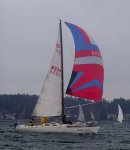
Heavy air spinnaker?

Ok and another question.....

Usually we are trying to go dead downwind.

So obviously in 20 knots plus true the apparent wind is still 180?

So maybe we should think about sailing the angles with a heavier spinnaker. Boat probably does 5-6 knots through the water ddw?

We need polars!

I wonder if I could figure out an angle for 20 knots. Work out the apparent wind. And see if a more reaching spinnaker would work. Which would make rolling less of a problem?
 
A 30 degree angle, so running with the true at 150, adds about 10% to the distance so if it finds you just over 1/2 a knot in your case your on to a winner.
 
You don't need polars.
You need to try heading up a bit and watch the speedo.
Once you have more speed try bearing off a little, but come up again as soon as the speed starts to drop.

I suspect a lot of your problems are trying to go ddw, presumably partly to avoid gybing?
I find it's best to be positive about it.
Know from the outset that you are going to go a little bit to one side or the other and gybe because you've planned to, on your terms.

Remember cos 15 degrees is 0.966, so coming up a whole 15 degrees you only need 3.5% more speed for it to pay.
That's 6.2 knots instead of 6.0.

Remember what I was once told. The most important control for the spinnaker is the tiller.
 
Yes we are in the windy north so might be more than once a season!!

Well to be fair we now hoist the big kite (S2) happily in up to 20kts, and have a really good new S3 that takes us to about 25kts. The tiny kite only comes out of the bag on >15kt just about kiteable reaches or >25 downhill.

With regard to getting downwind. I have found in the Elan that the fastest route downwind starts off with quite wind angles in lighter breezes, gets close to DDW from about 15 until about 18 kts true, when heating up doesn't really increase the speed with a displacement hull, then starts opening out again. Mainly because driving hard downwind with a kite up in more than that just risks a chinese gybe, which overall is quite a bit slower.
 
Usually we are trying to go dead downwind.

You would NEVER attempt to go DDW in 20 knots of wind, or at least until you have much more experience. Your boat will be rocking and rolling and you will soon learn what a Chinese gybe is. Probably the very deepest you would go is 155 - 165 apparent. Even these are very deep when the wind gets up. Make sure to keep the tweekers tight when you are sailing deep.

By the way, for a chicken chute you can always take the route I took. I'd ripped one of my main chutes several times and eventually just cut one of the horizontal panels out along with one of the vertical panels on each side. I sewed the sail all back together myself and had a great chicken chute for those days when I was getting up to the 30 knot range.
foolish-144.JPG

After many more high wind broaches eventually even this sail was beyond saving and I did the same with the next spinnaker that I'd shredded too many times.
 
We have a small assymetric on our Elan 295 which came with the boat and I suspect the previous owner bought it second hand from a smaller boat. It's quite a heavy fabric, flat and pretty narrow - it's really good with a big breeze and we can run surprisingly deep with it flying off the pole (avoiding DDW as others have said and fully hoisting to avoid rolling). So seeing if you can buy a used assymetric may be the answer - different gybing technique required of course to symmetric.
 
Much as I'm a fan of asy's, I suggest that getting competent and confident with a conventional kite is going to be a good way forwards.
As the Muse shows above, a small kite can work very well.
One of the things I used to do was to have a practice session before racing with new people.
Just go out, get the kite up, gybe it several times, douse it.
Get back upwind while you discuss it, change roles perhaps and repeat.
Home for beer and pizza.
I found it good to get a different helm in, so I could move around the boat and see what the problems were.
Basically I don't want to be on a racecourse unless my crew can make a reasonable job of allowing me to take the boat where I like.
That means we need to be able to gybe or drop to a reasonable competence in any conditions we're looking to be out in.
Once the crew know what they're doing with the kite, it's all a lot easier.
 
Much as I'm a fan of asy's, I suggest that getting competent and confident with a conventional kite is going to be a good way forwards.
As the Muse shows above, a small kite can work very well.
One of the things I used to do was to have a practice session before racing with new people.
Just go out, get the kite up, gybe it several times, douse it.

+1
10 tacks upwind and 5 gybes downwind before the race works wonders!


Get back upwind while you discuss it, change roles perhaps and repeat.
Home for beer and pizza.
I found it good to get a different helm in, so I could move around the boat and see what the problems were.
Basically I don't want to be on a racecourse unless my crew can make a reasonable job of allowing me to take the boat where I like.
That means we need to be able to gybe or drop to a reasonable competence in any conditions we're looking to be out in.
Once the crew know what they're doing with the kite, it's all a lot easier.
 
We race in the Forth. Pretty inexperienced. Parker 275.

We do now have a number 3 jib which is great over about 12 knots.

Being Scotland we seem to quite often have 15 knots plus and have the number 3 on the furler.

If it is say 18 knits and there are some waves I am a bit nervous flying the spinnaker as we have an inexperienced crew and haven't practiced enough. I do know to flatten the spinnaker etc.

But if we chicken out we are stuffed as we then have the number 3 on the furler and can't change to the genoa quick enough to use is as a smaller downwind sail. So we then lose even worse than usual!

So my question is does anyone doing club cans racing have heavy weather smaller spinnakers. Does this affect your handicap? Is this chickening out?

What % sail area would be a good idea? I was thinking of a second hand spinnaker off a slightly smaller boat?

Would also be good for practicing with new crew?


when we RORC raced we had a spinnaker made specifically for heavy weather. I worked with my sail maker to get a kite that went from the masthead and fitted properly. The shape was different to my 3 other symmetric ones but proved manageable in up to 38knots (we chicken out around there cause we worried about the rig). Don't just scale down a bigger kite. Talk to a sailmaker. The usually more than happy to discuss sail design forever..... Especially if beer is available.

We still have that kite, 1.75 oz material and bullet proof. We use it these days in a sock downwind on tradewind ocean passages.
 
Top