
Hallberg-Rassy vs Bavaria

All this stuff about "weight high up" is nonsense. Do you seriously think that designers are not aware of this and ensure that their designs have sufficient stability for the chosen rig.

Whatever the subject, be it VAT or boat design, you seem to know best.
Being the fount of all knowledge must be such a burden for you. :rolleyes:

Now, on subject:


Placing heavy weights low in the hull improves stability by lowering the CG.

For this reason, fuel, water and heavy equipment should be stored as low as possible in the hull of the vessel.

Raising the CG by fitting roller-furling gear, radar and aerials up the mast of a yacht reduces stability. Because of the length of the lever, a small increase in weight at the top of the mast can have a large effect.

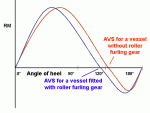
Before fitting an in-mast furling mainsail system to a sailing vessel, consider how heavy the main sail is to lift, all that weight and more will be spread up the mast! The effect is to reduce the angle of vanishing stability.

Slide13.gif
From the diagram above it can be seen that the extra weight of roller furling equipment has reduced the angle of vanishing stability for the vessel. Essentially, it will be more likely to invert from a lower angle of heel than a vessel of the same type but with out roller furling equipment.

In strong winds, when a roller main or headsail is fully or partially furled away, there is a considerable amount of weight spread up the height of the mast. On a vessel with conventional reefing or in-boom roller reefing, that weight is stored much lower in the vessel, thus lowering the centre of gravity and reducing the angle of vanishing stability.

Source: Adlard Coles Heavy Weather Sailing

Adlard Coles' Heavy Weather Sailing, Sixth Edition (English Edition) eBook : Bruce, Peter: Amazon.fr: Boutique Kindle
 
In mast furling is dreadful for sail setting. Particularly when reefed. I would not want to give up sailing to windward because the wind piped up a bit too much to carry full sail. Slab reefing for main and jib gives a much better set than rolling anything up.

Of course other have lots more time than I do and can afford to turn around and go downwind. I am very jealous of those guys!
I agree, but different people have different priorities, and a lot of people will be happy to sacrifice the sail performance for the ease of handling of a furling rig.
 
Whatever the subject, be it VAT or boat design, you seem to know best.
Being the fount of all knowledge must be such a burden for you. :rolleyes:

Now, on subject:


Placing heavy weights low in the hull improves stability by lowering the CG.

For this reason, fuel, water and heavy equipment should be stored as low as possible in the hull of the vessel.

Raising the CG by fitting roller-furling gear, radar and aerials up the mast of a yacht reduces stability. Because of the length of the lever, a small increase in weight at the top of the mast can have a large effect.

Before fitting an in-mast furling mainsail system to a sailing vessel, consider how heavy the main sail is to lift, all that weight and more will be spread up the mast! The effect is to reduce the angle of vanishing stability.


View attachment 129529
From the diagram above it can be seen that the extra weight of roller furling equipment has reduced the angle of vanishing stability for the vessel. Essentially, it will be more likely to invert from a lower angle of heel than a vessel of the same type but with out roller furling equipment.

In strong winds, when a roller main or headsail is fully or partially furled away, there is a considerable amount of weight spread up the height of the mast. On a vessel with conventional reefing or in-boom roller reefing, that weight is stored much lower in the vessel, thus lowering the centre of gravity and reducing the angle of vanishing stability.

Source: Adlard Coles Heavy Weather Sailing

Adlard Coles' Heavy Weather Sailing, Sixth Edition (English Edition) eBook : Bruce, Peter: Amazon.fr: Boutique Kindle
No need to be rude to Tranona whose extensive knowledge - and tendency to put accuracy above personal bias - has assisted a huge number of members on here.
Of course more weight up aloft impacts the AVS curve - and I am sure that Tranona would not for a moment dispute that. His actual point as I read it is that whereas ADDING extra weight aloft that was not included in the original design is a bad thing, many modern boats are now DESIGNED allowing for in mast furling sails, genoa and mainsail in the first place.
The article you referred to was precisely about the former, adding stuff to a boat not designed for it.
Personally I too prefer the sail shape of a adult battened mainsail - but as most seem to go upwind in “Solent rig” (motoring) then the loss of efficiency doesn’t matter to many, whereas the convenience does
 
As a cautionary tale -

We came to know of a friend of a friend who bought a vintage HR and with similar plans to us (but we bought a slightly less vintage 41’ Jen) - namely, refit/update and be ready to go longer distance cruising.

Our boat was always, and very obviously, a project. The HR was ostensibly turn-key, ready to go. I grew up lusting after 80s HRs (going aboard at boat shows etc.) so when I found the friend of a friend’s boat on the brokerage page I was immediately envious.

It was the same money as ours and the pontoon-side, on deck and down below photos initially had me smitten. Only on second viewing when I started pondering the original Volvo (vs. our low hours Beta 50), the cats cradles of wiring, and that lots of the things we’d enjoyed easy access to (chain plates, stern gear, bulkheads) for critical repairs appeared well-hidden behind the solid, beautiful, joinery.

Anyway, fast forward, and the latest news is the engine is dead (hydro locked somehow) and the will/money ran out and the boat is due back on the market.

Meanwhile, we’ve so far been able to repair/replace everything DIY - including all bearings/seals in the dreaded in-mast furling! - and our Jen is approaching ‘fully refitted’ status in most of our priority areas and under-budget.

She’s comparatively easy to work on (for a boat!). She also boasts a partial skeg, beefy rig, 2 Atlantic crossings under her belt, and much more ‘liveaboard’ space than the Rassey (with the coffin aft cabin!).

Both boat purchases were the result of internet ‘dreaming’ to an extent - but the brand snobbery (‘marque loyalty’?!) seems to have curtailed the dream for our distant acquaintances (and very sadly too) whereas we’re in the water and due some sailing this season.
 
Agreed, hoisting our slab main aged 75 is a lot harder than it was 20 or more years ago :(
That’s my only criticism too . It’s just plain heavy !
Mind, I really miss battens on any in mast set up that I have used .

For a third consideration the op may wish to read/watch some of the thoughts of Tom Cunliffe who bought in boom furling . With decent shape.

However he did note that compared to heavy old lead swingers ( I have had one or two of them too!) a boat that is quite tender means reefing early.

And some extreme beam boats look quite distorted when they are allowed to heel over - that is the challenge to the navel architect to juggle that with nice wide accommodations ( and cruising weight stuffed in everywhere ).

To my mind all boats have become so over complicated now - and I include those 30 yr old and refitted with all the comforts and whistles - that I wouldn’t particularly fancy taking any of them on unless I were to eat the depreciation and just treat it like a disposable car ownership thing ?
But the OP is doing good research and asking expensive- edit , or expansive- questions , he will find the sweet spot that works for him and his plans ??
 
Agreed, hoisting our slab main aged 75 is a lot harder than it was 20 or more years ago :(

I agree.
Downsized for that very reason.
However, rather than opting for an in-mast furling main there are other remedies available.
When it came to ordering a new mainsail for my 'new to me' boat last year I opted for a lighter cloth than the Dacron I had on my previous boat.
And I added a ball bearing batten car system to the mast.
Hoisting the mainsail on my previous boat left me out of breath and I had to sit down to recover 5 minutes after the sail was fully hoisted.
The mainsail on my current boat is only marginally smaller (3m/sq) and I can hoist the sail in just over the minute without breaking a sweat.
Should this no longer be the case in future, I plan to add an electric winch.
 
I too find hoisting a main harder than in the past, and have found that doing it with the clutch open reduces friction a lot, though a better solution might be to replace the clutch. However, in my 80s I can still do it without undue stress and have also found that wearing gloves makes a big difference. It stands to reason that a boat with less weight aloft will be more stable, even though larger crafter are better able to cope and modern boats will be designed with main furling in mind. It is one reason why I have my radar at the stern. On the other hand, we read of sailors who have found that a furling main has allowed them to sail with more pleasure and later in life, and I'm sure that we wouldn't want to begrudge them this, even if it offends our aesthetic sensibilities.
 
Interesting thread. Much of my early crewing was on a large HR, and despite remembering it's gloomy, dated and smelly cabin (and stubbornly contaminated fresh water tank) I focused on HRs and Nauticats for my return to sailing, because despite his best efforts, this HR just would not break! Couldn't find a nice one of either brand in my budget. Saw a 2006 Bav37 in Universal marina expecting to hate it ... and loved it. Simple, clean, reasonably modern. I got comprehensively outbid for that, and another, then nudged my budget up to my acquisition of an immaculate 2018 Bav34 (so obviously I'm biased). With in-mast furling, which I'm not sure I'd pay the extra for that from new, but it functions very smoothly, and the new Elvstrom seems to set nicely enough, with careful adjustment of the leech tensioner line to avoid curl or flapping. The higher freeboard took me a bit of getting used to in windy marinas, but with a pang of guilt, I can resort to the bow thruster, which I would recommend if that's a regular challenge. Yes, the old HR was a doodle to sail in nasty conditions, but with the Bav, I am more selective in what I go out in, and love the extra speed with the higher LOA/LWL, and hull design, and the lower marina fees and costs. for given LWL/interior volume.

There's a couple of interesting YouTube videos of the Bavaria factory, and it's very clear that with extensive use of robots and standardisation, the build and quality is going to be highly consistent - I really don't want to find out I got a Friday afternoon yacht, half way across Biscay! (And beneath the boards, Bavaria's are supposed to be slightly superior to the French offerings.)
 
While not yet retired and clearly not as grey hair/experienced as some we find a stack pack at 12.8 m boat fine (although many at our size have the in mast it’s not universal choice) but whether I would go much larger with stack pack to say a Hanse 470 etc might influence me to accept some of the benefits of in mast or in boom. In boom as per XC 42 would seem ideal but at a price and you also have to be careful with boom rotation by electrics/hydraulic rotation. The real tip for an easy life is to have a couple of electric winches and 2 headsails to give choice in sail usage ‘reduction . Clearly at the OP level /size I would not be worried if say a lovely HR 36 happened by if you have budget for decks (ie replacing old teak with Flexiteak say might be 10k ) but leaving aside decks I would be deciding based on what interior layout works really for your crew and how much fettling you enjoy. I would be more concerned at state of diesel,sails if stern access is important etc.
 
Not to mention that it affects the stability/motion of the boat.
Leaving the weight of the sail so high up...
Regardless of the make of the boat, I would prefer slab reefing any day of the week.


Indeed, it's difficult to think of any innovation that has less going for it. It's

Heavy
Inhibits sail shape
Inhibits sail size
Inhibits sail trim
Expensive
Prone to fail unsafe and
................Puts weight where you least want it

Stability is about more than just safety. It's a measure of the boat's ability to stand up against the wind, and make progress. Mainsail reefing is a convenience, this is fine, no problem at all, room for all sorts. Great if it means people can get on the water who otherwise would not but lets not kid ourselves it is a great ornament to sailing, as opposed to boating.


.
 
Electric winches are the answer to that.

I'm too tight to buy electric winches. I leave the clutch open and don't take a turn on the winch until I'm ready to use it for the last few feet, makes life easier.

I don't see any problem with in mast reefing and stability if the boat (such as Amel and many larger Moody) are designed for it but adding to older lighter ballasted boats will have an effect. Many years ago, I mounted radar and a Blipper reflector fairly high on our Centaur mast and there was a noticeable difference so I dropped the radar much lower down.
 
I have been in a number of HRs as well as my own and have never thought that any of the various interiors were gloomy. Most of them have exuded a certain warmth as well as being comfortable and well supplied with handholds. What one person might think of as gloomy, another will see as cosy. For real gloominess, some of the '90s Bavarias take some beating.

Teak decks are always a contentious issue, which is often dominated by those with strongly adverse opinions. Much depends on how the deck is cared for, though the earlier examples were possibly from better timber, with later ones such as mine being from plantation teak. My own HR deck is now 22yrs old and apart from having a couple of mm trimmed from the caulking is almost as good as new, with a likely life of another thirty years at least. The only plugs covering screws that are lost have been from the much thinner boarding platform.
 
I agree.
Downsized for that very reason.
However, rather than opting for an in-mast furling main there are other remedies available.
When it came to ordering a new mainsail for my 'new to me' boat last year I opted for a lighter cloth than the Dacron I had on my previous boat.
And I added a ball bearing batten car system to the mast.
Hoisting the mainsail on my previous boat left me out of breath and I had to sit down to recover 5 minutes after the sail was fully hoisted.
The mainsail on my current boat is only marginally smaller (3m/sq) and I can hoist the sail in just over the minute without breaking a sweat.
Should this no longer be the case in future, I plan to add an electric winch.

Faced with similar age challenges I bought a Winchrite electric winch handle and the mainsail raising challenge has been beaten !
 
Faced with similar age challenges I bought a Winchrite electric winch handle and the mainsail raising challenge has been beaten !
I bought one of those too. Although it's not man enough to hoist my main or sheet in the genoa, it certainly takes all the grunt work out of sheeting the main in and furling the genoa.
 
I have been in a number of HRs as well as my own and have never thought that any of the various interiors were gloomy. Most of them have exuded a certain warmth as well as being comfortable and well supplied with handholds. What one person might think of as gloomy, another will see as cosy. For real gloominess, some of the '90s Bavarias take some beating.

Teak decks are always a contentious issue, which is often dominated by those with strongly adverse opinions. Much depends on how the deck is cared for, though the earlier examples were possibly from better timber, with later ones such as mine being from plantation teak. My own HR deck is now 22yrs old and apart from having a couple of mm trimmed from the caulking is almost as good as new, with a likely life of another thirty years at least. The only plugs covering screws that are lost have been from the much thinner boarding platform.
Yes, you're right actually - the area of HR glazing is quite good, especially for the vintage (a factor which sent me in the direction of the nauticat initially). It was just a false impression on that particular boat from the acres of dark wood and dark blue upholstery, and general clobber about the cabin.
 
I too find hoisting a main harder than in the past, and have found that doing it with the clutch open reduces friction a lot, though a better solution might be to replace the clutch. However, in my 80s I can still do it without undue stress and have also found that wearing gloves makes a big difference. It stands to reason that a boat with less weight aloft will be more stable, even though larger crafter are better able to cope and modern boats will be designed with main furling in mind. It is one reason why I have my radar at the stern. On the other hand, we read of sailors who have found that a furling main has allowed them to sail with more pleasure and later in life, and I'm sure that we wouldn't want to begrudge them this, even if it offends our aesthetic sensibilities.
We met an Aussie here in Antigua. A really interesting guy. Built his own aluminium 57 ft sloop in 1981. Still sailing it with his wife. He is 84 years old. He has no electric winches. Somebody suggested he should fit some to make life easier. He said no way! He has the best outdoor gym in the world! Use it or lose it! He still kite surfs.
 
Top