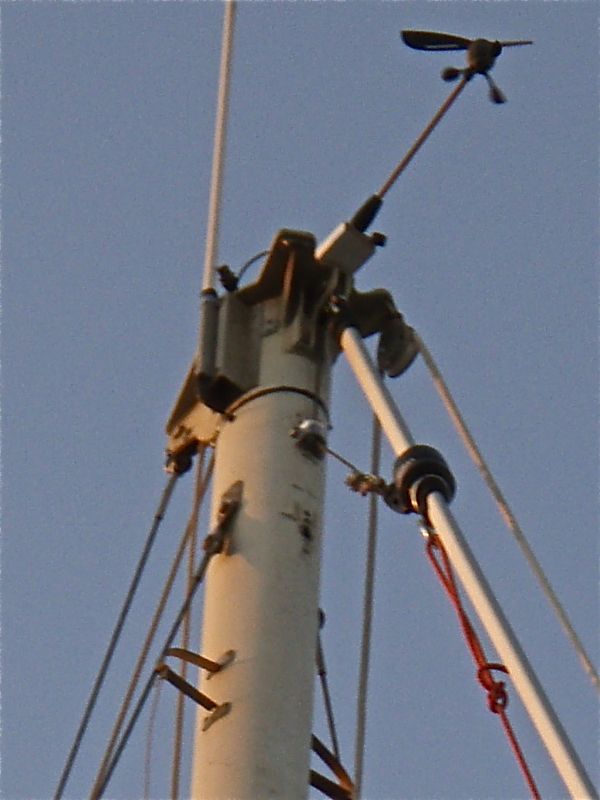
Going up the mast (solo) and what to expect at the top...

Climbing harness is not expensive from an outdoors shop where you can try them on.
Definitely get an assistant to tail a safety line and lower you when you're done.
You will always find you need a different tool or extra materials, coming back down the mast because the screws are a different size allen or torx is a wind-up. A friend on deck to put the tools in the bucket is a great help.

I mostly use a home-made step with a cam cleat and foot loops.
I have ascendeurs but they are not great on halyard rope. You can hoist a climbing rope on the main halyard, but that loses more height.
 
Forgive my criticism, but you sound a bit gung ho.

Having climbed more masts than most (excluding riggers of course) the more I climb the more care I take.

It only needs one fall.

You definitely need some sort of safety backup whatever mechanism you employ (don't ask me - I'm biassed!).
 
I use a climbing harness designed for big wall climbing. These have extra-wide leg straps so help to avoid blood being cut off to the legs. I combine that with a Petzl Kroll chest jammer and and Petzl ascender using the 'frog technique'. (Google for details.) This set-up is designed for climbing a single rope. It works better with a single static rope rather than a stretchy climbing rope so I don't hesitate to use it on a good condition 10mm halyard. My jammers are now 40 years old - are bombproof and never slip. I reverse down, which is a bit more of a faff, but perfectly safe. Cavers use them on ropes with no other safety line but, given the ease of setting up a safety line, I would generally have someone operate a lifeline or, if alone, use a prusik knot on another fixed line. It gives a fast and safe ascent and gets the head well above the top of the mast.
 
Last edited:
From looking through binoculars it would appear there may be a sheave at the front of the mast head and another at the back... The halyards run externally. Would that be correct? The halyard running over the 2 sheaves?

Doesn't sound right. Would expect this to be for 2 halyards, and for them to run internally and exit above deck level (are there any exit holes in the mast at knee to nose sort of level?).
 
I use a climbing harness designed for big wall climbing. These have extra-wide leg straps so help to avoid blood being cut off to the legs. I combine that with a Petzl Kroll chest jammer and and Petzl ascender using the 'frog technique'. (Google for details.) This set-up is designed for climbing a single rope. It works better with a single static rope rather than a stretchy climbing rope so I don't hesitate to use it on a good condition 10mm halyard. My jammers are now 40 years old - are bombproof and never slip. I reverse down, which is a bit more of a faff, but perfectly safe. Cavers use them on ropes with no other safety line but, given the ease of setting up a safety line, I would generally have someone operate a lifeline or, if alone, use a prusik knot on another fixed line. It gives a fast and safe ascent and gets the head well above the top of the mast.

I've been looking for a harness that is both comfortable to wear and safe. Bosuns' chairs are designed to sit in and, used as such, mine is ok.
As soon as I stand, the load is transferred in a nuts direction. However, with the shoulder straps and the chest straps I added, it is virtually impossible to fall out.

Can I be sure that is true of a "big wall climbing" version? Steer/link please.
 
I've been looking for a harness that is both comfortable to wear and safe. Bosuns' chairs are designed to sit in and, used as such, mine is ok.
As soon as I stand, the load is transferred in a nuts direction. However, with the shoulder straps and the chest straps I added, it is virtually impossible to fall out.

Can I be sure that is true of a "big wall climbing" version? Steer/link please.

Climbers take uncontrolled falls in their sit harnesses. If you don't have any hips then a sit harness may not be right for you. However in the frog set-up there is a kroll jammer held into the chest. By the way, I don't have anything to sell. :rolleyes:

This is my current harness but there are others with wide leg-straps.https://www.petzl.com/GB/en/Sport/Harnesses/CALIDRIS
 
Last edited:
Ties in with the reluctance of my trousers to stay up.:nonchalance:

This is no joke. If you do not have the hips for a belt, you cannot wear a seat harness alone. You must be able to tighten the waist belt such that there is no way to push the harness down without breaking bones. If this is not true, a full harness is needed. You can fall upside down, out of a harness. I saw it done once, and yeah, it was fatal. No, it was NOT a member of my party.

This is not a problem with fit rock climbers, which is who these are made for.
 
The problem with a bosuns chair is it doesn't lift you quite high enough to see the top of the mast.

I use on of these, but there are lots of variations on the theme.

http://mastmate.com/

It means you can stand up above the top of the mast looking and working downwards. Wouldn't surprise me if the previous owner lost the jib halyard so switched to the sp to hoist. Small fishing weight or drill on some fishing line to feed down the mast will help. Short length of bicycle chain also might work.

+1 for the mast mate. However, using the top 2 steps is very nerve racking! I have spend several hours at the top of the mast in the last few months, and my system was as follows; Mast mate to climb the mast, on the main halyard. I wore a climbers harness attached to 2 separate rope ascenders (Prusicks should do the same thing). These were slid up the spiny and genoa halyards as I ascended. I found it quite difficult at first, due to the height, but got used to it eventually!

I would recommend replacing the top light with the NASA LED anchor/tri light
 
Doesn't sound right. Would expect this to be for 2 halyards, and for them to run internally and exit above deck level (are there any exit holes in the mast at knee to nose sort of level?).

I agree. A common arrangement is for a couple of sheaves at the front of the mast (for genoa halyards) And a couple at the rear of the mast (for main halyard and boom topping lift) The halyards normally run up the mast and exit at the sheaves, and above deck level at the other end
 
This is not a problem with fit rock climbers, which is who these are made for.

With respect, I need to take issue with this! In my eightieth year, I was recently assessed for repair of a detached rotator muscle. I was declared by the consultant to be "remarkably fit and remarkably healthy".

My shape is a function of genetics (or something) not to being over-weight. My BMI is spot on.

Apology accepted (er, anticipated):o

I would very much like to find a harness that was comfortable and safe (and affordable).
 
Last edited:
Homemade mast ascender

dsc_3603.jpg


https://middlebaysailing.wordpress.com/tag/mast-climbing-system/
 
Before we all get too carried away ... it sounds like he does have the genoa halyard correct at the moment, it is supposed to be like what you describe.

With a furling genoa the genoa halyard should come out of the sheave, then down the mast a short distance and through a fitting, before going to the top swivel on the genoa.

Like this:

correctangle.jpg


It should NOT go directly to the sheave, or this happens:

getimage.aspx


You need an angle of around 10 to 15 degrees between the halyard and the forestay.
 
Before we all get too carried away ... it sounds like he does have the genoa halyard correct at the moment, it is supposed to be like what you describe.

With a furling genoa the genoa halyard should come out of the sheave, then down the mast a short distance and through a fitting, before going to the top swivel on the genoa.

Like this:

correctangle.jpg


It should NOT go directly to the sheave, or this happens:

getimage.aspx


You need an angle of around 10 to 15 degrees between the halyard and the forestay.

It's coming off an external block on the front of the 'branch' for lack of knowledge of a better word at the top of the mast. The halyard then goes back towards the saddle on the front of the mast (and this is where the fouling of the furler is happening). If I can re-direct it over a sheave at the top of the mast instead of the external block, that should sort that issue.
 
OP here...

Would just like at this stage to thank all contributors so far for insight and advice :)

I have bought a climbing harness for my next trip up and will use a separate fixed line with a prussic as the back up.

Someone mentioned that I seemed a bit 'gung ho'...

I wouldn't necessarily agree with that assessment, especially with not being all that comfortable with heights, but sometimes you just have to grab the bull by the horns and get on with it.

With 2 lines being used, the chances of failure are reduced by a good margin, and with the safety not using an external block, even were a sheave to fail, the line would be supported by the top of the mast itself.
 
Got you, yes, that does sound like the spinny halyard then, will be very draggy the way it is setup there.

A new halyard isnt expensive, I imagine 8mm or 10mm will be thick enough? better to run a new one than re-purpose the spinny halyard no?

... take my advice however on this: buy 30m of 2 or 3mm paracord and a bit of bicycle chain, about 8 inches is enough. If you imagine that pushing the halyard over the pulley it will somehow "magically" fall under gravity down the mast to appear at the bottom, sadly, you will be very disappointed.

I have found that by far and away the easisest way to thread a halyard is to use a bit of bike chain attached to a bit of thin paracord about twice the length of the mast, it's easy to push it over the sheave and it is heavy enough to pull itself down the mast under its own weight, bringing the thin cord with it ... you can even use a magnet to encourage it to come out of the appropriate hole at the bottom. you can then use the cord to pull the halyard through. It is usually a 2 person job.
 
Got you, yes, that does sound like the spinny halyard then, will be very draggy the way it is setup there.

... take my advice however on this: buy 30m of 2 or 3mm paracord and a bit of bicycle chain, about 8 inches is enough. If you imagine that pushing the halyard over the pulley it will somehow "magically" fall under gravity down the mast to appear at the bottom, sadly, you will be very disappointed.

The halyards are ran externally it seems... I don't see any cut outs in the mast for them to exit at the bottom, so, e.g., it appears that the main halyard goes over a sheave at the front of the mast and then over another at the back.
 
Top