
Going to be windy - safe to disconnect lowers for chainplate repairs?

webcraft

Well-Known Member
Joined
8 Jul 2001
Messages
40,439
Location
Cyberspace
www.bluemoment.com
We are lifting out tomorrow for chainplate repair/reinforcement.

The plan is to disconnect the lower shrouds first to inspect the deckplates and reinforce the chainplates (see previous thread for details)

Mast is about 11m high. The plan is to reconnect the lowers temporarily to the toerail, which will involve moving them approx. 1" outboard, and slightly retensioning them. Toerail is ally through-bolted every 4" to a continuous backing plate.

We have already postponed the liftout once because of bad weather. The plan is to get the work done ASAP once we are lifted tomorrow afternoon, so we want to move the lower shrouds to toerail and remove the deckplates on Tuesday.

Forecast for the next few days is once again not great though, with periods of gusts up to 30kts
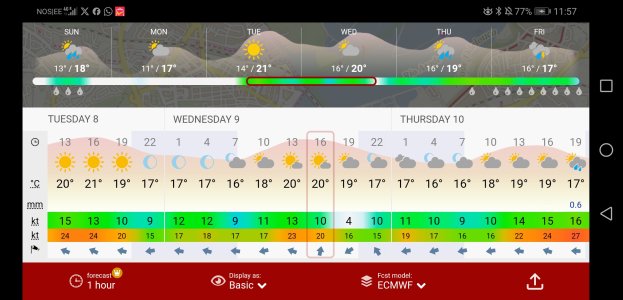
Screenshot_20250406_115721_com.windyty.android.jpg

My feeling is, with the boat not moving and the lowers reasonably well secure on the toerail this will be alright and the mast and toerail are unlikely to come to any harm. (Caps, forestay and backstay will be in place).

How confident would the team be?

— W
 
Very confident.

I think you will be fine just keep the new temporary position shrouds tightened up so as not to be slack with a bit of tension.

Reported on here a while ago, was a situation where a person always slacked their rigging off, after sailing of course, but on a mooring. The rigging prematurely failed due to the mast wobbling about, IIRC. However that was over a long time than just a few days.

It will be fine.
 
It's better to keep a mast up with just the lowers than with just the upper shrouds, if at all possible I would secure the lowers to a good chainplate (the upper shroud one?) and bring the upper shrouds to the toerail.
 
It's better to keep a mast up with just the lowers than with just the upper shrouds, if at all possible I would secure the lowers to a good chainplate (the upper shroud one?) and bring the upper shrouds to the toerail.
I am confident the toerail will take a reasonable amount of upward pull, the lowers should not need to be much slacker than normal.

Moving the lowers to the middle chainplate would totally alter the angle (ie to vertical)

- W
 
Very confident.

I think you will be fine just keep the new temporary position shrouds tightened up so as not to be slack with a bit of tension.

Reported on here a while ago, was a situation where a person always slacked their rigging off, after sailing of course, but on a mooring. The rigging prematurely failed due to the mast wobbling about, IIRC. However that was over a long time than just a few days.

It will be fine.

Thankyou. That is my thought, but reassurance is great.

My plan had always been to use the toerail in the event of a shroud or chsinplate failure.

It just would be less worrying with a better forecast!

- W
 
It's better to keep a mast up with just the lowers than with just the upper shrouds, if at all possible I would secure the lowers to a good chainplate (the upper shroud one?) and bring the upper shrouds to the toerail.

What ... you serious ??

As long as forestay ... main cap shrouds and backstays are set even and well (I would ease off backstays if you have tensioned to 'bend' the mast) - lowers are there to control the mid section of the mast. There should be no problem to disconnect and work on lowers.
 
I'd be inclined to release tension on the backstay and caps too. The lowers, amongst other things, keep the mast in column. I have known of three dismastings over the years and all of them were caused by a lower giving out.
 
I would certainly keep an eye on whether the mast remains in column.
When I did my standing rigging one stay at a time, too much tension on the fore and back stays did seem to try to push the mast down and curve it sideways a bit. I only really noticed when I was at the masthead looking down, and it was a bit late by then 😱
 
Once again: the blind leading the blind.

In a single spreader rig, the lowers are calculated to take up 60 % of the entire load or RM righting moment). A load of, very likely, several thousand foot pounds, that is.

There isn't a hope in hell that 40% of this sort of load would or could be generated on the spars and the remainder of the
standing rigging in anything short of the most violent of hurricanes.

Should you notice the street lights being blown over, you might want to head down to the boat, if it is still on it's cradle, and tie things off.

I shouldn't give it another thought.
 
Once again: the blind leading the blind.

In a single spreader rig, the lowers are calculated to take up 60 % of the entire load or RM righting moment). A load of, very likely, several thousand foot pounds, that is.

There isn't a hope in hell that 40% of this sort of load would or could be generated on the spars and the remainder of the
standing rigging in anything short of the most violent of hurricanes.

Should you notice the street lights being blown over, you might want to head down to the boat, if it is still on it's cradle, and tie things off.

I shouldn't give it another thought.
This. And Refueler and runaground. In fact I reckon you’d need about 200kn of wind to endanger the mast. You may well have other problems well before this.
 
What ... you serious ??

As long as forestay ... main cap shrouds and backstays are set even and well (I would ease off backstays if you have tensioned to 'bend' the mast) - lowers are there to control the mid section of the mast. There should be no problem to disconnect and work on lowers.
Can't be ''serious'' on forum, I just suggest you check figures by yourself: compute the bending moment at the spreaders with a. only the lowers (the upper part of mast self standing), then b. only the upper shrouds bearing the whole mast load= spreaders compression load without lowers. Same mast section, uniform load, etc, which mast collapses first?
Then of course do whatever you like :)
 
Assuming a mast length of 11m and a width of 0.17m, the lateral loading in 52 kn of wind (F10) would be 69 kg or 665 N.
Alas, as the wind speed diminishes towards the ground, it is save to assume a value of 70% of the one calculated above: i.e. 466N or about 45 kg.

In a hurricane with wind speeds above 65kts, the actual load would be something like 102 kg. This however would be quite irrelevant, as the loading on the mast would be significantly reduced at this point with the entire boat lying on it's side.

I think we can now "seriously" put this whole "the sky is falling" debate to bed.

Good night.
 
I know I'm on a hiding to nothing but it's nothing to do with the dynamic loads on the mast but with the static load from caps forestay and Backstay.
So the function of the lowers is to stop the other stays/shrouds from pulling the mast down?

Seems unlikely, but I may have misunderstood you?

— W
 
Masts are calculated according to Euler's formula as columns under compression.
In order to keep the required moments of inertia to a minimum, i.e. the size of the mast, the mast is divided up into shorter panels of unsupported lengths.
This is the purpose of having spreaders, single or multiple as that may be.
This is also the reason why masts tend to be oval in shape, as the longitudinal moments of inertia need to be greater due to the longer, unsupported fore & aft lengths.
Babystays, running backstays, and the spread of the two lower shrouds permit thinner longitudinal mast sections, by shortening the unsupported fore & aft panel lengths.

The compression loads on a mast result from dividing the righting moment (RM) by the distance from the mast to the shroud base. Consequently, the beamier the base/boat, the greater the angle between mast and shroud, the lower the compression loads are on the mast and, additionally, the shorter the unsupported panel lengths are, the smaller the mast section can be.
 
Top