
Generator Locker has anybody ever tried it?

MengWalton

Well-Known Member
Joined
24 Apr 2014
Messages
78
Visit site
Good Morning All,

Not sure if I'm just tired because I stayed up late watching turkey going mad but I just had a thought and I wonder why no one has ever tried it.

I have 4 or 5 smallish lockers and I imagine larger boats have bigger and more of them. Why hasen't anyone converted one to a generator compartment, it should be easy enough to do obviously taking in safety considerations.

Obviously the blower would be intrinsically safe and the vent would be of the bell type so there would be flow even with the blower off to avoid petrol fume build up (better to use diesel to avoid this best to keep the blower still for engine/alt cooling .
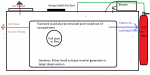
Generator Locker.png

The fuel tank could be removed and put on deck somewhere with a stopcock, i think this would improve it even more.
The skin fitting for the exhaust would require some investigation for heat but i suspect that by the time its gone through the silencer and hose it would not be a problem.
The co2 or foam extinguisher could just be normal one fitted in the cockpit somewhere with a pipe leading to the locker (Inspiration taken from small paint lockers on ships)
I also have a CO detector in the cabin, I could put one in the locker aswell but not needed in reality

Am i missing something here?
 
Last edited:
Good Morning All,

Not sure if I'm just tired because I stayed up late watching turkey going mad but I just had a thought and I wonder why no one has ever tried it.


Am i missing something here?

What you may be missing is that your proposed exhaust connection may be contrary to the manufacturer's stipulation that no modification of the generator is permissible

It was the failure of the pipework connecting a portable generator exhaust to a skin fitting which resulted in two deaths in a Lake District three years ago.

Dont underestimate the temperature of the exhaust.

https://assets.publishing.service.gov.uk/media/56a20e2040f0b667ce00002b/MAIBInvReport_2_2015.pdf


.
 
Dont underestimate the temperature of the exhaust.

.

That's why most inbuilt generators are water cooled and water cooled exhausts.

Also and cooling air vents meed good baffling to keep the noise from escaping the box.

I did try something similar with a suitcase generator in one of my cockpit lockers with the exhaust straight out of a brass skin fitting with no hose but it worked OK if the lid was kept open but was still noisy. That's why I went for a water cooled diesel generator.
 
That's an interesting case thanks for that, appreciated.

I can't believe they used a soldered joint!! I would use a single hose secured with 2 hose clamps, not a solid pipe like in the above case and certainly not a soldered pipe! the generators I have looked at the exhaust pipe after the silencer sticks out some way.
I see they used the generator in an enclosed cockpit that was connected to the living area, no blowers (supprised they didnt blow themselves up first) and they were asleep and they had disconnected the CO alarm!!, Poor buggers they obviously didn't have a clue and unfortunately paid the price, hate reading cases like that they just leave me shaking my head in disbelief.

Just to be clear this would be in a sealed locker, with no direct flow possible to the cabin even in the event of a exh leak, I would also NEVER use it whilst sleeping it would only be fired up for battery charging, elec oven/microwave.
I already have a CO detector in the cabin anyway but I would prob fit a backup and one in the locker to detect any leaks.

I have sent an email to honda asking for rough exhaust temp after the silencer. Cant imagine it been much over 100'C after the silencer. I'm trying to guestimate as the exhaust outlet from our ship generators is around 380'C at the cylinders exhaust mainfold.

With the cabin totally separated, forced ventilation and using it whilst awake with adequate co alarms just in case.
Just thinking about it even more even if there was a leak and it escaped the 'sealed locker' through the access door it would leak into the open cockpit and be blown away (CO weighs roughly the same as air), the cabin is force fed from the coach roof.

Thanks for you reply, especially with the accident report it was an interesting if not rather depressing read
Jonjoe
 
Last edited:
That's why most inbuilt generators are water cooled and water cooled exhausts.

Also and cooling air vents meed good baffling to keep the noise from escaping the box.

I did try something similar with a suitcase generator in one of my cockpit lockers with the exhaust straight out of a brass skin fitting with no hose but it worked OK if the lid was kept open but was still noisy. That's why I went for a water cooled diesel generator.

You got any pictures of your prev setup? Interesting idea re skin fitting
I'm not massively concerned about noise, it would only be used for short times as above and when at anchor or at a marina with no shore power.
 
Just don't do it. They are intended for use outside. If manufacturers thought they could be used in an enclosed space they would design it for that purpose.
 
I have sent an email to honda asking for rough exhaust temp after the silencer. Cant imagine it been much over 100'C after the silencer.

Try touching one. Or if you are not feeling that brave, spit on it.

Getting the exhaust out of the locker isn't that difficult though. If it's only a small generator an Eberspacher exhaust might do the job. If not, something similar but bigger could be made.

That said, the reduction in noise wouldn't be massive. Seems like it would be vastly easier, cheaper and quieter to just buy a suitcase genny and use it on deck, just storing it in the locker.
 
Cant imagine it been much over 100'C after the silencer. I'm trying to guestimate as the exhaust outlet from our ship generators is around 380'C at the cylinders exhaust mainfold.

Just a comment on exhaust gas temperatures from Thermodynamics 101..
Exhaust design for thermal engines should be such that the exhaust gases exit the pipe at greater than 100 degrees C during normal (not warmup ) operation.
This is to prevent condensation of the water vapour which is a product of combustion within the exhaust system.
Liquid water when combined with other products of combustion forms an aggressively corrosive mixture which will shorten the life of the exhaust system components.
The aim of wet exhausts in marine engine installations is thus twofold: to lower the temperature and to hugely dilute and wash away the other combustion components.
Remember that at least 70% of the energy from burning petrol is converted directly to heat. A piston engine really is just a form of enclosed fireplace.
Not saying it cant be done, and designing a triple walled exhaust would be an interesting challenge, but please go cautiously with this project, there are some real dangers involved.
Cheers
John
 
That's why most inbuilt generators are water cooled and water cooled exhausts.

Also and cooling air vents meed good baffling to keep the noise from escaping the box.

I did try something similar with a suitcase generator in one of my cockpit lockers with the exhaust straight out of a brass skin fitting with no hose but it worked OK if the lid was kept open but was still noisy. That's why I went for a water cooled diesel generator.

I don't have any pics as this was on my previous boat. If you are not concerned about noise why have an enclosure anyway.

My current petrol generator is normally either on the foredeck or my mooring finger and when not in use has a ripstop nylon cover that folds up to allow free flow of air and exhaust but still protects it from any rain of spray.

As I said my inbuilt generator is water cooled and water cooled exhaust so can be in a sealed box which greatly reduces any noise and thus annoyance of neighbours.

I think you will find exhaust temperature will be much higher than 100 C so rubber /plastic hoses will just burn away of even set fire. I know mine has melted any plastic that I left near by.
 
Last edited by a moderator:
I suspect that the biggest problem in a project like this is not getting safely rid of the exhaust gasses but in maintaining enough airflow round the generator to keep it cool enough. Suitcase generators use forced air cooling, taking air and forcing it past both the engine and generator to keep them cool enough to work. This is a fairly marginal setup: I had a generator that would not work for more than about 30 minutes before the thermal protection tripped out when it was being used in Greece in the summer.

Translate that experience to enclosing one in a locker with no free air circulation, only a blower pushing air into it. I don't think that you'd be able to keep enough air moving through the locker to keep the air temperature down low enough for the cooling system to work properly.

And that's after you've managed to solve the problems inherent in making sure the exhaust is properly dealt with. By the time you've dealt with all of these it'd probably be not much more expensive to buy and fit a properly designed generator.
 
Try touching one. Or if you are not feeling that brave, spit on it.

Getting the exhaust out of the locker isn't that difficult though. If it's only a small generator an Eberspacher exhaust might do the job. If not, something similar but bigger could be made.

That said, the reduction in noise wouldn't be massive. Seems like it would be vastly easier, cheaper and quieter to just buy a suitcase genny and use it on deck, just storing it in the locker.

I'm coming to the conclusion that it isn't worth the effort to do, the point was to reduce noise slightly and have a perm installation that could be wired into a selector panel without the need to move the generator around and plug un plug ect, however I will prob end up just putting it on deck and running a cable to the shore power connector, its easier. This was just a question to see if it could be done, it looks like it could be done but not worth the effort unless noise is a big issue.


Just a comment on exhaust gas temperatures from Thermodynamics 101..
Exhaust design for thermal engines should be such that the exhaust gases exit the pipe at greater than 100 degrees C during normal (not warmup ) operation.
This is to prevent condensation of the water vapour which is a product of combustion within the exhaust system.
Liquid water when combined with other products of combustion forms an aggressively corrosive mixture which will shorten the life of the exhaust system components.
The aim of wet exhausts in marine engine installations is thus twofold: to lower the temperature and to hugely dilute and wash away the other combustion components.
Remember that at least 70% of the energy from burning petrol is converted directly to heat. A piston engine really is just a form of enclosed fireplace.
Not saying it cant be done, and designing a triple walled exhaust would be an interesting challenge, but please go cautiously with this project, there are some real dangers involved.
Cheers
John

This is true, hence why I said much above 100'C , Nox and Sox scrubbers on ships use this principle (well some) by spraying water mist across the exhaust flow. Some use pellets to create a reaction as the exhaust gasses pass through. As above this was just to see if anyone has done this before for all I knew it was a common thing. but the effort to the rewards make it not very viable i suppose just getting the geni out when needed and pluggin in is easier whilst not as neat and tidy of a setup. On that note i should actually get back to studying Thermo I've got an exam on Tuesday for my Cheif engineer academic exemptions.


I think the rewards to the effort required make this un-viable, it would be possible indeed it would be quite simple and a neat setup that could be setup to an on board system. The sound proofing would be slightly more difficult however still possible.
It would be completely safe if done correctly with the correct alarms fitted and the setup monitored.
A note would be that this should never be run whilst not attended and not done at all where the locker could leak fumes into the cabin or enclosed cockpit no matter how good the system.
For now I think it would be easiest to use it as storage and plug in when needed, just not as neat and tidy of a setup. once I have finished everything else on the boat I may revisit this. If anyone else is doing this for the love of god don't dis connect your CO alarm like in the above report.
Everything is possible to do and to do it safely as long as you take the correct safety measures

Jonjoe
 
you might like to have alook at what Honda can do in the States.

It seems to be a well-thought out system incorporating exhaust and cooling air extract. Also they have a remote fuelling pipe which looks a bit of a fir hazard.

http://www.generator-line.com/
 
Thats interesting. Do you know what base diesel engine they use.

there's a clue in the description:

Weighing in at only 51kg .................. Sporting a Yanmar engine ...........................................​
 
Buy a Honda 2.0i and stick it on the foredeck, or the swim platform if you've got one ... quietest suitcase genny on the market. Save all that faffing around and a lot safer!
 
there's a clue in the description:

Weighing in at only 51kg .................. Sporting a Yanmar engine ...........................................​

Yep OK OK Vic point taken but which one as the smallest water cooled Yanmar 1GM10 is about 6.6 Kw at 3600 rpm so may be 5Kw at 3000 rpm so overkill for a 2 Kva generator I would put at least a 4 Kva generator on that one not 2 Kva
 
Top