Fuel consumption curves

eddystone

Well-Known Member
Joined
18 Aug 2013
Messages
1,936
Location
North West Devon
Visit site
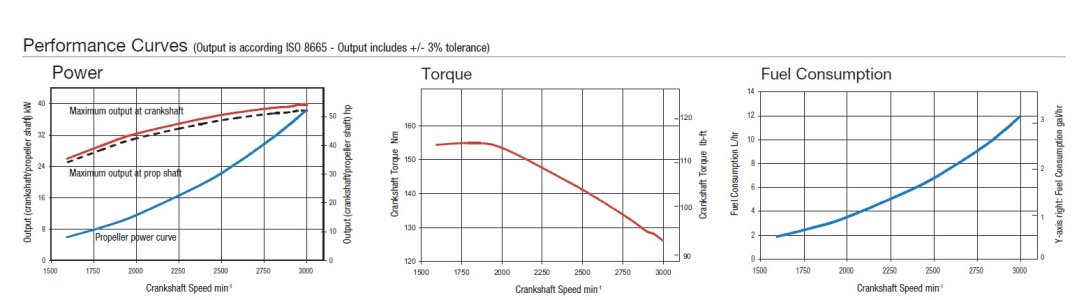
I found a fuel consumption curve for Volvo MD22L but there are two curves, one for full load and one for calculated propeller load at an assumed gearbox reduction ratio (in this case 2.5:1)
Which is best indicator of real world consumption?
 
I would assume that "full load" is flat out on engine and with no sails up. The "propellor load has to be throttle dependant so it should say something about speed / throttle on the graph
 
Fuel consumption curves are based on test bed figures with an adjustable load. Using them to estimate for an actual boat installation pre-supposes that the propellor is accurately matched to the engine power curve ie; max. revs at WOT. This might not be the case.
NB; I'd expect this to be so whatever the gear-box ratio.
 
Last edited:
Which is best indicator of real world consumption?
Prop curve. The full load curve is measured on a dynamometer and shows the maximum power and corresponding fuel consumption at varying engine speeds. This isn't the same as the load that a typical prop applies at the same engine speeds apart from at the maximum engine speed where the prop is chosen to match the maximum engine power. Below maximum engine speed the prop is only taking a smaller proportion of the possible maximum power available. That's the way props work - the load they need at lower speeds does not match the power curve of the engine.

The prop curve is only an approximation for a typical prop on a typical boat, but is as near as you will get for consumption figures.
 
Last edited:
To build on what Angus writes, the load on a propeller increases as the cube of the rpm.
The torque increases as the square of the rpm.
The output from a typical marine diesel, doesn't match the the requirements of a propeller very well. At revs above tick over the maximum it can produce is much more power than the prop requires. However, at higher RPM, as the load on the prop increases quickly, the maximum output power of the engine is quite flat, and then decreases.
So, at low RPM the governor throttles back to maintain the request rpm, and the engine uses less fuel.
As the RPM increase the power required to turn the prop increases rapidly, whilst the maximum power the engine can produce only increases marginally. ie. The engine has to work harder and uses more fuel.
If the prop and the engine are matched, at maximum revs, the prop is demanding all the power the diesel can produce, and it uses maximum fuel.

To illustrate this take a look at the engine curves for the Yanmar 4JHJ4E fitted to my boat.
Screenshot (39).jpg
From the power curve you can see that at 1750 rpm the maximum power the engine can produce is about 28kW, but the prop only needs 8kW to drive it. The engine can produce about 3.5 time more power than is required. The fuel consumption at 1750rpm at full power is about 2.5 L per hour. But working at less than 1/3rd of full power it is going to consume significantly less.
I tend the cruise under power at about 1950rmp, and use about 2L per hour, this gives a boat speed of around 6.5 to7 knots (14m waterline length, slim hull, very little wetted area, assuming flat calm and a clean hull).
If I crank it up to max revs, I get about 9.5knots, but as you can see from the power graph the prop is absorbing all the power the engine can produce, and it's using maximum fuel, more than 10L per hour.
On my boat running flat-out doesn't make any sense, I get 3knots extra speed but use about 5 time more fuel.
This is a highly simplified explanation, to illustrate the mismatch between conventional naturally asperated diesels with mechanical fuel injection and a propeller. There's a lot more going on under the hood, prop diameter, pitch, blade area, prop foil section, gear box ration, and all the compromises which go into a practical propeller.
The power graph can also be used to investigate the effects of under of over pitching the prop. An over pitched prop will make the blue prop line steeper, and it may cross the engine maximum output curve before max revs are reached. The governor will still be trying to reach maximum revs and put more fuel in the cylinders than the engine can burn, resulting in back smoke, but no more speed. Under pitching a prop has the opposite effect. The blue line will flatten out and never reach the maximum output power that the engine can supply, which may result in the boat not reaching it's maximum designed speed.
To answer the OP's question, use the calculated propeller load (propeller power curve in the graph), but treat it with a "pinch of salt", there'll be a lot of assumptions hidden in there.
 
Many moons ago before my forum membership was hacked ... and the infamous events that another forumite posted leading to my posts / threads being deleted mistakenly by moderators back then ... I had a thread running that collected together Fuel data for members boats. The idea being to gather enough together to be able to indicate to others values obtained in real use for engine - HP - Boat brand use ...
It ran to considerable length. If I can find it - I may post it up again ...
 
I’m always torn between chugging along at 2k rpm which gives me 4.5 to 5 knots, or increasing revs to 2.5 or 2.6k to give 5.5 (or a tad more) knots, but uses noticeably more diesel. Forum advice seems to be that diesels like to work hard, and that the running at higher rpm will be good for engine longevity. I’m a bit of a tightwad though, and the extra diesel consumption rankles somewhat.
This on a 30ft boat with 3GM30 and kiwi-prop (not the most efficient of feathering props).
 
This is the spec of the engine sra-moteur.com/uploads/catalogue/produits/documentations/md22-md22.pdf Pretty common engine for the period and well suited to the boat in question. I expect the new prop will be pitched to allow a maximum of about 3600 rpm, well in the recommended range. This would give a cruising speed of +/- 2500 and a typical consumption of around 4l an hour.
I would be using less revs than that and aim to keep to 3L an hour or thereabouts so I had a range under motor of 70-80 hours (with 80L in jerrycans)
Talking of jerrycans I’m concerned about having a fuel filler on the transom for refuelling at sea - has anyone come up with a bung for the filler pipe with a push through for a siphon tube and a non return vent. Or should I start designing?
 
I have a 12v fuel pump ..... it has a long straight tube that you put into the container .... the motor is in the hand part - the pump at bottom end of the tube ... the fuel transfers then via flexi pipe to the tank .... saves all that heaving heavy cans up and pouring !

Cost about a tenner on eBay ... I use for Gasoline (motorboat) and diesel (garden machinery and sailboats).
 
I would be wary at running at lower than 2500 for long periods of time. Not only will your speed be lower but the load on the engine will be low leading to possible exhaust elbow problems. While the theoretical curves are a useful guide, better to carry out some real tests to establish actual consumption. I did a lot of motoring across the Med in my Bavaria 37 with an MD 2030 and running at 2400rpm/5.5 knots used under 2l/h about 10% les than predicted from the graph. That boat also had the transom filler and we used a squeezy syphon pump with a long hose running well inside the filler pipe.

BTW Bruntons may be a better bet if you plan a lot of motoring as although it may not actually reduce fuel consumption it will load the engine better. Downside (apart from price) it is maybe not so good as others on thrust nor reverse.
 
Top