Fuel additive

tug57

New Member
Joined
29 Oct 2020
Messages
19
Visit site
As anyone ever added fuel additives to thier petrol outboard engine. I use to when I had a diesel inboard in another boat and it worked well, mainly a cetane booster.

 
Having blended fuels over many years .... and been in boats since I could walk ....

I have only ever added anything to gasoline when I needed a 'cleaning agent' .... but that is rare ..

My 20hp Mariner on back of the speedboat has been left on back of the boat ashore as always for winter ... the fuel can with gasoline 2T mix in ... and I'm sure that in a few weeks time when its launched - the engine will fire up as usual.

Today - interestingly enough - I dragged out my chainsaw - which was put in the garage before winter ... pulled the cord and away she fired ...

My 4stroke gasoline Lawn tractors - all 3 of them started as normal after winter storage .....

Like I say - no additives ... and all are running on E10 (95) fuel ....
 
I think it partly depends on the engine.

I started our little runabout aluminium dinghy today for the first time in 6 months, using whatever stale 2 stroke fuel was left in the portable tank from last year (which has been sat in the boat getting rained on all winter). I'd quickly checked the engine over at home before re-fitting (that had been stored in the garage over winter to look after it), removed and cleaned the plugs, greased it up, etc., and then after fitting it to the boat and plugging in the tank it fired on the 3rd pull and ran beautifully.

But that's a 35 year old 2 stroke Johnson/Evinrude 6hp with a super simple carb with fairly large passages. If it was a modern carbureted 4 stroke with much smaller carb passages, they seem to clog up at the tiniest sniff of anything, so then I would be trying much harder to keep the fuel and carb as clean as possible over winter.
 
I don’t put fuel additives but I use Shell V-Pro and add Sta-bil 360 marine to the jerrycans. Been doing that for 12 years and I have never had any issues.
 
I’ve always used additives in the winter be it diesel or petrol. I don’t like the idea of fuel sitting in the tank for months, going stale and potentially taking on moisture. I’m sure big plums would disagree, naturally, but as I don’t want to be like him that’s fine.
 
Avoid E10 fuel. It will cause issues with your fuel lines, also clogging of carb jets etc, and it attracts water. and goes off quicker!
Fully Recommend E5 fuel, esp Esso Supreme or Texaco Super (there are no shell garages left in cardiff), Avoid Supermarket fuel

Additive wise, either startron or marine 16 is the best to use
 
Avoid E10 fuel. It will cause issues with your fuel lines, also clogging of carb jets etc, and it attracts water. and goes off quicker!
Fully Recommend E5 fuel, esp Esso Supreme or Texaco Super (there are no shell garages left in cardiff), Avoid Supermarket fuel

Additive wise, either startron or marine 16 is the best to use

Are you aware that supply of Fuel to Supermarkets is one of the biggest contracts fought for by literally ALL brand names ?

Are you also aware that the large storage facilities such as on the Thames supply fuel to many different brand names ?
 
Avoid E10 fuel. It will cause issues with your fuel lines, also clogging of carb jets etc, and it attracts water. and goes off quicker!
Fully Recommend E5 fuel, esp Esso Supreme or Texaco Super (there are no shell garages left in cardiff), Avoid Supermarket fuel

Additive wise, either startron or marine 16 is the best to use
Why avoid supermarket fuel?
 
I can only imagine that supermarket fuel having a greater turnover, is more likely to be fresher fuel than joe bloggs garage out in the sticks, who,s tank of fuel lasts him weeks because of a slow turnover,
i know which i would chose!
 
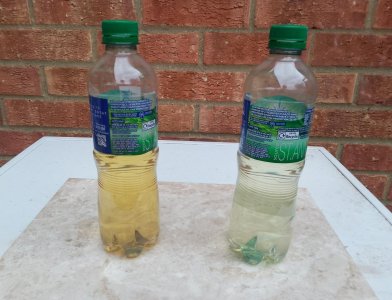
When my tank of last years petrol evaporated it left a thick soft wax in the bottom, so I assume that is what blocks jets in the carburettors. Problem also you can't now just take off the carburettor bowl and take out the jet in some small outboards without it going into a workshop and taking the petrol tank off - and looking at video there are lots of fiddly bits to be undone - so not a task for doing in lumpy water off the river mouth - gone are the days that you had a little box of spare jets and it was a couple of minutes to change -

Refueller will be able to tell us soon hopefully if any modern petrol will wax in this way, or indeed whether the Honda or Mercury stabiliser makes the waxing worse.

Going electric now as the electric motor just starts when we want it.
 
Last edited:
I've near given up trying to describe or ilustrate ... but ...

ALL gasolines will wax when evaporated off .. its called Gums ... and its tested for in every blend ... there are limits specified in all blends. The amount may vary with the grade - but the test time to Gum is fairly constant across them.

Evolution of engines is often not tied to fuel developments - that is the biggest issue. When Diesel reduced to Ultra Low Sulphur ... it took time for manufacturers to adjust ... remember Mercedes advising against ULSD for ages, various others were slow to adjust to Unleaded gasoline ... but they were wasting their time ... ULSD / Unleaded was here and that was the standard.
I honestly feel that engine manufacturers forget that the engines are not run every day ... but this is one of the reasons I always advise to run the carb as dry as possible when stopping the motor.... not to use the stop button unless its a short stop.

Stabilisers - I never use them .. never tested them ... I cannot comment on their form or results.
 
Top