
Forepeak condensation and remediation plan

bitbaltic

Well-Known Member
Joined
21 Nov 2011
Messages
2,698
Location
Boat in Milford Haven
sailingkarisma.wordpress.com
Ten years ago, when I bought my boat, I noticed that there were a couple of damp patches in a veneered panel which lines the port side of the forecabin. It looked like either a very, very slow leak or the effects of condensation, and looked like it had been slowly getting worse over the lifetime of the boat (10 years old at the time). I've investigated in the past (and re-checked occasionally) that the damp is not the result of a deck leak by liberally hosing the deck and feeling with my hand up above the wooden panel where it's possible to reach deck bolts and the nuts holding on the pulpit. I've also had a good look using a boroscope. There's no water ingress and i'm certain that this damage is not a leak from the deck/hull joint or any through-deck fittings, and that it is condensation. Nevertheless, it's been slowly getting worse over the last 10 years and now is the time to do something about it. Picture:
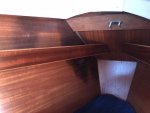

IMG_3023.JPEG

I took this on Saturday morning after my wife and daughter slept in the cabin and you can see the odd drop of condensation running down the outside of the panels. The white headliner is a solid GRP panel which is very difficult to remove but you can get your hand between it and the veneered panel and reach the deckhead and through fittings. All were very wet with condensation after two had slept in the cabin on a dry night.

I think the condensation is soaking through the wood because it's touching the hull in these areas (which of course it shouldn't be), so the water is wicking through. Something like this:
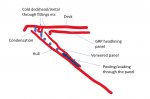
condensation.jpg
In an ideal world I would remove and replace the entire panel (both sides to match), making sure the new ones are kept off the cold hull. But this is impossible. Getting these panels out on a Hanse 301 looks to be very difficult, probably requiring removal of the GRP headliner which in itself might require removal of the forepeak hatch.

So my intention is to carefully drill a few holes through the panel in the area where the damp is worst and cover them with a vent:
IMG_3023a.JPEG
Hopefully the vent will allow the condensation to dry out and, once the wood has dried later this summer I will line the whole berth with bulkhead carpet (which my wife is very keen on as she hates the cold sides of the berth).

I havent done anything like this before and I want to do it right first time so I thought before acting I'd optimise via the forum hive mind. Will a vent work? Will it need multiple vents? Should I put something like a plastic membrane over the panel before carpeting? or is it just a case of try it and see....??
 
If it is condensation, which I would have expected identical patch on starboard side , get them to sleep with open hatch to prevent it.
I would 100% want to guarantee its not a leak before drilling any holes
Could it not be tracking along from chain locker .
 
As I am not on your boat I can only go by what you write and the pictures.
But the hosing from above does not satisfy me that it is not a leak. It only points to that it does not leak where you could feel for it.

On a boat water can come from anywhere. Well, mostly from above but the water in the panel can come from below. Maybe even from the very bottom of the panel but only showing itself at the top of the panel. (I have experienced something similar in my cold molded plywood/epoxy boat)
Maybe it is indeed a leak in the chain locker or similar.

As for treatment, I do not know if it is feasible but i'd consider sanding bare and applying vacuum plus a little heat over the wet area, as a copy of the osmosis treatment for quick drying of polyester.
 
I comment not knowing the construction detail. Are not Hanse built with foam above the waterline - reducing the potential for condensation as high up as indicated in your photo.

What on earth is that fitting on the first image that looks like a large 'U' bolt specially installed to pierce the skull of anyone tidying up the forepeak?

I assume the space forward of the forepeak is the anchor locker. I would check that - do the drain holes actually drain - but I'd also check the 'condensation' if its condensation it should be fresh water - if its from bashing into seas or poorly draining locker I'd expect the water to be salt.

I'd do the salt test first - if its salt you don't, necessarily, need ventilation but further investigation (though ventilation is never a bad thing - unless it leads to other issues).

There seems to be some discolouration aft of the main 'dark' patch - as if there are two independent sources (of the same mechanism?) - but that might simply be a photo effect (or 2 stanchion bases).


It would be odd if your Hanse was unique - is there an owners forum has anyone else reported same?

You have made the comment you want to do it once and get it right first time - I'd check and double check your conclusions before I do anything else. Its an exceptionally large and focussed location and area to be condensation. Currently my money is on a leak at the toe rail or a stanchion base (which may only occur when you sail and bash into seas, not evident from a hosepipe) or a poorly installed bulkhead forming the rear of the anchor locker. The toe rail is usually the interface of hull and deck any slight movement through actual sailing may exacerbate a leak not evident when sitting idle. We had a leak from a stanchion base that only occurred at sea but was masked as we thought it was a leak from the head.

Jonathan
 
whether that is a leak or condensation, I would install extra ventilation in their anyway. I would suggest even that overhead hatch locked on vent might only just be enough. When not in use the air needs to blow though the yacht in each cabin like a draft, so big vents in the companion and aft cabin as well. Also always tie the doors back open when the yacht is not in use. Alternatively close up everything and use a de humidifier in the (uk) winter.

When the aft cabin is in use then ventilation is still necessary. I found leaving the hatch on vent still leaked when it rained and at sea it had to be closed anyway, hence why I installed vents that do not let the water into the cabin.

I agree with above comment, just using a hose pipe does not find all the leaks. When I had leaks on my yacht the water somehow worked its way through the deck hull/deck join when the yacht was in motion.

btw, some sealants/adhesives have a stated design life of 25 years. So any time after that one can start to have a risk of adhesion failure. As an aside the reason for the failure of some of my yacht’s sealant/adhesives was because when overflowing diesel from when filling ran down to the side and transom deck/hull joint area and rotted the adhesive. The replacement adhesive is resistant to diesel.
 
Please share :)

(unless it involves something about which the Mods might object - politics, sex, race....?

Jonathan
Well there is a choice.
I removed and replaced the top and bottom forward bulkheads (where the u bolt ends are sticking out) The two longitudinal shelves have to be removed first. They are held in with two screws at the back and sikaflex on the join to the side panel. The bulkhead bottom is just sikaflexed in place. You may have to destroy the top piece to remove it!
The side panels could be stripped back to bare wood with a scraper dried through and sanded and refinished with spray laquer from toolstation.
That's what I did. It's very hard work and you still won't stop future damp.

You could carry on stripping out the entire cabin furniture the two cupboards on each side in the bow (a couple of screws and cut a line in the sika) maybe a but harder on starboard side because of water filler pipe.

This will then give you access to the lining to strip it completely out and you then can organise proper insulation behind it before rebuilding.

Alternatively cut it off following the vertical line of each cupboard leaving an edge for a nice new lining to get fitted with a layer of silver bubble foil insulation behind it and the hull.

I found that despite refinishing the damp had darkened the wood veneer such that despite trying oxalic acid it looked gloomy. I spray painted warm white above the shelves where the gloom was worst.

I would love to post a picture but the forum size policy just really pishes me off.

So you don't get to see the finished result of my work to improve the shagatorium on our Hanse!

I can of course send that on what's app to Huw.
 
looks like you have a few leaks. If you cannot remove the panels maybe drill lots of holes and then use slightly raised battens. They look better than plywood anyway. No substitute for doing it properly though. Boats are a pain in the whatsits.
 
Does sound as though there is a case for a small dehumidifier in that cabin- plus some good air circulation. Do you think there might be a possibility of water though the hawse pipe if no cover over the entrance. If you already have a wind generator fitted it could be useful for power the former item whilst away from the boat. although not perfect you can buy cheaply some dehumidifier cartons that collect the dampness, and easily disposable in recycling when drained. Ours last about two weeks then renewed( about £1.50per carton.) -drain the water before recycling them.
 
If the cause is condensation then it needs sorting properly or the wood finish will continue to deteriate. If it's a leak it also needs dealing with. As suggested strip the wood out. Fitting a vent may actually increase condensation problem. Condensation occurs when you allow humid air to make contact with a cool surface. Fitting a vent will allow more humid cabin air in contact with the cold hull.
My money is on a leak. Most AWB have the deck to hull joint riveted and Sikaflexed together. The torail then bolts through the joint. Lots of AWBs get leaks here as the hull to deck is not monocoque construction. It relies on goop in the joint to keep water out. It could also be a bolt hole through the toerail that is weeping. Good luck sorting it
 
Thanks for the input folks. Steve (TSB240) and I have conferred and with our joint experience of the Hanse 301 we are confident that this is condensation and not a leak, as per the OP.

Stripping out the forepeak joinery, properly insulating the hull and refitting is the proper thing to do, but this is not something i'm going to try at the start of the season. Reducing the air gap above the side panels (below the toe rail) with some insulation will be the first stop, to see what effect that has, and probably an attempt to dry out the wood - I like SvenH's idea of applying some heat. The finish of the wood wont be recoverable and in the long term it must be either replaced or covered over, so I will see what effect the insulation has over the season - and try to persuade the wife to sleep with the forepeak hatch cracked open for a little ventilation....
 
Thanks for the input folks. Steve (TSB240) and I have conferred and with our joint experience of the Hanse 301 we are confident that this is condensation and not a leak, as per the OP.

Stripping out the forepeak joinery, properly insulating the hull and refitting is the proper thing to do, but this is not something i'm going to try at the start of the season. Reducing the air gap above the side panels (below the toe rail) with some insulation will be the first stop, to see what effect that has, and probably an attempt to dry out the wood - I like SvenH's idea of applying some heat. The finish of the wood wont be recoverable and in the long term it must be either replaced or covered over, so I will see what effect the insulation has over the season - and try to persuade the wife to sleep with the forepeak hatch cracked open for a little ventilation....
When you insulate the hull ensure you seal the edges of the insulation and any joints to stop damp air getting through to the hull. Closed cell foam works well with high temperature contact adhesive.
Just as an observation, we don't get a condensation problem as our hull and deck are foam core construction. We do get dripping off aluminium deck hatches, chainplates and portlights. Heat and ventilation is the answer when living aboard
 
Top