

bitbaltic
Well-Known Member
Ten years ago, when I bought my boat, I noticed that there were a couple of damp patches in a veneered panel which lines the port side of the forecabin. It looked like either a very, very slow leak or the effects of condensation, and looked like it had been slowly getting worse over the lifetime of the boat (10 years old at the time). I've investigated in the past (and re-checked occasionally) that the damp is not the result of a deck leak by liberally hosing the deck and feeling with my hand up above the wooden panel where it's possible to reach deck bolts and the nuts holding on the pulpit. I've also had a good look using a boroscope. There's no water ingress and i'm certain that this damage is not a leak from the deck/hull joint or any through-deck fittings, and that it is condensation. Nevertheless, it's been slowly getting worse over the last 10 years and now is the time to do something about it. Picture:
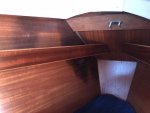
I took this on Saturday morning after my wife and daughter slept in the cabin and you can see the odd drop of condensation running down the outside of the panels. The white headliner is a solid GRP panel which is very difficult to remove but you can get your hand between it and the veneered panel and reach the deckhead and through fittings. All were very wet with condensation after two had slept in the cabin on a dry night.
I think the condensation is soaking through the wood because it's touching the hull in these areas (which of course it shouldn't be), so the water is wicking through. Something like this:
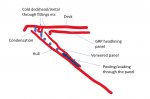
In an ideal world I would remove and replace the entire panel (both sides to match), making sure the new ones are kept off the cold hull. But this is impossible. Getting these panels out on a Hanse 301 looks to be very difficult, probably requiring removal of the GRP headliner which in itself might require removal of the forepeak hatch.
So my intention is to carefully drill a few holes through the panel in the area where the damp is worst and cover them with a vent:

Hopefully the vent will allow the condensation to dry out and, once the wood has dried later this summer I will line the whole berth with bulkhead carpet (which my wife is very keen on as she hates the cold sides of the berth).
I havent done anything like this before and I want to do it right first time so I thought before acting I'd optimise via the forum hive mind. Will a vent work? Will it need multiple vents? Should I put something like a plastic membrane over the panel before carpeting? or is it just a case of try it and see....??
I took this on Saturday morning after my wife and daughter slept in the cabin and you can see the odd drop of condensation running down the outside of the panels. The white headliner is a solid GRP panel which is very difficult to remove but you can get your hand between it and the veneered panel and reach the deckhead and through fittings. All were very wet with condensation after two had slept in the cabin on a dry night.
I think the condensation is soaking through the wood because it's touching the hull in these areas (which of course it shouldn't be), so the water is wicking through. Something like this:
In an ideal world I would remove and replace the entire panel (both sides to match), making sure the new ones are kept off the cold hull. But this is impossible. Getting these panels out on a Hanse 301 looks to be very difficult, probably requiring removal of the GRP headliner which in itself might require removal of the forepeak hatch.
So my intention is to carefully drill a few holes through the panel in the area where the damp is worst and cover them with a vent:
Hopefully the vent will allow the condensation to dry out and, once the wood has dried later this summer I will line the whole berth with bulkhead carpet (which my wife is very keen on as she hates the cold sides of the berth).
I havent done anything like this before and I want to do it right first time so I thought before acting I'd optimise via the forum hive mind. Will a vent work? Will it need multiple vents? Should I put something like a plastic membrane over the panel before carpeting? or is it just a case of try it and see....??


