Flopper Stopper

Poey50
In a sense, you are right, but all that is necessary is that the stopper plate falls faster than the downward speed of the boom end, or whatever the stopper is attached to and that is dependent on the rolling rate of the yacht. I think a steel plate probably would. Hence the words "would sink fast enough".

Now for the positive comment. I have just found that YM did a review of flopper stoppers in May 2015. When they looked at home made flopper stoppers, there first finding was that the one they tried was not heavy enough. (as above) Secondly, they seemed to prefer triangles with angles more like 130deg, and 2* 25deg, with the dive weight near the 130deg angle.

There is obviously a relationship between the dive angle, the height of the triangle and the amount of slack that needs to be taken up in the loose ropes before the plate become flat on the upward roll of the yacht. So the greater the height of the triangle, the more it needs to move before all the ropes snatch tight. Going for a triangle with a great height may increase dive angle and hopefully the overall sink rate of the board, but I certainly know that my maths will not find the best compromise in the two situations of the diving rate and the start of the upward roll.

The reason I tried an equilateral triangle, was simply that was the size of the scrap wood I had handy for a first attempt.
 
Taking the idea to a logical, if not wholly practical extreme, I suppose a folding 'ama' would be the ultimate solution...

...heavy enough to discourage the opposite roll of the yacht, and buoyant enough to stay afloat when pressed the other way...

...perhaps a pair of strapped-together water-pipes, one filled, just below the waterline, the other above, sealed empty, for buoyancy...

...a couple of very robust gudgeons at the waterline, and two more at the gunwale...a spar from each gudgeon, keeping the ama in position on the waterline (plus another spar, diagonally, to give the hinged structure rigidity...

...every centimeter of empty 250mm diameter pipe would provide nearly half a kilo of buoyancy. So even a two-metre pipe would provide 100kg of buoyancy to defy roll.

Not saying I'm planning to, but it could be done. Might seem very attractive after several days moored or anchored in open water.
 
...heavy enough to discourage the opposite roll of the yacht, and buoyant enough to stay afloat when pressed the other way....

To my way of thinking, Dan, (and I've watched flopper stoppers work (and not work) quite a lot), weight has no bearing in discouraging rolls except in forcing the stopper to sink ready for the next roll. Water resistance is all that matters. Similarly, a floating stopper on the lee side cannot work (except in the unlikely event of it's being attached to the boat by a rigid column).

But I'm wide-open to discussion.
 
...a floating stopper on the lee side cannot work (except in the unlikely event of it's being attached to the boat by a rigid column).

Hmm. I don't deny, I haven't given it more thought than came to mind as I was typing last night.

But I was envisaging gudgeons at the waterline, attaching two horizontal spars which would hold the combined float/ballast pipes about two meters from the yacht's side...

...while two further gudgeons on the gunwale above, would secure slightly longer spars to keep the float/ballast pipes permanently level with the yacht's design waterline...

...and a fifth spar would run from, e.g. the forward end of the float, to the rear upper gudgeon, preventing the whole assembly from pivoting on its pins.

So, the yacht would have to heave 100kg of weight (two meters outside its gunwale) out of the water, to heel in one direction...

...and would likewise have to submerge 1000N (about 100kg) of buoyancy, to roll the other way.

Not saying that would necessarily be enough, but it could be scaled up to match the size of yacht. I understood that a full bucket (12 litres?) suspended from the end of the boom, held out at a right angle, applies enough torque to discourage opposite roll in a small yacht. If the boom (or carefully designed equivalent) could also apply buoyancy at that distance from the hull, mightn't it equally discourage the return roll?

If one pipe were a slightly larger diameter, and both had detachable sealing ends, the pipes could telescope neatly for storage and the support-spars could fit inside the inner pipe. As long as yachtsmen don't mind looking vaguely like chimney sweeps, it might be a popular new system. "I got a grrreat way ta stop ya boat rollin', Mary Poppins!" :)

latest
 
If I was going to design some flopper stoppers I would go for thonthing like this

Seite%2015%20neu%20stabilisator%20open.jpg


I would make the frome from aluminium or stainless steel angle bolted together at the cormes using eye bolts for line attachment points.

There would be 2 flaps as shown from stiff rubber (conveyor belting) as the flaps with crass braced to stop the rubber from going down too far.

As this is all bolted together its easy to dismantle and store, the largest single iten being the rubber floppers.

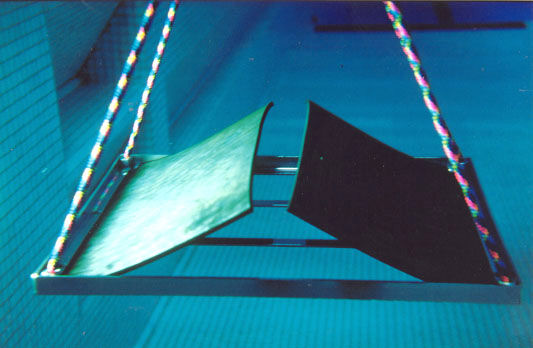
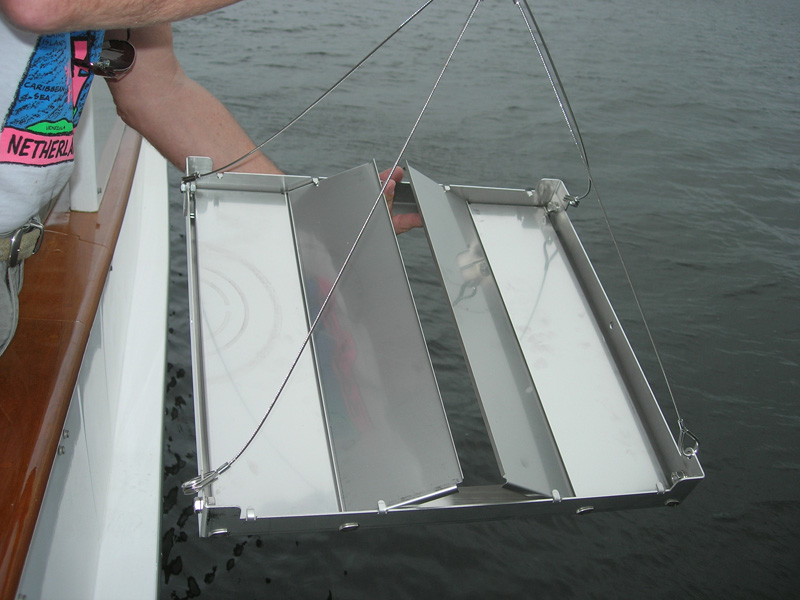
2 other similar types

IMGP0657-flop.jpg


Flopstop.jpg
 
Last edited by a moderator:
That refers to a drogue "type". I was thinking about an actual drogue - one less item to carry. I guess one each side, spinny pole and main boom might be better.

It was an actual drogue, although not something robust enough to be used as a sea anchor. It happened to be on board the boat when I bought her, filed under "might come in useful one day" and half forgotten about. Diameter about 1.5m. As said, I first deployed it anchored in swell off St Kilda...the rhythmic rolling was so awful, I had to try something. With maybe 15kg of chain hanging off the bottom, it absolutely killed the rolling -- the drogue pulsing like a giant orange jellyfish with each wave. The one other yacht at anchor, a Rassy, was still going apesh*t in the morning. We'd had a grand night's kip.

It's worth restating: the dynamics and drogue effectiveness in swell are completely different from those in local wind waves, which in my experience are generally more challenging. What works in one quite likely won't work in the other. On the other hand nothing, but nothing, is quite so horrible as the rhythmic rolls, which I've only experienced in swell.
 
We use an equilateral triangle of aluminium chequerplate (had some in stock) 1 metre to a side with my spare 2kg pearshaped anode bolted as close to the corner as possible. Very effective when attached to the extreme end of the boom, and out at 90 degrees. Reducing the distance outboard diminishes the efficiency considerably.
 
This is the type with a hinge in the middle.
afd2b0e1-5573-4685-89a6-98ae967514e9_1.19dd6582f8b2fb70727541d31da8c935.jpeg
Our motorboat came to us with a flopper stopper outrigger on the port side and that exact model of hinged plate. When the swell is coming from the port side it is miraculous. It turned an untenable anchorage in the South Haven of Skomer Island into a peaceful night's sleep. When the swell comes from the starboard side it is less effective because the boat can roll away from the swell with no resistance from the flopper stopper which only does its job when the boat rolls back. The conventional wisdom is that one flopper stopper is about 70% as effective as two, but I think that is assuming you can always deploy it on the side the swell is coming from. On a yacht you would hang the flopper stopper off the boom, and deploy it on the side the swell is coming from, in which case one will be all you need.
 
"all that is necessary is that the stopper plate falls faster than the downward speed of the boom end, or whatever the stopper is attached to"

Impossible - the flopper stopper is attached to the boom by a rope and so cannot go downwards faster than the boom.
 
"all that is necessary is that the stopper plate falls faster than the downward speed of the boom end, or whatever the stopper is attached to"

Impossible - the flopper stopper is attached to the boom by a rope and so cannot go downwards faster than the boom.

That's obviously right, although I think I know what the writer means. In an ideal world, the plate/drogue or whatever would fall at the same speed as the connection point to the boom. In practice, there's a bit of a hiatus as the stopper reaches max height (and before a plate can go into a diving angle, which it clearly can't do if all three lines are tight), putting slack into the connection, and then the stopper can fall faster than the boom. Again, not only the stopper's design but the wave period is fundamental in determining whether this can actually happen. In a short chop, it probably won't.
 
Last edited:
Top