Martin&Rene
Well-Known Member
Poey50
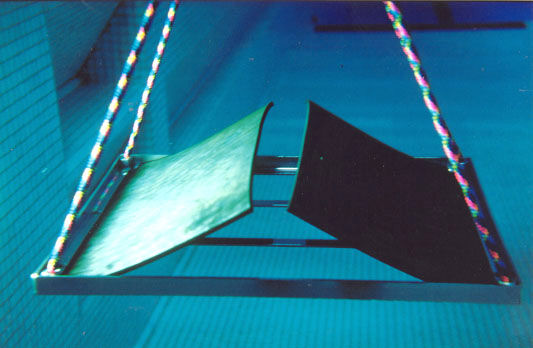
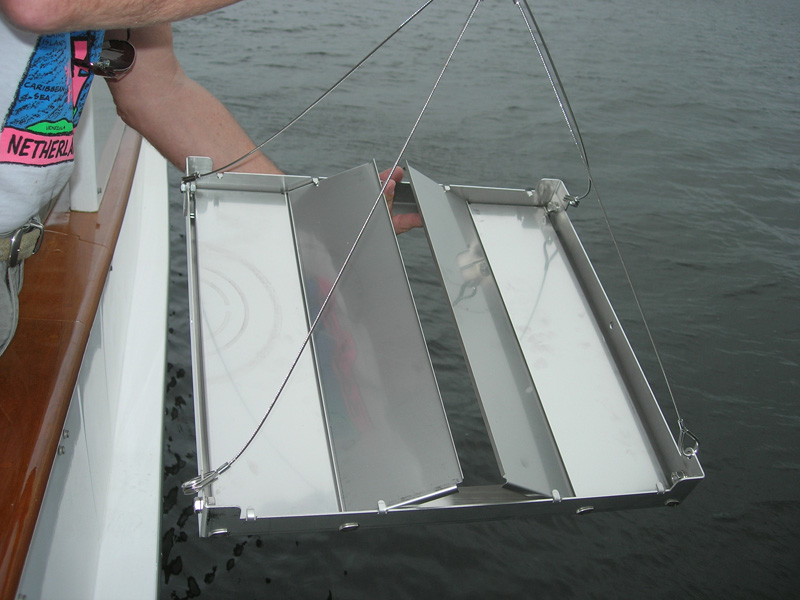
In a sense, you are right, but all that is necessary is that the stopper plate falls faster than the downward speed of the boom end, or whatever the stopper is attached to and that is dependent on the rolling rate of the yacht. I think a steel plate probably would. Hence the words "would sink fast enough".
Now for the positive comment. I have just found that YM did a review of flopper stoppers in May 2015. When they looked at home made flopper stoppers, there first finding was that the one they tried was not heavy enough. (as above) Secondly, they seemed to prefer triangles with angles more like 130deg, and 2* 25deg, with the dive weight near the 130deg angle.
There is obviously a relationship between the dive angle, the height of the triangle and the amount of slack that needs to be taken up in the loose ropes before the plate become flat on the upward roll of the yacht. So the greater the height of the triangle, the more it needs to move before all the ropes snatch tight. Going for a triangle with a great height may increase dive angle and hopefully the overall sink rate of the board, but I certainly know that my maths will not find the best compromise in the two situations of the diving rate and the start of the upward roll.
The reason I tried an equilateral triangle, was simply that was the size of the scrap wood I had handy for a first attempt.
In a sense, you are right, but all that is necessary is that the stopper plate falls faster than the downward speed of the boom end, or whatever the stopper is attached to and that is dependent on the rolling rate of the yacht. I think a steel plate probably would. Hence the words "would sink fast enough".
Now for the positive comment. I have just found that YM did a review of flopper stoppers in May 2015. When they looked at home made flopper stoppers, there first finding was that the one they tried was not heavy enough. (as above) Secondly, they seemed to prefer triangles with angles more like 130deg, and 2* 25deg, with the dive weight near the 130deg angle.
There is obviously a relationship between the dive angle, the height of the triangle and the amount of slack that needs to be taken up in the loose ropes before the plate become flat on the upward roll of the yacht. So the greater the height of the triangle, the more it needs to move before all the ropes snatch tight. Going for a triangle with a great height may increase dive angle and hopefully the overall sink rate of the board, but I certainly know that my maths will not find the best compromise in the two situations of the diving rate and the start of the upward roll.
The reason I tried an equilateral triangle, was simply that was the size of the scrap wood I had handy for a first attempt.