Flooring a Redcrest

Quandary

Well-Known Member
Joined
20 Mar 2008
Messages
8,214
Location
Argyll
Visit site
My wife is starting to find getting back on board from our 45 yearold Avon more difficult, I suspect that the problem is exacerbated by the movement in the floor when she tries to step out on to the transom step, I think a firmer floor would help mobility and give her confidence.
I have a sheet of 6mm wbp ply doing nothing so thought I might have a go at making a floor. The dinghy is carried hung one side down across the transom and needs to stay light enough to lift into position there. I propose to cut the floor in two pieces joining with rebated tongues beneath the inflatable seat.
Some of you must have done this so any comments welcome ( I know I should be using Robbins super expensive marine plywood). I you have a a floor in a dinghy how tight does it have to fit round the edges, a bit of tolerance, say 25mm. would obviously make it easier to get it in to position and out but is that a bad idea? Would a tighter fit be more rigid? While we have a 2.5hp outboard and a bracket I tend to row everywhere so the outboard is not used a lot though a floor might make it easier to fit and remove. My idea is to coat the ply in epoxy with some grit or beads on the top surface. It only has to last a couple of seasons, three if I am lucky.
 
This was covered recently in another thread ... but no problem .. here is the floor that I have for my Avon. But its heavy !!

HN2o6lIm.jpg


Note that the width is same as the wood slat that is supplied as folding floor. It does not need to get into the ends of the donghy - but you do need to have it fit into the sides similar to the slats. You should not leave any gap at sides as this will then strain and could lead to floor failure when being dragged up beach etc. The bottom material will sag where floor is creating an edge.
To fit my floor - it needs to be placed in before inflating dinghy. As you then inflate - the sides need to be eased to ensure floor is sited properly.
I have no need for any tongues and the two pieces butt each other only. The inflation and sides gripping the floor are all that's needed. You can see that location is also set by the two holes in each that the inflatable seat toggles fix through.

My floor is well over 20yrs old and is good quality WBP with paint finish ... I have never repainted or touched it up. The dinghy was bought 2nd hand with the floor all those years ago.
I've just measured and its 21mm thick ! It really adds serious weight to the whole ... such that two people have difficulty lifting it. In fact last time we tried - one of the side sling ropes parted. If I was to make replacement - then I would consider 12mm.
But with regard to use and engine ... I have a little 3hp Mariner start and go ... that pushes it along nicely. Getting in and out of the dinghy is stable without floor moving / flexing.

The original slats are 10mm thick. I know when I use the slats - at 10mm they do bend and flex but as long as boat is in water and fully supported - are ok.

IMHO - 6mm may be a bit on the thin side - but if used - will definitely need to fit into sides properly to have support.

If you need full measurements - I will try find the sketch I made for another guy some time ago.
 
I made a floor for a avon r340 with half inch WPB, 10mm would do just as well, 6mm is quite skinny but if neither of you are giants and you only stand in it afloat it may survive; it was stamped BS1088 but that's mostly lies these days so I'd just try and buy from a decent timber merchant. As Refueler suggests there's no need to go into the ends, although if you motor a lot extending into the stern helps stiffen things up. if you made up a template from cardboard or hardboard that might help and once down to size and test-fitted sand the edges round or chamfer with a router to prevent chafe.

A floor does make a big difference!
 
Yep ... bow and stern are not essential - but if you do go into the stern all way - as P says - it will help stiffen the stern.

But you do need to go fully into the sides ... I cannot stress that enough.
 
I had a Redcrest with an Avon floor years ago and before I sold it I made a copy in wbp ply to the same design with three boards joined by a spine in the rear and a single board under the seat. I'll try to post a photo tomorrow. The plywood is 3/8 inches thick. The dinghy with floor in is very heavy. There's still a problem with water in the dinghy as it ends up on top of the plywood and makes your feet wet. I have had some success putting swimming noodles under it. An Aerodeck inflatable floor is better. I had one in my last Redcrest and wish I had never sold it.
The fit has to be quite tight into the side hinge tapes but although it goes right under the rear tubes it stops about a foot past the mid seat.
Sea Hawk may be through the canal going out next week and if I am I'll look for you.
 
Last year, I was given & fitted a manufacturers ply floor to my Redcrest & then took it out ,as I found it better without.I had a Redstart between 1959 & 1968 & the floor was similar, so It was not the way it was made that was the issue. It just felt awkward & added unnecessary weight.
 
Because of the weight factor along with where to stow the massivle overspec'd floor. I ended up leaving the dinghy fully rigged all time. This then led to flooded when it rained .. increasingly grotty underside from growth ... mold developing under the floor ... and last of all - it had to be towed ....

Despite my dislike of the slats floor .... I intend to resume using that as its far easier to deal with ... all I need to do is get hold of new Ply and replace the broken slats.......
One modification I may make - pal of mine did this :

The original slat floor has loose ply slats in the Hypalon pockets. This lets them slide when being fitted, can be a pain ! My mate took the slats and used packaging strap - that really strong stuff that gets put round the boxes with fridges etc. He created folding slats with that ... 4 runs of it pinned to each slat in an over - under config. This meant that water was not trapped by the original slat material .. the slats were fixed in correct position to each other etc. He reckoned it would be better if more straps were used - to support the ply against standing on ... but it worked.
 
My Avon has one item I really need to fix .... the painter eye has torn away from the dinghy leaving an awful rough glue patch that I have tried everything to clean up so I can attach a new painter arrangement ....

Why did it pull away ? I tried dragging my dinghy up a steep grass slope at home from my channel with that heavy floor in ...
 
You need the Scuttlebut solution not the PBO one - buy a new one with air deck, massively better. If it keeps her sailing it will be more than worth it.
Absolutely agree.

At 45years old, are you just keeping the old Avon for sentimental reasons rather than accepting technology has moved on in that time. I also have an Airdeck (Seago 270) which is light, hard wearing and so stable. Big tubes also make a massive difference. You are more than welcome to see ours next time we're up.
 
I made a floor for a avon r340 with half inch WPB, 10mm would do just as well, 6mm is quite skinny but if neither of you are giants and you only stand in it afloat it may survive; it was stamped BS1088 but that's mostly lies these days so I'd just try and buy from a decent timber merchant. As Refueler suggests there's no need to go into the ends, although if you motor a lot extending into the stern helps stiffen things up. if you made up a template from cardboard or hardboard that might help and once down to size and test-fitted sand the edges round or chamfer with a router to prevent chafe.

A floor does make a big difference!
The OP could use his sheet of 6mm to make the template, and then make the floor out of sterner stuff.
 
Thanks guys, I accept the point about a tight fit along the sides and reject the advice to replace it.
If it is not stiff enough, I have plenty of mat and it would be an easy task to add a couple of ribs where it bends, if weight precludes carrying the dinghy across the stern I will abandon the idea, there is no way I would become patient enough to either deflate or tow a dinghy, it has been infllated since we moved here 15 years ago, in winter it lives upside down in our trailer.
A product that has performed its task since 1974 deserves some loyalty, it might reach 50 years, it has a better chance than I have.
 
Good for you ... I've had some ask me why I keep mine when they see how many patches on bottom ... and like you - my reply is that its provided loyal excellent service - so why should I replace it ? And it will continue to do so.

As to weight .... it will be heavy, no way round that I'm afraid.
 
Bought my Redcrest in 1968 & 2 weks ago it was still doing sterling work. The Seagull 40 Plus stayed in the garage though as I really did not want the hassle for a 200 yd row. Must get it out sometime though. It is in excellent condition with the original oars. I always keep it partially, or fully inflated, in the garage roof unless in use. Rarely deflate & fold it.
 
I do have different oars though ... mine are slightly longer and one piece standard wood oars from a hard dinghy. I was very glad of them one time in Yarmouth IoW when it was storm and we had to get from boat to shore (we were on the outer pontoon). The extra length of the oars made sure they dug in ...
 
You might find that a rectangle of ply you just drop in before dinghying away will do all you need.
Exactly my thought. Anyone tried this? I have a wooden floor in a Zodiac 260 and it almost doubles the weight making single-handed anything a pain. I had thought of just that - a large piece of ply with rounded off edges and radiused corners which sits about 6 inches in from each edge and fitted loose. Lift out when carrying ashore or lifting aboard. Also allows partial deflation for those of us challenged for deck space. Current boards are 10mm and plenty strong enough.
 
My wife is starting to find getting back on board from our 45 yearold Avon more difficult, I suspect that the problem is exacerbated by the movement in the floor when she tries to step out on to the transom step, I think a firmer floor would help mobility and give her confidence....
Thanks guys, I accept the point about a tight fit along the sides and reject the advice to replace it....

Being a luddite will not help your wife or your future sailing prospects. :rolleyes:
 
Exactly my thought. Anyone tried this? I have a wooden floor in a Zodiac 260 and it almost doubles the weight making single-handed anything a pain. I had thought of just that - a large piece of ply with rounded off edges and radiused corners which sits about 6 inches in from each edge and fitted loose. Lift out when carrying ashore or lifting aboard. Also allows partial deflation for those of us challenged for deck space. Current boards are 10mm and plenty strong enough.

I strongly advise NOT to have board not reach the sides .... there's good reason for this.

If you have the board less width than the material floor ... you create a stress edge along that board edge with wear and tear increased along it underneath. The board will make the material hang lower and when you drag dinghy up the beach or slip .. that edge will be your eventual failure.

Having the board out to the sides as the slats do - keeps the material floor tensioned and without that potential failure line each side.

Think of it like a piece of cloth held between your hands. Place a piece of board in the cloth that does not reach the edges and hold it up ... see it sag and the board edge creating the failure points ? Now get a board that reaches cloth edges and you now hold cloth and board with hands .. significant difference with no sagging edge line to fail.
 
Quandary,
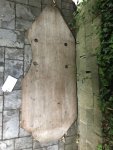
I have a fine 12mm plywood floor which came with a very fine Avon I bought last week in Lochgoilhead. But fear that the dinghy is the smaller one than the mighty Redcrest. The dinghy is now in Argyll poised ready for its holidays but the floor is here at home. I have just measured the floor and it is (in new money) 189 cm long and 81 cm wide, 12mm thick. But as other posters have pointed out it may still provide some stability I have attached a photograph which also shows what looks like a bite which has been taken out of its port side, fortunately the dinghy seems to have survived this, just shows how robust avons are.

If you are interested, then a small varnished yacht will be passing your house on Sunday as part of the Tobermory race, and the owner was agreed to take said floor as deck cargo as far as your abode. I hope Scottish Canals do not charge yachts for deck cargo ;-(

Do you know of any good canal pilots:-)
 

Attachments

  • Avon dinghy floor.jpg
    Avon dinghy floor.jpg
    83.1 KB · Views: 12
Top