Fitting EGT probes+gauges to diesel (MAN) engines

To answer your questions MapisM:- You may be correct with regard to the instrument origins. I merely mentioned this option to give you more choice, it was one I stumbled over when looking to replace my existing aircraft gauges which are too large for the helm panel. I also needed an adjustable alarm point output contact, and therefore I thought the Cruzpro delivered. Not being a dual application gauge (space limitation) the jury is still out.
I seem to remember the engine manufacturer specifies the point at which one measures the EGT in the exhaust tract and the corresponding full load temperature. Further down stream and inertial influances cick in. Debated above! One can find this design location difficult for a retrofit but once you find this max. value, under ideal conditions then wherever the sensor is located, all you need to be aware of is changes to temperature outside your preset limits. I'm sure this is your thinking.
You may have already stumble over the proprietary EGT alarm only. One single and the other dual engine.
I personally now like the idea of hi/lo temp. sets because if the hardware cannot be mounted at the helm then the audio alarm output contact is more than adequate, given the fact that early boats don't even enjoy this feature.
No, sorry, no personal experience of either components. In hindsight perhaps my contribution here is an error, the topic is at present causing consternations, so I couldn't resist offering you what help I could!!!! Good luck.
 
Last edited:
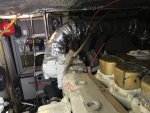
Mine 2876 I6 s are before the turbo where the exhaust just enters .
The sensors nowadays can cope .

Its out of shot underneath where the dotted red is .
6E2C00BF-D9A7-47E6-8B19-EBDC07E5454C.jpeg

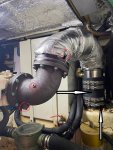
There should be threaded inspection ports on the other side , in the dry elbow if you are unable to locate a way in before .
See red circles all in the dry .The water IN elbow is next to that fuel tank .
I guess theses are inspection ports and pyro probe ports for surveillance if necessary??
Or just good engineering practice ?
44399F72-5990-4635-AFD9-BF08E27ACBBE.jpeg
Ignore the arrows .^^^ .Heat jacket removed too .

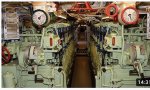
WW 2 MANs in u boat ……note the EGT gauges high lighted in blue .One per cylinder and one overall ave .
96C1E898-8477-44CC-98D5-1BBBDBBAA387.jpeg
108 L , circa 1400 Hp inline 6 s ^^^ .
 
Last edited:
Have you decided where the probes will be located?
To my knowledge, all V engines have a threaded port right before the flange where the boat-specific part of the exhaust is attached.
It's the one in the red circle below.
The smaller one on the s/steel pipe is an equally good alternative, but you might have that or not depending on how the boat exhaust was fabricated, while all the white painted parts exist in any MAN V engines (one for each bank, obviously).

Just for the records, in the meantime I decided to NOT fit probes+gauges on my engines.
Reason being that after 4 seasons with them, during which I randomly checked the exhaust temp of each cylinder (which is something only feasible pointing an IR gun on the manifold, straight at each cylinder output), I never noticed anything unusual.

Now, leaving aside overloaded boat and dirty bottom, which could increase overall engine load and EGT but are conditions the helmsman should be aware of regardless of any instrument, the main risk that can only be spotted by EGT is a defective/leaking injector (=more and/or less nebulized fuel injected).
And for this purpose, an IR gun (even if somewhat "filtered" by the manifold metal) is much more accurate than the EGT probe, whose temperature is not cylinder-specific, because it's either a compound of 4/5/6 cylinders on V8/V10/V12+L6 engines.

OqM1pyMs_o.jpg
 
I think you would notice a leaky / faulty injector because the EGTs tend to be pretty identical/ close .
Eg 562 and 558 running .
Presume the alarm level can be preset to alert the helm if values exceed a certain point .
They can with the other sensors - alert the helm .

Bit dangerous leaning over stuff in the ER while running @1800 rpm with Mrs at the helm …..on a lot of levels !:unsure:.

It might be worth those interested in pursuing this to speak to there local MAN guy(s) .

2003 ish the MMDS , the Man Monitoring Diagnostic System was born .Coming up to 20 yrs tech wise .

Theres L / hr and load to throw into the monitoring mix too along with the EGT .So with MMDS one way or another you can get an accurate pic of a faulty injector or something else .I think that’s how it works .

But I get MapishM s point of just seeing one side of that triangle blind to the other two .
 
Last edited:
My boat is 2003 with MMDS but only the basic system.

I am currently talking to Boening who supplied the original system to MAN about upgrading to their current displays.

With their current displays the data is them available on NMEA 2000 as well.

They are asking if I currently have EGT probes and I cannot see any. Their suggestion is 1 per engine.

The port that MapisM suggested is the one that I originally thought would work so thank you for the confirmation.

I have just messaged them to see if I can have 2 EGT probes per egine, 1 per turbo.
 
Suggesting 1 per engine on any engine with 2 cylinder banks, each with its own turbo, strikes of incompetence.
Regardless, I would think it's harder to find a decent opinion (let alone actual support!) directly from Böning, rather than from a MAN dealer.
Particularly if, as I see, you're based down under.
If you already have a good MAN service supporting you on overall engine maintenance (and you really should!), I'd rather ask them.

Anyhow, I'm skeptic that an MMDS display upgrade could give you any actual benefit, aside from a nicer colour display.
Which BTW is the nightmare of all those who have it in their boat, because it randomly loses track of engine hours and must be sent to Germany (at high cost) to restore them.
But back to the point, if your ECU, which I suspect is only there to govern an injection pump that is actually mechanic, doesn't handle load and fuel burn data, you'll never get those numbers out of it.
I mean, you could still get the fuel burn in real time, but only installing separate flow sensors on fuel pipes and fitting its own instrument on the dashboard.
Floscan used to be the best supplier of these things, but I'm not sure if they are still active.
I think Maretron is the most popular alternative, but recently I had good references also for an Italian company, Naviflow.
 
  • Like
Reactions: vas
Bit dangerous leaning over stuff in the ER while running @1800 rpm with Mrs at the helm …..on a lot of levels !:unsure:.
Well, boat ownership is dangerous on many levels anyway! :ROFLMAO:
Besides, if you never tried, you should, because the sound is intoxicating! (y)
Also with good ear muffs, which are absolutely essential of course.
 
Suggesting 1 per engine on any engine with 2 cylinder banks, each with its own turbo, strikes of incompetence.
Regardless, I would think it's harder to find a decent opinion (let alone actual support!) directly from Böning, rather than from a MAN dealer.
Particularly if, as I see, you're based down under.
If you already have a good MAN service supporting you on overall engine maintenance (and you really should!), I'd rather ask them.

Anyhow, I'm skeptic that an MMDS display upgrade could give you any actual benefit, aside from a nicer colour display.
Which BTW is the nightmare of all those who have it in their boat, because it randomly loses track of engine hours and must be sent to Germany (at high cost) to restore them.
But back to the point, if your ECU, which I suspect is only there to govern an injection pump that is actually mechanic, doesn't handle load and fuel burn data, you'll never get those numbers out of it.
I mean, you could still get the fuel burn in real time, but only installing separate flow sensors on fuel pipes and fitting its own instrument on the dashboard.
Floscan used to be the best supplier of these things, but I'm not sure if they are still active.
I think Maretron is the most popular alternative, but recently I had good references also for an Italian company, Naviflow.
I read post # 28 as 4 in all one on each turbo or bank .

Thats a given in all theses threads from my POV .
 
Suggesting 1 per engine on any engine with 2 cylinder banks, each with its own turbo, strikes of incompetence.
Regardless, I would think it's harder to find a decent opinion (let alone actual support!) directly from Böning, rather than from a MAN dealer.
Particularly if, as I see, you're based down under.
If you already have a good MAN service supporting you on overall engine maintenance (and you really should!), I'd rather ask them.

Anyhow, I'm skeptic that an MMDS display upgrade could give you any actual benefit, aside from a nicer colour display.
Which BTW is the nightmare of all those who have it in their boat, because it randomly loses track of engine hours and must be sent to Germany (at high cost) to restore them.
But back to the point, if your ECU, which I suspect is only there to govern an injection pump that is actually mechanic, doesn't handle load and fuel burn data, you'll never get those numbers out of it.
I mean, you could still get the fuel burn in real time, but only installing separate flow sensors on fuel pipes and fitting its own instrument on the dashboard.
Floscan used to be the best supplier of these things, but I'm not sure if they are still active.
I think Maretron is the most popular alternative, but recently I had good references also for an Italian company, Naviflow.
Why did they do it measure EGTs on the u boats .Apart from rpm and poss temps why the emphasis on this ?

I mean let’s dissect this .
Its not as if the prop was fouled as the things never moored up like a leisure boat ?They we’re “put to work “so to speak !

Being stranded on the surface = death wish miles away from the home port .

They could open flame valves on each cylinder to see kinda the burn inside and they routinely did in a timely manor .
Bit primitive but there’s your injector health monitoring.

Under Water they would on batts anyhow .

So why the EGTs only displayed so eloquently on the mains ?

Whats going through the German engineers minds designing theses motors ?
 
I read post # 28 as 4 in all one on each turbo or bank .

Thats a given in all theses threads from my POV .
Boning wrote back and said there are two temperature slots available per unit (per engine). They suggest 1 inlet temperature and 1 EGT. I am not sure why.

Perhaps I don’t need inlet temperature.
 
I have a “ charge air temp “ delta on one of the four pages re MMDS .
I think it’s to do with clogged ie oiled up CAC or indeed older coolant dirtying that side = inefficient CAC = higher than optimal inlet temps .The sensor is on the inlet side some where of the CAC .
9E413371-D729-44E5-818D-71B2DF0B0F47.jpeg

Your original plan of a EGT per bank seems sensible.

How ever having said that and come to think about it recent V 12 MANs 1360 hps and the V8 900 had that I have test driven funnily enough have exactly the same single EGT / side as mine . One number displayed

Now mines a inline 6 it never occurred to me the twin bank thingy ? I might be mistaken ? Sure I never saw two numbers ie per bank?
How ever interns of overloading from gunning it with a fouled bottom / sterngear, with only one bank measured it achieve s the same hopefully result the operator eases back the throttles as EGT elevate north of 650 or what ever .
Its the extra heat from overloading chronically that knackers the injector tip = hosing = piston holing .
So on that basis does it really matter if only one bank is measured ?

The latest , the ones I have test driven ( at WOT ) at wet boat shows remember are Uber stuffed with further electrotwackery and probably each injector time etc is monitored by various ECUs anyhow .
So should a problem occur on the none measured bank the ECU s will throw a code and if necessary trigger limp mode or whst ever.

I know the V s have one CAC sat on top twixt the V , the inline 6 s it’s mounted on the side lateral aspects of the motor .

Coming back to electrotwackery I have mentioned this before on previous threads summer 20 i had a sensor error on one cylinder 1 .Just the sensor .No show stopper .
MMDS flagged up “ sensor error “ and alarmed @ every start up which I had to clear .But it’s stored in the memory.

Cut a long story short I saw on the franchised MAN techs lap top all sorts of stuff on bar charts , graphs , oscilloscopes etc of each independent cylinder .Opening times , fuel flow in all on one page as they were running .
Idea was to compare to base level and then compare to each other .By comparing to each other you can see if one is aberrant .
We looked both motors and overlaid the charts = identical btw .
Theses are 2003 vintage .
The reason why we did this is because I popped the “ thou shalt pull the injectors every 1000:hrs “:Question .

It was on 950;hrs .
Expecting a Kerchung “ certainly sir do you want me to quote for this work “:

I got a ” we hooking up the computer anyhow to calibrate the new sensor on injector 1 let’s go into the injector screens “:

Told me about 2000 hrs and really depends on how you use the boat .
Too much slow running = fouled up soot sticks in the cannuli. Acts as a heat insulator and ruins the spray patterns .
Too much overload = burns the tips = compromised fuelling possible hosing eventually.

Anyhow was nice to see them metaphorically speaking appearing in rude health on the screen .

Of course without this level of info then you just have to pull them every 1000 hrs because grand dad did it that way .
 
Last edited:
It’s more of a water flow or lack of injection water sensor for the wet rubber exhausts likely to melt .
MMDS cover that with a inlet pump pressure sensor .

Over loading with that may or may not be detected depending on the water flow , the vol of water which will vary depending on the rpm .The temp will rise but wether enough to effect the helm to change throttle position??
Certainly if there is a water obstruction which is what it’s for.

Changes in EGTs are instantaneous with every mm of throttle movements if measured before the turbo .

Overloading is from either or both ……….
-Fouling esp the props .
-Excess weight gain

To find out ( without load or EGT measurements ) the best way is after its annual lift + antifoul/ stern gear hygiene work , is to see if it will reach the engine manufacturers WOT rpm .
Say it’s for example 2370 rpm with a large MANs or similarly 3800 rpm with small D series Vps .

If you only reach say 2250 or 3720 rpms respectively it’s over loaded and you should have its props re pitched to suit .

Now a I know a lot of you are thinking “ it’s near enough “:-“ broker said ok on the sea trial they all do it “ etc .

Thing is the excess heat will over time damage the motors + components.
As said lead to premature injector problems , mushrooming of the E valves , over heating = cracking of turbos or premature bearing failure of said turbos .
You just don’t see it coming .
 
Last edited:
Extracts from a professional MAN forum , well a engine forum run by MAN mechanics to share info .
I watch + read + Learn !

Happy to pass this on .(y)

A guy was loosing a little closed water coolant having to top up a cup full in the mornings after doing his rounds of engine checks .
Where is it going ? Who cares ?
Apart from that no other signs or symptoms, Boat ran fine fully serviced + maintained etc etc .

As you can see a low hrs new ish boat with 275 hrs , but the pros are straight in with the Dx .

Should be getting 2370 rpm but thought it was ok or near enough ( my point I keep beating you all up with :D ) that he never could find any more than 2250 rpm on his new boat .


C1DBAAE1-B6D5-473D-BE2E-D4BDEDA47DF2.jpeg

5B594564-5A72-48A6-90FA-69D7BBC5C957.jpeg
Note ^^^ the overload through the WHOLE Rev range explained.

[ Practicing what I preach I get 75 rpm OVER the manufacturers rated .]……and watch my EGTs through the season re fouling

See the attachment below the tel tale …..he added a seakeeper = weight and from then onwards was unable to reach rated rpm .
Deja vu - guys on here me thinks :unsure:
 

Attachments

  • 6DC4E83C-419C-4B6C-B985-5B32A83F1025.jpeg
    6DC4E83C-419C-4B6C-B985-5B32A83F1025.jpeg
    545.2 KB · Views: 12
Last edited:
On a similar note, when I had my Landcruiser FJ80 4.2 turbo diesel, there was a known flaw in the inlet manifold that if you didn't let the engine cool down slowly after a hard run then the high temps of the turbo could crack the inlet manifold.
In Australia you could get what they called a "Turbo Timer" that would keep the engine running for a few minutes after stopping to let the turbo cool down slowly and would preserve the inlet manifold.

After a year and a bit of driving the Landcruiser and putting 113k miles on it I was moving to a different company and the Landcruiser was handed over to one of the senior members of the installation team for him to use, a week or so later driving up the A1 with one of the engineers the Landcruiser passed us, we were doing at least 80mph and the Landcruiser was towing a cherry picker behind it.
A few days later the company director picked me up in the Landcruiser and you could hear the whistle from the cracked inlet manifold. The car was taken from the engineer fixed and given to one of the other partners in the company.
 
Have you decided where the probes will be located?
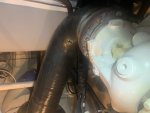
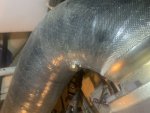
There are four tappings into the exhaust, just after the turbos.
 

Attachments

  • 73DD3C02-9D67-49F2-A474-5080471EB806.jpeg
    73DD3C02-9D67-49F2-A474-5080471EB806.jpeg
    66.3 KB · Views: 38
  • A577F40E-2683-459C-89A3-4C4D4890DD40.jpeg
    A577F40E-2683-459C-89A3-4C4D4890DD40.jpeg
    105.4 KB · Views: 37
Top